
The Mid-Engine Toyota With Ferrari 348 Looks And A Camry’s Service Bill
A Ferrari 348 can make an enthusiast feel rich right up until the workshop calls. The classic Italian has the mid-engine shape, pop-up lights, gated manual, and side strakes that still stop traffic, but it also comes with maintenance bills that can cost as much as another enthusiast car. If you think about it, Toyota offered a much cheaper way into the same basic sports-car formula in the early 1990s. It looked exotic, put the engine behind the driver, and, in Turbo form, could nearly match the Ferrari to 60 mph. Better yet, it could survive daily life.
The Ferrari Experience Gets Expensive Long After You’ve Bought The Car

The Ferrari 348 still looks like someone drew the late 1980s with a ruler and then added an expense account. Its low nose hides pop-up headlights, the deep horizontal strakes cut across the side intakes, and the cabin sits far forward of the rear axle, while the rear bodywork stretches over a mid-mounted 3.4-liter V8.
Buying one already takes serious money, although current data makes the picture a little less dramatic than some older valuation claims suggest. Classic.com currently puts the overall Ferrari 348 average at about $84,980, while Hagerty says a good-condition 1991 348 tb typically sits around $79,600. Special models, top examples, and some current asking prices can sail well beyond $105,000, with rare Serie Speciale and Challenge cars living in another financial neighborhood entirely. In other words, nobody shops for a nice 348 by emptying the coin tray.
Then comes the part that makes the purchase price look like the cover charge. An older Ferrari dealer service special listed a 348 major at $6,375. Today, independent Ferrari specialist J. Scuderia lists 348 major service from $7,300, including removal of the rear subframe and engine assembly for belt and related work. Those figures can climb when a mechanic finds other worn parts, which is not unlikely on a 30-plus-year-old exotic.

Someone Else Had The Mid-Engine Ferrari Formula In The Early ’90s

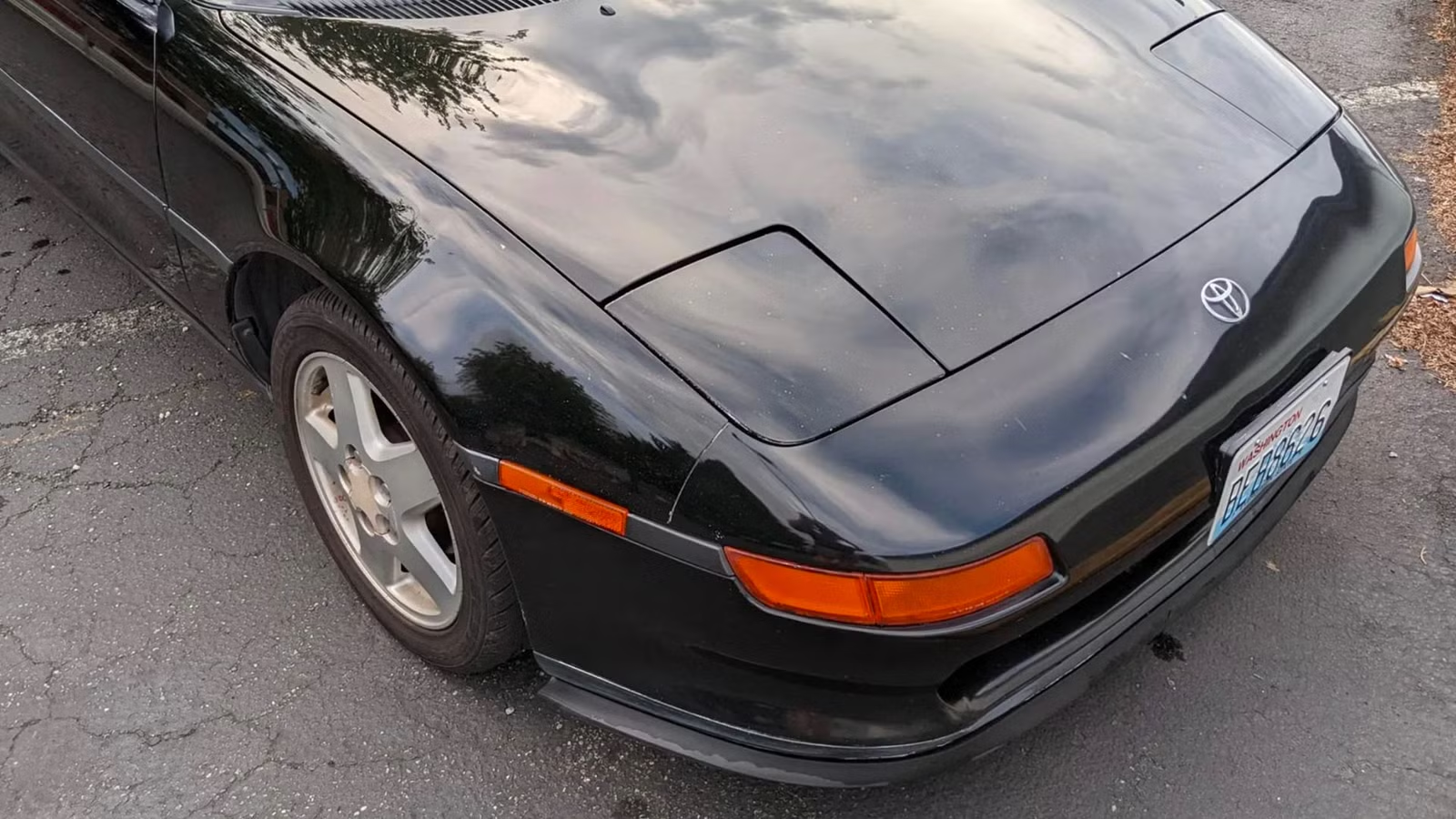
Now consider another sports car from the same period. Its engine sits behind two seats and ahead of the rear axle, and power goes to the rear wheels. Its nose drops low toward a pair of hidden headlights, while air intakes carve into the rear quarters. The roofline stays low, the tail sits wide, and the proportions come directly from the mid-engine playbook.
Those ingredients created comparisons that never really went away. Enthusiasts have spent decades calling this mystery machine a “baby Ferrari” or a “poor man’s Ferrari.” The names can sound dismissive, but they also explain why the design has aged so well. It copied none of Ferrari’s badges and needed no fake V12 soundtrack. From 30 feet away, however, it offered much of the same visual shorthand: wedge shape, hidden lamps, two seats, big rear haunches, and an engine where a normal car would keep groceries.
More importantly, the resemblance went deeper than the body panels. Plenty of affordable coupes from the era wore spoilers, scoops, and dramatic decals while keeping an ordinary front-engine layout underneath, but this car actually used a transverse mid-engine, rear-drive platform.
The Toyota MR2 Turbo Was The ‘Baby Ferrari’ That Could Run Like One

That car was the second-generation Toyota MR2, better known by its SW20 chassis code. Toyota launched it in Japan in October 1989, and the generation continued globally through 1999. Compared with the tiny, angular first MR2, the SW20 grew longer, wider, heavier, rounder, and far more exotic-looking. In its home market, the top version received a turbocharged 2.0-liter 3S-GTE making 225 horsepower at launch. American buyers got a 200-hp version of that turbo four shortly after.
Put an SW20 beside a Ferrari 348 and the old nickname starts making sense. Both put the engine amidships and drive the rear wheels, and both use a low nose, pop-up headlights, a cab-forward profile, and bodywork that swells around the rear tires. The Toyota’s side scoop and black trim create some of the same visual movement as the Ferrari’s much more dramatic strakes. Nobody would confuse the two after walking around them, of course, but the family resemblance becomes obvious when viewed through the design language of 1990. Toyota had built a $20-something-thousand sports car with the stance of machinery that usually required a much more interesting tax return.

Then the Turbo supplied the punch line. The second-generation MR2 Turbo was listed at roughly 5.8 seconds from 0 to 60 mph, while the Ferrari 348 had a 5.6-second figure. Period tests varied, as old performance numbers often do, but the comparison remains remarkable. The Toyota used half as many cylinders and a turbocharger to put its four-cylinder output through a five-speed manual, while the Ferrari relied on a naturally aspirated 3.4-liter V8. Nobody needs to pretend the two engines deliver the same sound, response, or sense of occasion. Still, two-tenths of a second made for one heck of an underdog story.
That underdog case looks stronger three decades later. Current SW20 Turbo market data puts the average sale near $24,700, with a benchmark around $23,000. Recent cars have sold for everything from the mid-teens into the $30,000s and $40,000s depending on mileage, originality, condition, and specification. A working enthusiast budget of roughly $15,000 to $30,000 still covers a meaningful part of the market, though exceptional cars cost more. Compare that with an overall 348 average around $85,000, and the gap becomes obvious. A single $7,300 Ferrari major service can equal project-MR2 money or consume a large chunk of the price of a decent SW20.
Toyota Reliability Changes The Entire Ownership Equation

The MR2’s biggest trick may have nothing to do with acceleration, though. Toyota engineered an unusual sports car using a surprisingly conventional parts philosophy. In America, the naturally aspirated SW20 even used a 2.2-liter 5S-FE four closely related to the unit found in the Camry, while the Turbo received the 3S-GTE associated with Toyota’s Celica All-Trac. That does not make a Turbo MR2 a Camry wearing running shoes, but it shows how Toyota approached the project. The company combined a strange layout with mass-production engines, controls, electrical systems, and service expectations instead of treating every component as exotic jewelry.

High-mileage survivors back up that reputation, with the usual warning that owner care matters more than the badge on the nose. Hagerty has noted second-generation MR2 owners with cars above 200,000 miles, while one enthusiast report lists a 1993 naturally aspirated example at 303,000 miles with its original drivetrain.
Age also deserves a seat at the table. A cheap 30-year-old MR2 can become a very expensive MR2 with impressive speed. Buyer guides warn about rust in the sills and body structure, aging suspension mounts and bushings, coolant leaks, tired radiators, power-steering faults, and the consequences of overheated engines. Turbo cars add another layer of hoses, boost hardware, and heat. Previous owners may add a final layer using parts purchased at 2 a.m. after watching three YouTube videos. In the end, a stock, documented car can make a great driver, but a rusty, modified mystery box can make a mechanic’s children very excited about college.
The MR2’s Bargain Comes With One Famous Catch

Of course, Toyota did not find a loophole in physics. Early SW20s earned a reputation for snap oversteer, especially when a driver lifted the throttle or made a sudden correction while cornering hard. A mid-engine car carries much of its mass near the center, which helps it rotate quickly but also gives a driver less time to clean up a bad decision once the rear tires lose grip. Toyota responded during production. For the 1993 U.S. model year, it revised the suspension, widened the tires, and made other changes aimed at reducing lift-throttle oversteer.
The internet sometimes turns the bad reputation of the early cars into mythology, as though every early SW20 spends its morning waiting behind a hedge for an inexperienced driver. Reality has more variables: tires matter, so do alignment, shock condition, suspension bushings, road surface, speed, and driver inputs. Later revisions changed the behavior, and modern tires can change it again. A driver who abruptly lifts in a loaded corner can still discover why engineers care about weight transfer. Just keep in mind that respect solves more problems than panic. The MR2 simply asks its driver to remember that the engine sits behind the seats, not under the windshield like it does in an ordinary Toyota.

That famous catch makes the MR2 more convincing, not less. Toyota gave buyers the shape, layout, and some of the reactions associated with genuine mid-engine machinery. The Ferrari 348 remains the far more exotic car, with a V8 soundtrack, greater prestige, and an experience the Toyota never even intended to duplicate. Yet the SW20 Turbo could run to 60 within a few tenths of the Ferrari’s quoted time, survive mileage that would scare many exotic-car shoppers, and avoid a recurring major service that starts around the price of another old Toyota.
The clever enthusiast never needed to find a cheaper way to maintain a Ferrari. They needed a Toyota that put its engine in the same place.
Source: Toyota, Ferrari, Hagerty, Classic.com

Related posts



Latest Post


No Comments