
The Hidden American Icon That’s Still Shockingly Affordable
Many automotive enthusiasts will admit they’d love an iconic modern muscle car. But it must have the top-trim performance to back up its menacing styling. Finally, they want something priced reasonably on the used market. Naysayers will tell you, “You can only pick two of the three.” But the truth is that if you are smart about the make and model year you choose, you can have your cake and eat it too. In fact, one hidden American icon is shockingly affordable.
Modern V8 Performance Icons Aren’t Cheap

The mid-2000s and early 2010s saw a wonderful resurgence of retro-styled muscle cars. Many enthusiasts have been eagerly waiting for these V8-powered performance icons to hit the used market at reasonable prices. The only problem is that performance-tuned trims are holding their value.
Take, for example, Ford’s revived Trans-Am icon: the 2012–2013 Mustang Boss 302. It’s no Hellcat, but it does feature a 444-horsepower naturally aspirated V8 and cool retro styling. As of August 2026, Classic.com lists its average sale price at $34,863.
What about Chevrolet’s naturally aspirated 2014–2015 Camaro Z/28? The LS7-powered, track-focused trim has an average sale price of $60,388.


Prefer an SRT badge? Dodge created an iconic halo car when SRT developed the supercharged 6.2-liter Gen III Hemi for the Charger and Challenger Hellcat trims. The package proved immensely popular. So now they’re reselling cheap, right? Not so fast. Classic.com currently lists the average 2015–2023 Charger SRT Hellcat sale at $64,700.
Some drivers are fine picking up a V6-powered Mustang, Camaro, or Charger for cheap. But many enthusiasts refuse to sacrifice performance for looks, dreading the day they line up at a stoplight next to a true muscle car. They’d much rather drive a “sleeper” built for power.
Affordable Sleepers Often Look Like Appliances

Another popular choice is to buy a performance trim sitting near peak depreciation because its styling never earned universal affection. The RADwood and Y2K eras produced plenty of cars whose performance still holds up, even if their rounded shapes, busy bodywork, and economy-car roots remain an acquired taste. These cars have passionate followings, but buyers who want their performance car to look as special as it drives may keep shopping.
Examples include the “catfish” Camaro and its Trans Am cousin from the fourth-generation F-body platform, especially the 1998–2002 cars; the SN95 Ford Mustang, especially the SVT Cobra sold intermittently from 1994 through 2004; the final Pontiac GTO, sold from 2004 through 2006; the Pontiac Grand Prix GXP, sold from 2005 through 2008; and the Pontiac G8 GT and GXP, sold from 2008 through 2009. Other choices include the 2006–2007 Chevrolet Monte Carlo SS, the 2006–2009 Impala SS, the 2003–2005 Dodge Neon SRT4, and the 2008–2009 Caliber SRT4.

We’re not here to knock any of the above cars. But you can have a gnarly, retro-styled muscle car with factory-tuned V8 power: one that won’t paint a target on your back at every stoplight, still looks special pulling up to dinner, and earns “bro nods” wherever you drive. Best of all, it won’t break the bank.
The Chrysler 300C SRT8: A Hidden American Icon You Can Afford

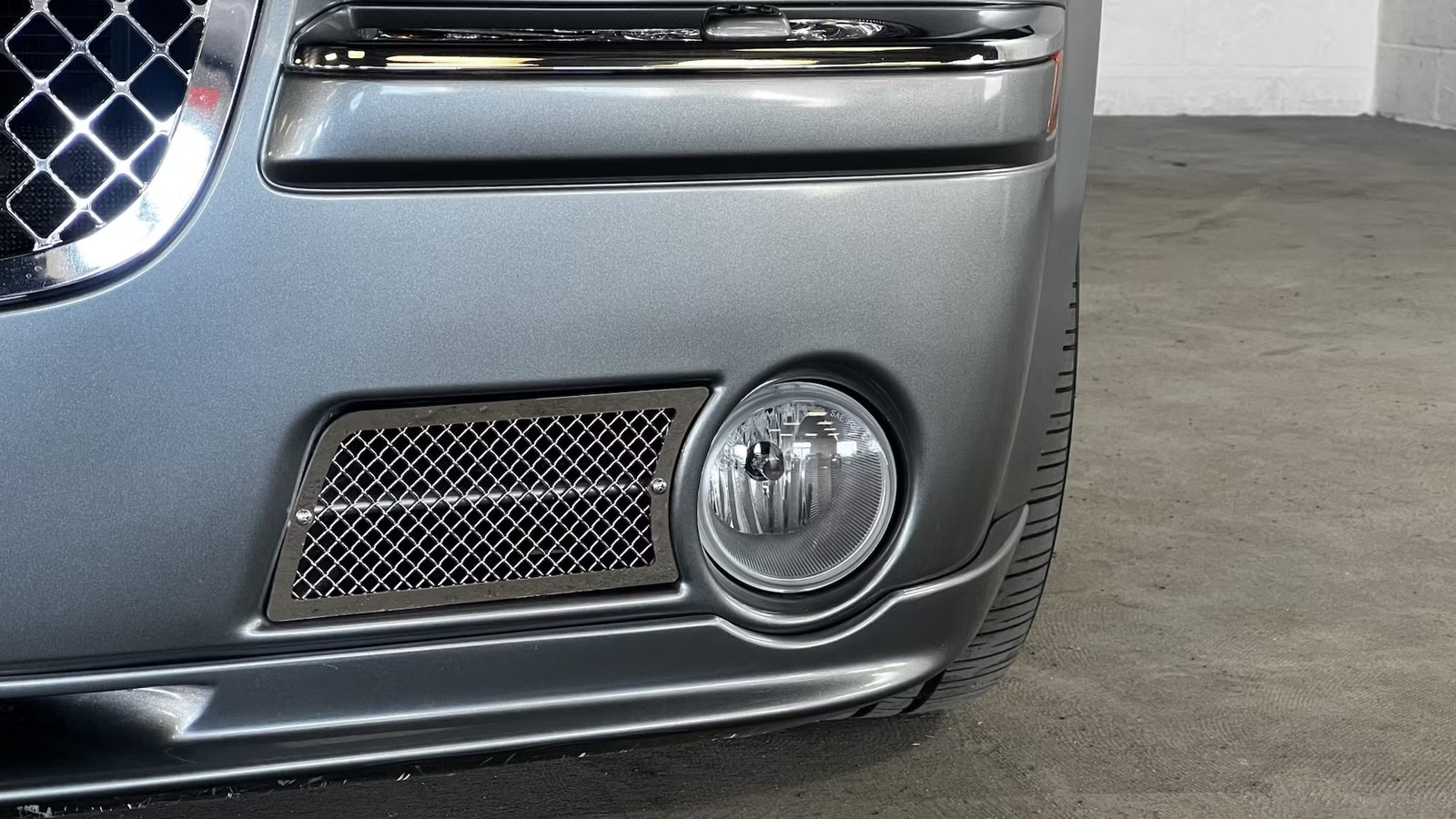
Before Dodge revived the Charger for the 2006 model year, Chrysler had already reinvented the 300 nameplate for 2005. The sedan featured a low roof, tall grille, and imposing proportions that harkened back to Detroit’s golden era of performance-luxury sedans and Chrysler’s own 300 letter-series.
The clever part was that the SRT8 did not abandon the standard 300’s successful design. It kept the same chopped roofline, slab-sided body, and imposing grille that made the regular sedan instantly recognizable. Its deeper fascias, subtle decklid spoiler, larger wheels, and twin exhaust outlets only hinted at what was underneath. To an enthusiast, those details identified something special. To everyone else, it could disappear among the countless V6 and 5.7-liter 300s already on American roads. That combination made it a rare kind of sleeper: a car with genuine visual presence that still concealed the extent of its performance.

Chrysler revealed the 300C SRT8 in August 2004 as a 2005 model, announced its $39,995 price in January 2005, and said it would arrive in showrooms that spring. Chrysler continued building the first-generation 300C SRT8 through the 2010 model year. Every example was rear-wheel drive and paired with a five-speed automatic; Chrysler offered neither AWD nor a manual transmission.
SRT left the 5.7-liter Hemi’s stroke unchanged, increasing displacement to 6.1 liters entirely through a larger cylinder bore. The engine also received higher compression (10.3:1 versus 9.6:1); a performance camshaft; larger valves; high-flow heads; a short-runner intake; and header-style exhaust manifolds. SRT backed those upgrades with a reinforced block, forged-steel crankshaft, stronger connecting rods, oil-cooled floating-pin pistons, and revised high-rpm lubrication.
The resulting 6.1-liter Hemi was rated at 425 horsepower at 6,000 rpm and 420 lb-ft of torque at 4,800 rpm. That was 85 horsepower more than the regular 5.7-liter Hemi.
The “Sport-Tuned” Sedan Wasn’t Just Talk

Reviewers found the 300C SRT8 could rocket to 60 mph between 4.7 and 4.9 seconds. Its quarter-mile times ranged from 13.2 seconds at 109 mph to 13.66 seconds at 105.4 mph. But despite being a full-size muscle sedan, the SRT8 had more tricks than straight-line speed.
Chrysler advertised a “sport-tuned” chassis, and reviewers found this wasn’t just a marketing gimmick. It could also achieve a 0.89 g on the skidpad and stopped the 4,212-pound sedan from 70 mph in just 162 feet. The car used four-piston Brembo calipers with 14.2-inch front and 13.8-inch rear brake discs.
The 6.1-Liter Hemi Is An SRT Sweet Spot

Today, the 6.1-liter Hemi is one of several modern Hemi V8s available on the used market. For 2011, SRT replaced it with the naturally aspirated 6.4-liter 392 in the Challenger; the Chrysler 300 SRT8 followed for 2012. SRT then introduced the supercharged 6.2-liter Hellcat for the 2015 model year. But the 6.1-liter Hemi represents a unique bargain.
It’s an engine with true performance internals and dramatically improved airflow. At the time, it was Mopar’s halo engine, and SRT threw everything it had at the 6.1-liter V8. This is one of many reasons its low resale value is so shocking.
The 300C SRT8 Was Always A Luxury Performance Bargain

In January 2005, Chrysler announced that the 300C SRT8 would start at $39,995, including destination. The 300C SRT8 effectively offered two cars for one price. During the week, it could serve as a quiet, spacious luxury sedan with room for passengers and luggage. When the road opened up, its 425-horsepower Hemi, Brembo brakes, and sport-tuned suspension delivered acceleration and handling comparable to dedicated performance cars. European manufacturers routinely charged substantial premiums for that combination of comfort and speed. Chrysler packaged it beneath unmistakably American styling and asked less money.

As of August 2026, Classic.com lists the first-generation 300 SRT8’s average sale price at $19,692, less than half its original $39,995 MSRP. Multiple SRT8s have changed hands for $15,000 less in Bring a Trailer auctions.
It turns out you can have iconic styling, top-trim performance, and an affordable price. You just have to know which badge to search for.
Sources: Stellantis, Bring a Trailer, Classic.com

Related posts


Latest Post


No Comments