
The Classic Coupe That Quietly Became A Six-Figure Collectible
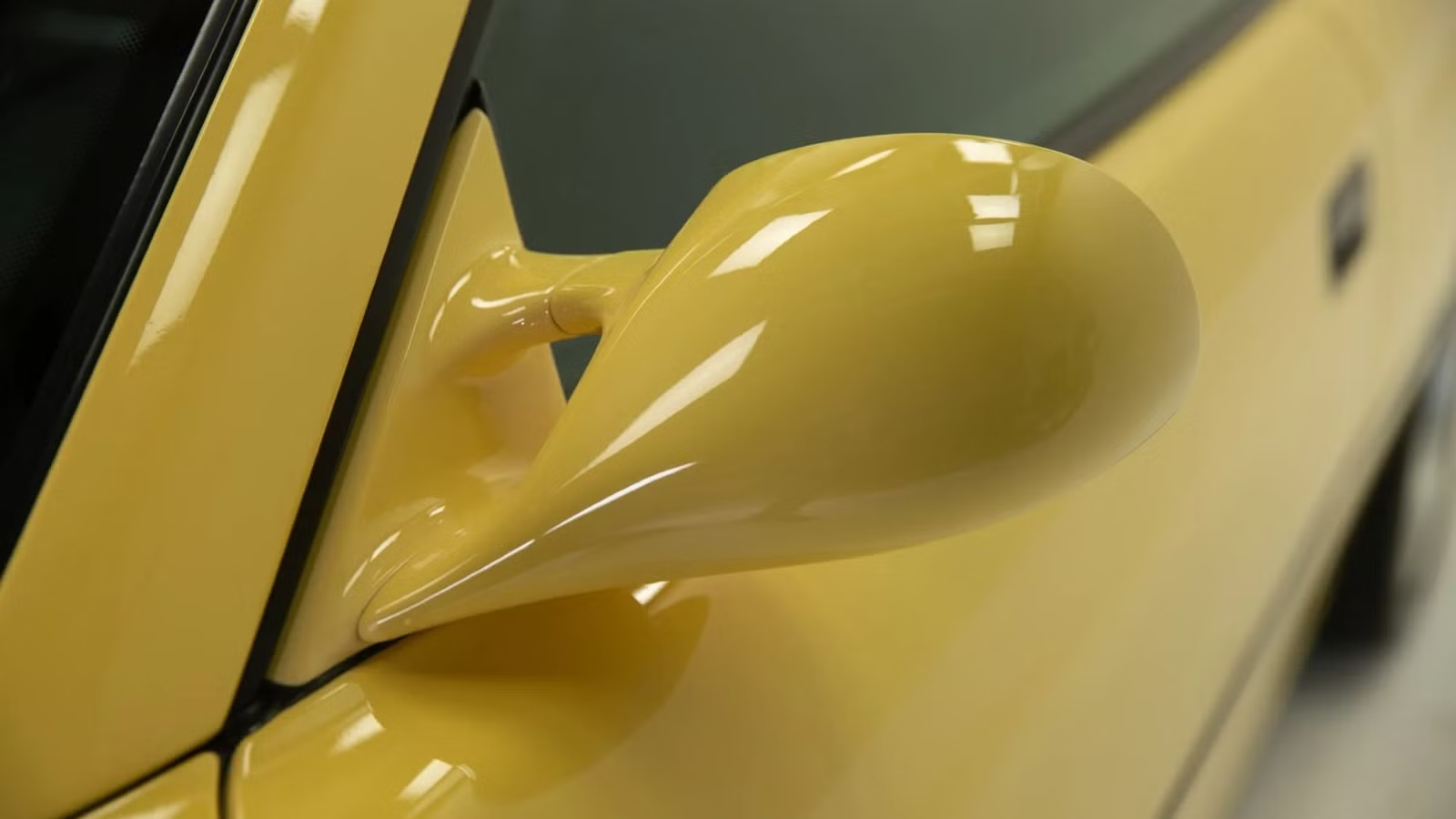
Coupes are designed to be noticed. These sleek two-doors, often with a sloping rear roofline and svelte features, are designed for the style-conscious, often matching the best bits from sedans to a more eye-catching aesthetic. So how is it that one high-end coupe, designed to be the cherry on top of an already impressive range, has apparently gone unnoticed for years? It’s striking, powerful, and has the right badge on its nose, but few people mention it. Well, the time has come for this model, and those in the know are pushing prices well into Ferrari and Lamborghini territory.
The ’90s Was All About Coupes

If the ’80s were the era of excess, with outlandish supercars to match, then the ’90s belonged to the coupe. Flaunting cash through exotic supercars with giant wings seemed to be on its way out, to be replaced by luxurious and/or sporty two-doors that matched capability with a more sophisticated style. Before long, all manufacturers were raiding the parts bins to create coupes.
The Mazda MX-6 epitomized the en vogue pebble look of the time; the Peugeot 406 Coupe proved that elegant beauty wasn’t just for the rich; the Honda Integra Type-R was a mini exotic for the masses; and the Fiat Coupe was a Chris Bangle-designed, front-wheel-drive Lancia Integrale. At the other end of the scale, the Mercedes-Benz C140 was an S-Class that was designed to be enjoyed when your chauffeur had the day off. Around this time, another German carmaker was working on a new two-door car that had all the ingredients to cause a complete coupe shutdown.
BMW Was Working On A Tricky Second Album

BMW has legions of fans, and rightly so — the Bavarian firm has a back catalog of iconic cars that could fill a sheet of A4 paper. But while BMW can reel off sports sedans and small coupes like the M3 and M4 without breaking a sweat, the high-end, more luxurious machines don’t always appear so easy. While the Mercedes S-Class walks the luxury sedan market, the 7-Series always seems a bit like it is juggling the needs of the driver and the rear passenger, for example.

So it was with the BMW M635CSi (E24) of the mid-’80s. Sharing BMW’s race-derived M88 straight-six engine with the E28 M5, the coupe should have been every bit as alluring, but in the end it was the M-badged sedan that became more of an icon. That said, the M635CSi oozed cool, with its shark-like nose adding menace, and it was this car that BMW decided to follow up on in the ’90s.
The BMW 8-Series Was The (Ultimate) Ultimate Driving Machine

When BMW introduced the 8 Series for the 1991 model year, it had pretty much everything going for it. The E31 offered a range of V8s and V12 engines, with the option of manual and auto transmissions, wrapped in typical Germanic quality and attention to detail. Then there were the looks. The shark-like front was a nod to the previous 635, but this time there were pop-up headlights, a wafer-thin grille, and subtly bulging arches. The pillarless glass created a sharp side profile, while the sliced off rear was subtle yet sophisticated. The 8-Series was a celebration of everything that BMW knew, bringing 7-Series luxury and class to a more sporting platform and look. Finally, you could have everything that made BMW great wrapped into one model.
The 850CSI Was The M8 That Never Was

BMW had thought seriously about making an M8 version of the 8-Series. The company went as far as creating an M8 prototype in the early ’90s, powered by a 640 horsepower 6.0-liter V12 engine. The program was top secret and stayed that way for years to come, with the board deciding not to go ahead with the project. Instead, BMW launched the 850CSi as its range-topper in 1992, which was, unofficially at least, a baby M8.
BMW took the 5.0-liter twelve-cylinder engine (M70) and increased the bore by two millimeters and the stroke by five millimeters, adding lightweight aluminum-based pistons and ferrostane coating. The resulting engine was called the S70, with a new displacement of 5.6 liters and power output up from 300 to 380 hp, with 406 lb-ft of torque. The twelve-cylinder unit was linked to a six-speed manual. The 850CSi can scoot to 60 mph in a shade under six seconds, and hit 125 mph in 20 seconds.
The Engine Was Just The Start

BMW M fitted a four-pipe exhaust system that was given pre-pipes with an enlarged cross-section of three millimeters and two special metal catalytic converters. Sophisticated electronics allowed the driver to switch between sport and comfort modes (groundbreaking for the time), making it a usable companion whatever the mood. The 850 CSi also benefited from a co-steering rear axle, which turned up to 1.8 degrees depending on the driving situation. BMW even went as far as creating a separate oil cooling system for the rear axle gearbox to withstand even the highest loads. The finishing touches were larger (345 millimeters) and slightly thicker brake discs, as well as lower aprons, an improved suspension, and rear diffuser.
The 8-Series Was Unfairly Unloved

The 8-Series didn’t seem to have it all its own way. There were reports of a lukewarm press reception when it was launched, and even BMW says now that the CSi version was seen as “more understated than eye-catching.” Then, there was a global economic downturn, which limited the market for V12 grand tourers. This is probably the main reason for reports of slow sales for the 8-Series range.
Just like the M1 of the ’70s, an ill-fated mid-engined BMW supercar, the 8-Series just didn’t seem to quite capture the big sales zeitgeist of an M3 or M5. The original 8-Series has long been forgotten by many people, and the top-end CSi never really achieved the cult status of, say, an E46 M3 CSL. Or has it? As they say, hindsight is a wonderful thing. If you want to buy one today, you will need deep pockets — it seems that the secret is finally out.
Collectors Have Started Swarming To The 850CSI

You can still buy a standard V12 850i for non-silly money in 2026. A 1992 car has a good condition value of $30,700, says Hagerty Valuation Tools. But the 850 CSi is a lot rarer, with BMW officially selling just 1,510 globally. Hagerty puts the price of these cars in good condition at $90,500, but that only tells part of the story.
A 31,000-mile 1994 BMW 850CSi recently sold on Bringatrailer.com for $142,500, and a 14,000-mile example sold earlier in 2026 for a cool quarter of a million dollars. That’s a lot more than you will pay for some Italian exotics from that era. CSis haven’t always been this hot on the secondhand market, either. If you go back ten years, 850 CSis were selling for $60,000 and less. In truth, the 8-Series may have been a victim of bad timing, with styling that was probably a touch too futuristic for some, but it is highly sought after today. There is one for almost every budget too — Bavarian cars really don’t come much cooler than this.
Sources: Hagerty.com, BMW

Related posts





Latest Post



No Comments