
The Highest Rated Horsepower In A Production Big Block V8 Engine In The ’70s
Few eras in automotive history burned as bright — or as briefly — as the muscle car peak of the late 1960s and early 1970s. Cheap fuel, flush consumers, and a culture obsessed with straight-line speed pushed Detroit engineers to stuff ever-larger, ever-angrier V8s under hoods that could barely contain them. The horsepower war was real, and for one glorious model year it produced something that has never quite been repeated: a factory big-block making 450 honest horsepower. Understanding how that engine came to exist — and why it vanished almost immediately — is one of the great stories in American performance history. The forces that killed it were already gathering. Members of the Organization of Petroleum Exporting Countries (OPEC) would soon impose an embargo against the United States, sending gas prices skyward and forcing domestic automakers to chase efficiency rather than displacement. Tightening emissions regulations added further pressure. So when the most powerful big-block engine of the decade arrived for 1970, it was, in many ways, the last of its kind.
Chevy 454 LS6 Was the Most Powerful Big-Block V8 Produced In The 1970s
454 LS6 Specs
 36 autotech Engine |
454 CID V8 |
|
Horsepower |
 17 autotech 450 hp |
|
Torque |
500 lb-ft |
|
Compression |
11.25:1 |
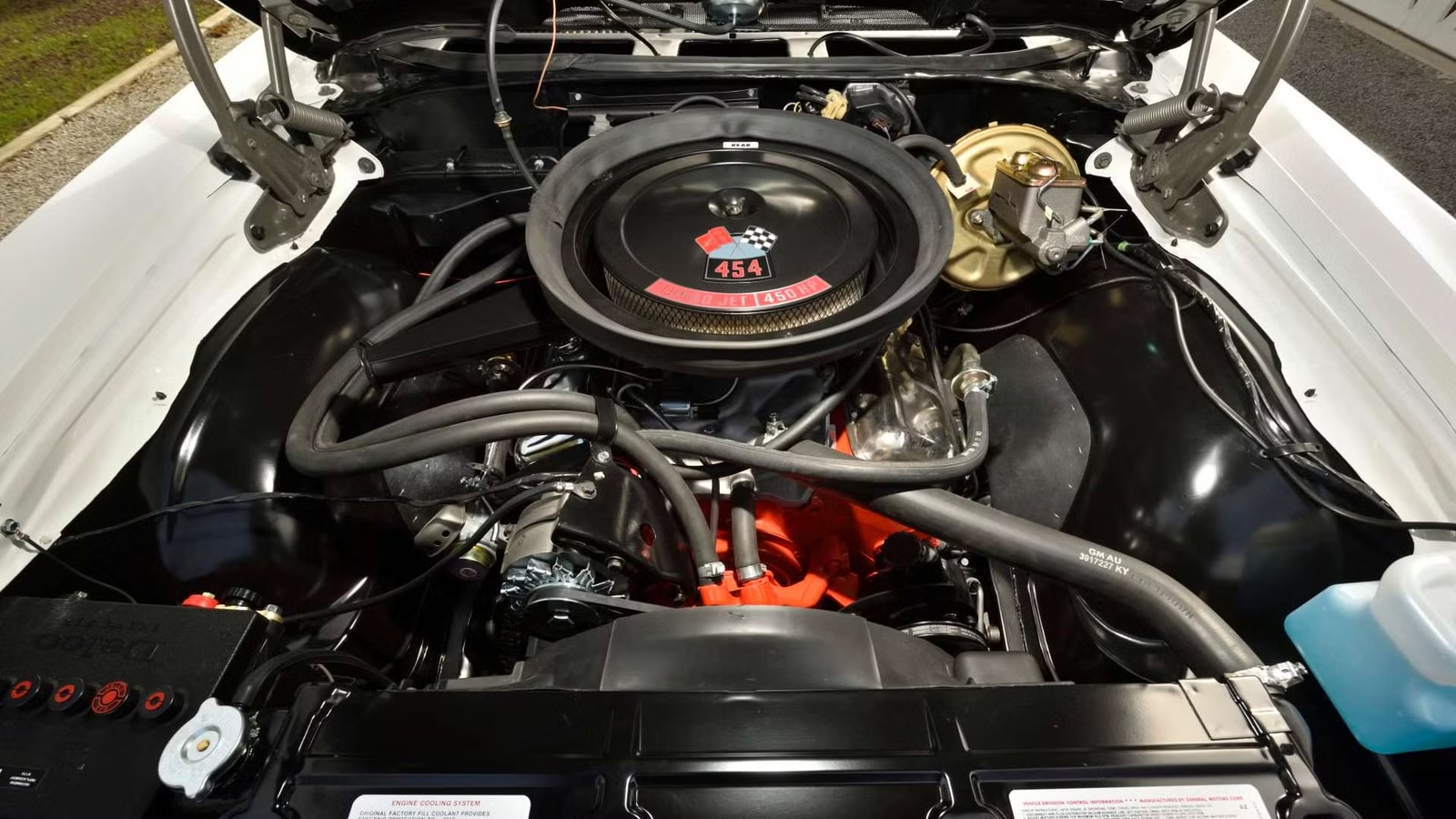
(Source: Motor Trend) The monster 454 cubic-inch Chevy LS6 V8 arrived in 1970 with up to 450 hp, making it the most powerful production big-block engine offered that decade. The 454 had evolved from the Chevy Mark IV 427 engine, which produced up to 425 hp. The new 450-hp LS6 engine first appeared in the Chevrolet catalog in 1970 as the perfect embodiment of the old adage ‘there’s no replacement for displacement.’ Offered in the Chevelle SS and El Camino SS via the RPO Z15/LS6 ordering code, that mighty output figure would survive just one model year before power began to fall away under the combined pressure of tightening emissions standards, the transition to lower-octane unleaded gasoline, and the looming oil crisis. Despite this, there are plenty of ’70s muscle cars that deserve to be remembered. The 454 retained the 427’s 4.25-inch bore but stretched the stroke to 4 inches. It came in three distinct versions — LS5, LS6, and LS7 — although the LS7 never reached a production car due to rising fuel costs and insurance concerns. That left buyers with two choices: the LS5, rated at up to 390 horsepower and 500 lb-ft of torque, and the top-dog LS6, pumping out 450 hp and 500 lb-ft.
The LS6 Was Only Offered In Two Chevy Models
Despite having the most potent big-block engine in its arsenal, Chevrolet was not eager to spread it across the lineup. In 1970, only two vehicles were offered with the LS6: the Chevelle SS and the El Camino SS. The Corvette did receive the LS6, but not until the following model year, by which point output had been dialed back to 425 hp. Hot Rod Magazine captured the moment’s significance perfectly, writing: ‘The past is gone. The future may never see a car like this.’
The Chevy LS6 Had Significant Upgrades Over the LS5
but had a beefed-up bottom end. An 800-cfm Holley four-barrel carburetor replaced the Rochester Quadra-Jet and was bolted to a new aluminum intake manifold. The LS6 featured a strengthened bottom end with four-bolt mains, a solid-lifter camshaft (compared to the hydraulic lifters on the LS5), a forged steel crankshaft, forged aluminum connecting rods, and an 11.25:1 compression ratio. Rectangular cast-iron port heads carried a 2.19-inch intake opening and a 1.88-inch exhaust opening. Buyers could also opt for a cowl-induction hood package that fed cool outside air directly into the carburetor.
A New King Of The Streets
Anyone who ordered a 450 hp Chevelle SS 454 with the LS6 could legitimately claim the title of the new King of the Streets. The Mustang Boss 429, then nearing the end of its production run, carried an official rating of 375 hp, and a Plymouth Hemi ‘Cuda with the flagship 426 Hemi V8 managed 425 horsepower and 490 lb-ft of torque. The Chevelle, by contrast, was turning in quarter-mile times just over 13 seconds — a few hundredths quicker than the competition.
The LS6 Wasn’t As Popular As Chevy Hoped
While few buyers ticked the LS6 option on the El Camino order sheet, take-up on the Chevelle was stronger. It is estimated that 4,475 LS6 cars left the factory in 1970, with only around 500 of them being El Caminos. Price was a significant barrier: a 1970 Chevelle started at just over $2,800, but the top-spec engine added another $988.55, pushing the total to nearly $4,000 before options.
Return Of The Big-Block 454 In The 1980s

Advances in fuel delivery technology gave the 454 a new lease on life in the 1980s. In 1987, Chevrolet introduced the L19 — a modernized 454 equipped with electronic fuel injection (EFI) — for use in trucks, producing between 230 and 255 hp. The following year, throttle body injection (TBI) was added, broadening the engine’s appeal for industrial and commercial applications. GM’s Marine Engine division adapted the 454 for use in Mercury Mercruiser boats by reworking the intakes, carburetors, and water pumps, and sealing the electronics against moisture. The engine also found its way into performance-oriented workhorses like the Chevrolet 454 SS pickup of the early ’90s. It was the ultimate forgotten muscle truck, though power was significantly down from the 1970s peak, topping out at 230 hp at 3,600 rpm.
Buying A Chevy 454 Crate Engine Today
For weekend restorers, Chevy offers the 454 HO crate engine, which blends classic architecture with modern refinement. It features an all-forged rotating assembly for added strength and longevity, while a smooth hydraulic roller camshaft delivers broad, usable power across the rev range — a far cry from the lumpy solid-lifter tune of the original LS6. Factory-matched powertrain combinations are also available to simplify retrofit installations in older vehicles.
454 HO Tech Specs
|
Displacement |
454 CID V8 |
|
Bore x Stroke |
4.250 x 4.000 in. |
|
Compression Ratio |
8.75:1 |
|
Maximum Recommended RPM |
5500 rpm |
|
Horsepower |
438 hp |
|
Torque |
500 lb-ft |
(Source: Chevrolet)
Get Your Hands On An Original Chevy Big-Block 454 LS6

Chevy LS6 Good Condition Values
- 1970 SS454 LS6 Chevelle Coupe: $109,000
- 1970 SS454 LS6 Chevelle Convertible: $274,000
- 1970 SS454 LS6 El Camino: $69,100
(Source: Hagerty) Unsurprisingly, getting hold of a legitimate 450-hp LS6 factory Chevrolet requires deep pockets. The more accessible entry point is the Chevelle Sport Coupe SS 454 with the LS6, which averages around $109,000 in good condition according to Hagerty — and these Chevelles do surface in barn finds from time to time. Dropping the roof adds considerably to the asking price: the convertible Chevelle SS 454 LS6 commands more than double, averaging $274,000 in good condition. Then there is the El Camino, which was extraordinarily rare in LS6 form — only around 1% of buyers selected this option — and you might expect that scarcity to push prices sky-high. The LS6 has one last surprise, however: an El Camino with the 450-horse engine is actually the most affordable of the three, averaging just $69,100 in good condition. Sources: Hagerty; Chevrolet.

Related posts


Latest Post


No Comments