
The Forgotten Mercury Aero Coupe Rarer Than A Boss Mustang
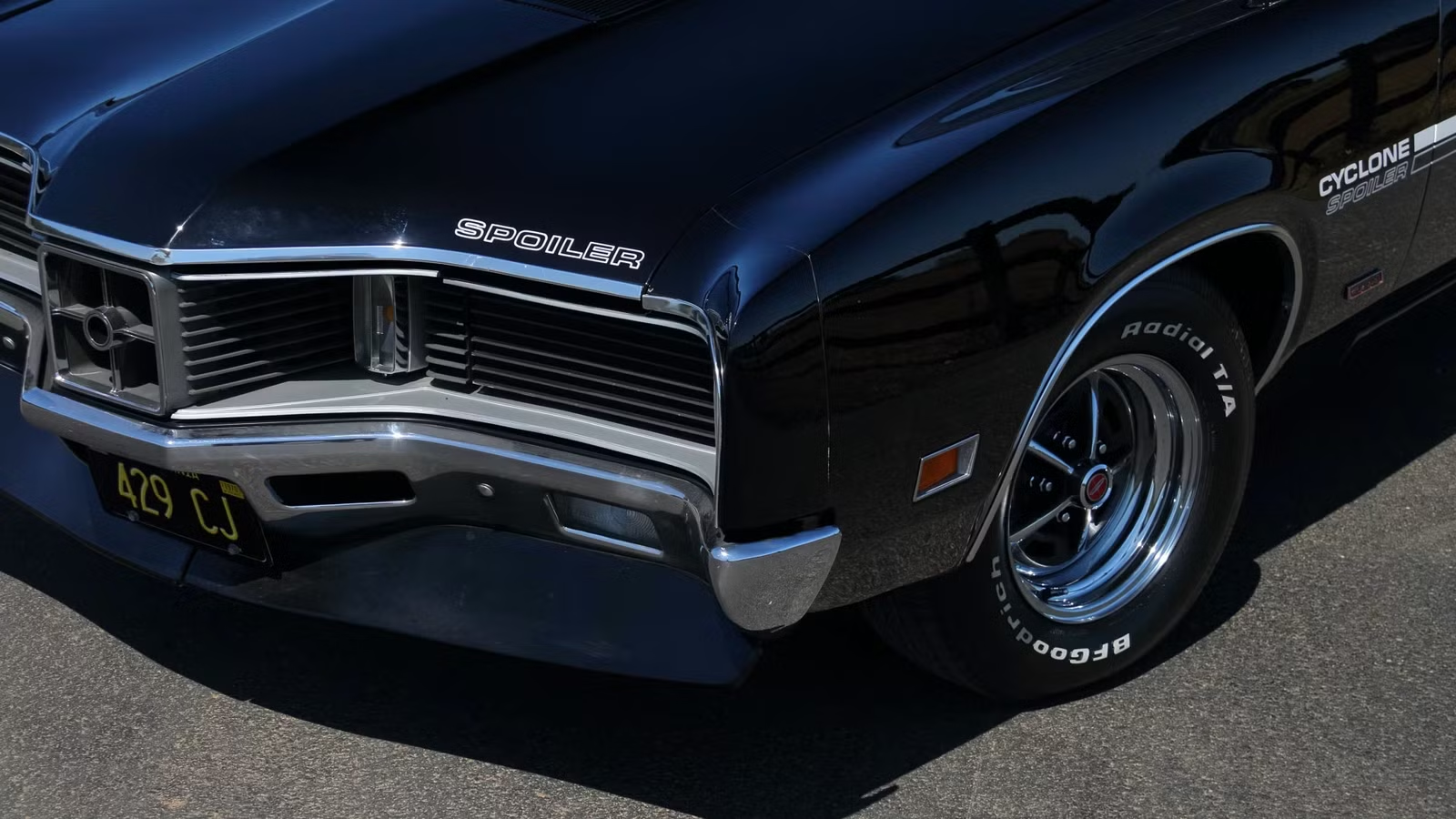
In 1970, Ford Motor Company launched a NASCAR-styled, big-block road car that should have been the next muscle icon, yet today it is almost forgotten and has vanished from the muscle car enthusiast crowd. Carrying the aggressively distinct “Bunkie Beak” nose and a standard 429 Cobra Jet engine, this car had a small production run, as it was built to conquer the drag strips and the high-banked ovals. However, this NASCAR-inspired car’s demise was not due to its performance, but because it simply became impossible to restore one today.
When NASCAR Aero Wars Created A Forgotten Legend

We have to dig deep to understand how a factory-built 429 aero car slipped through the cracks. Back in the late 1960s, the NASCAR aero wars were at their peak. Ford and Chrysler went head-to-head on 200-mph superspeedways like Talladega and Daytona, and Aero was becoming the king of winning. Chrysler homologated the massive rear wings of the Dodge Charger and Plymouth Superbird, while Ford had their own flush-nosed Torino Talladega.
For enthusiasts, Ford’s 1970s performance catalog has been the gold standard, with the conversation always centering on the high-revving Boss 302, the massive 429, and the working-man’s Torino Cobra. At the same time, a car sat quietly in Lincoln-Mercury showrooms, a fastback coupe that took a page from NASCAR and became a luxury street weapon.
It is often forgotten. It was wider, sleeker, and more exclusive than its Ford-badged platform cousin. Ford channeled its marketing capital mostly into the Mustang division; as a result, Mercury’s aero special had minimal fanfare, foreshadowing the fate the car would suffer.

How Mercury Built A NASCAR Fighter For The Street, And Nobody Noticed

For 1970, Mercury had a performance identity separate from Ford’s lineup. Designers took the Montego chassis and crafted a long-hooded, short-deck fastback with arguably one of the most aggressive noses of that era. Up front sat a protruding central grille flanked by dual recessed openings famously nicknamed the “Bunkie Beak” after Ford President Semon “Bunkie” Knudsen.
It also featured an integrated matte-black chin spoiler and a pedestal-mounted rear wing. This made the car incredibly aero-focused for its time. Inside, the driver-focused pod gauges angled toward the driver, creating an immersive, racing-cockpit-like environment. Under the hood, Mercury went all in and skipped base V8s completely.
Every car that left the assembly line was fitted with Ford’s 429-cubic-inch Cobra Jet V8, drawing cold air through a Ram Air hood scoop, producing 370 hp and 450 lb-ft of torque. This power was delivered through a heavy-duty Toploader 4-speed manual or a C6 automatic. Despite its impressive spec sheet, production of this car was limited to 1,631 for 1970. To put that into perspective, Ford produced almost four times more Boss 302 Mustangs: 7,013 units. So what was the car that got left behind?
The 429 Super Cobra Jet and the Unrestorable Reality

The Mercury Cyclone Spoiler was the big-block aero king that got left behind. Despite having a standard 370-hp 429 Cobra Jet that was more than enough to dominate the streets, Mercury offered a factory Drag Pak option that transformed the Cyclone Spoiler into a drag monster. By opting for the Drag Pak, you automatically upgraded the engine to the formidable 429 Super Cobra Jet (SCJ), bumping factory power.
The SCJ engine had upgraded internals, including four-bolt bearing caps, forged aluminum pistons, a solid-lifter mechanical camshaft, a massive 780-cfm Holley four-barrel carburetor, and an engine oil cooler. Out of the 1,631 Spoilers built, only 341 had the upgraded 429 SCJ Drag Pak package.
But the production numbers are only half the reason the Cyclone Spoiler disappeared from the vintage muscle collector market. The real reason is that today it is virtually impossible to restore an example to a historically accurate factory spec. If you decide to put together a project with the 1970 Mustang or Chevelle, you can practically build a one-to-one, historically accurate spec out of the aftermarket parts catalog.

The Cyclone Spoiler had almost non-existent reproduction tooling support. The intricate “Bunkie Beak” metal grille surrounds, the model-specific chin spoiler brackets, the rear wing, and the taillight bezels are examples of parts that were never reproduced due to low original sales. This lack of parts support creates a logistical nightmare for collectors and restoration shops. To rescue a barn-find Cyclone Spoiler means hunting for original parts that have been spread across the country for decades.
As rebuilding parts is a long and expensive affair, surviving examples of the Cyclone Spoiler are just rotting in garages around the country. As a result, they never quite reached the public platforms and never generated any hype around them, which kept the Spoiler in the shadows for decades.
Why This Big-Block Aero Monster Costs A Fraction of a Boss Mustang

Because sourcing the correct body panels is so difficult, the 1970 Cyclone Spoiler has a rare position in today’s classic car market. It is an exclusive, factory-built NASCAR aero-inspired coupe with the 429 block that trades for a fraction of the money that the Mustang commands.
While Ford produced 7,013 Boss 302 Mustangs and 7,675 429-powered Torino Cobras, Mercury produced only 1,631 Cyclones. Even the legendary Boss 429 Mustang had 499 units for 1970 and 1,359 total units across its two-year run. Hagerty valuation data confirms the Cyclone Spoiler’s sleeper status.

While a mint 1970 Boss 429 Mustang commands between $250,000 and $400,000 at top auction houses like Barrett-Jackson and Mecum, the 429 SCJ Cyclone Spoiler offers the same hardware, unique styling, and higher rarity for a fraction of that price. Recent auction sales tracked by classic.com show solid Cyclone Spoilers selling for $50,000 to $70,000 on average for a driver-quality example.
Even high-volume alternatives like the Boss 302 command $75,000 to $130,000, making the standard 429 Cyclone Spoiler a bargain. This price gap makes the Spoiler a genuine big-block monster that can be owned without paying the Mustang premium.
The Unrepeatable Peak Of Detroit’s Big-Block Aero Experiment

The window for a rare 1970s big-block sleeper won’t be open for too long. As the six-figure price tags lock average enthusiasts and collectors out of the Boss Mustang and Shelby markets, Ford fans and muscle car fans in general are quietly starting to look at the remaining Cyclones as an alternative.
If you are looking for these aero coupes, focus your search on complete examples of a number-matching 429 CJ or SCJ. Finding the correct spec today isn’t just about owning a piece of NASCAR history; it’s about owning one of the rarest muscle cars produced by one of America’s biggest and most historic muscle car manufacturers.
Source: Classic.com, Mecum, Hagerty, Ford

Related posts



Latest Post


No Comments