
This Toyota Sports Sedan Has A Strong Case Against The BMW M3
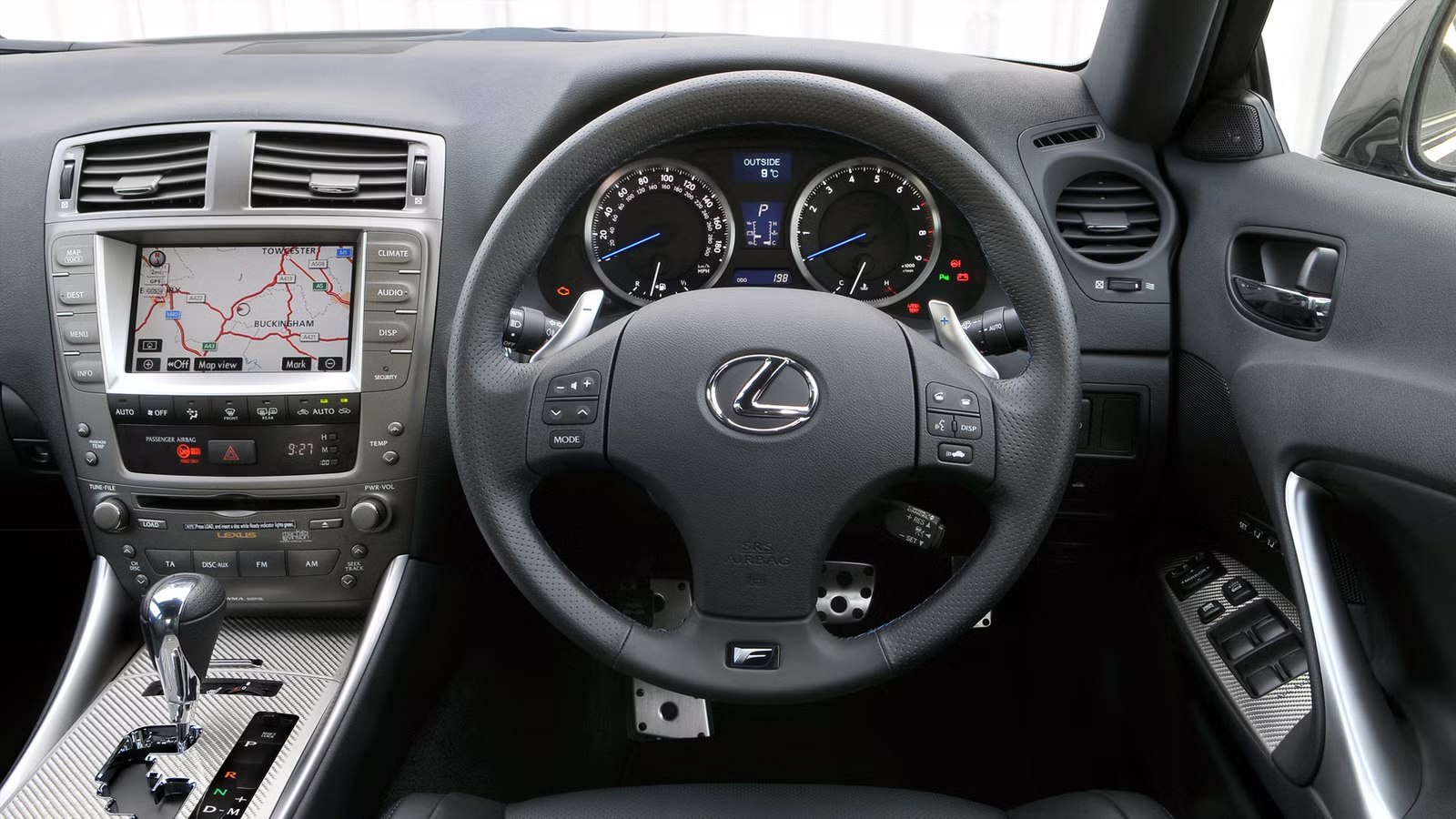
Picture the scene: it’s the late 2000s, and you’re after a performance sedan. Preferably something with a big, thirsty V8 engine and more power than you’re realistically going to be able to use on the roads. You can take the conventional option and go for something German, getting the associated power and reliability, or you can opt for something Japanese. It’s got the same power as BMW’s M3, also has a V8 engine, and it’s more reliable. It’s a compelling argument for sure.
The Golden Era Of V8 Sports Sedans Changed Performance Forever

The late 2000s were a great time to be in the market for a performance sedan. Horsepower figures were rising, naturally aspirated V8s were still king, and electricity was largely used to power the infotainment system rather than the car itself. It was a perfect storm of manufacturers all vying for attention, one-upping each other to try and get more of your dollars into their pockets. And while the US was doing its part with cars like the Cadillac CTS-V and Pontiac G8 GXP, it was Europe that defined the segment.
But as exciting as these cars were, it was Germany that really ruled the roost. Audi had the 4.2-liter twin-turbocharged V-8-powered RS 6, Mercedes-Benz had the 6.2-liter NA V-8 AMG C 63, and BMW had the 4.0-liter NA V-8 M3. In a market where performance was king, it was German brands that were pushing boundaries and establishing the country as a high-performance luxury sedan powerhouse.
But for all the excitement around the segment, there was one notable absentee: Japan. The country was known for making mass-produced, reliable, durable cars that functioned well in the real world, rather than between magazine covers, and luxury performance didn’t really factor in. But that would come to an end in 2007, when one Japanese manufacturer decided to take on Germany.

Toyota’s Luxury Division Was Ready To Challenge Germany

Lexus was already well-established by the mid-2000s as a brand with impeccable build quality, refined interiors, and exceptional reliability. But while those all helped to win some people over from the German brands, the brand was still seen as a sedate one. Soft, conservative styling, a comfortable ride, and Toyota-inspired reliability all make for an entirely sensible car, but not one that is going to entice people away from the lairy, barrel-chested performance cars of BMW, Audi, and Mercedes. If it wanted to get in on that market, it needed to change that.
Toyota allowed Lexus to chase that audience with its new F subdivision. It duly went off to some of the most demanding circuits in the world—the Nürburgring included, naturally—to ensure that this new car could provide both the mechanical and emotional responses Lexus wanted it to.
One crucial aspect of this was in how Lexus wanted the car to handle. Rather than simply throwing more power at it and calling it a day, Lexus engineers focused on creating a balanced driver’s car. Engines, brakes, suspension, chassis, and more were all developed in an attempt to produce a machine that was as comfortable on track as it was on the way to the track. The result was something that Toyota hoped would be ready to tackle one of Germany’s finest.
The Lexus IS F Was Toyota’s Answer To The BMW M3

When the Lexus IS F was revealed for the 2008 model year, it wasn’t just a faster version of Lexus’ pre-existing IS sedan. On the lower end, the regular IS had a 2.5-liter V6 engine that made 204 HP and 185 lb-ft of torque. Not exactly massive. The IS F, though, had a 5.0-liter naturally aspirated V8 that made 416 hp and 371 lb-ft of torque, hitting 60 MPH in 4.8 seconds en route to an electronically limited top speed of 168 MPH. Now we’re talking.
But the headline power stats weren’t the only thing the car had. Yamaha was involved in the tuning of the engine, engineering high-flow cylinder heads, lightweight titanium intake valves, and intake acoustics, giving the 2UR-GSE its 6,800 rpm redline and a linear acceleration curve in an NA engine. Coming with an eight-speed automatic gearbox did disappoint some enthusiasts, but Lexus argued that the eight-speed Sport Direct Shift automatic delivered quicker shifts and better performance than a traditional manual.
Of course, all this power is no use if the chassis is lacking, and Lexus made modifications here, too. The IS F chassis was widened, suspension was stiffened, larger Brembo brakes were fitted alongside BBS wheels, and a limited-slip diff came in later models. This turned the regular IS into a performance vehicle much in the same way as the M3 was the performance-oriented version of the 3 Series. And that’s just what Lexus wanted.

The IS F wasn’t just going after performance sedans in general, it was going for the king — the E90 and E92 M3. But rather than just trying to take the M3’s crown for power, it went about it a slightly different way. The M3 prioritized precision, driver involvement, and track-ready dynamics with a high-revving 4.0-liter V-8 making 414 hp and 295 lb-ft of torque and an optional six-speed manual.
These are all well and good, but Lexus focused on blending performance with refinement. It made for a car that wasn’t quite as razor-sharp as the M3 on circuit, but offered a quieter cabin, smoother ride, and a reputation for long-term durability in exchange. The cars were still remarkably similar in performance, hitting 60 MPH at almost the same time, but each went about it in a different way.
While the car wasn’t necessarily a commercial success—production numbers were deliberately low, as the car was intended to be a halo, flagship offering—it did what it had set out to achieve in positioning itself as an M3 alternative. Magazines of the time praised it, the V8 engine being a particular favorite, though noted that the handling wasn’t quite as sharp as that in the M3. But while BMW might have had the upper hand on handling, it certainly didn’t on reliability.
The IS F Delivered Super Sedan Performance Without German Ownership Anxiety

Power is only good if you can use it and, by the late 2000s, German performance sedans were developing a reputation for being excellent to drive but expensive and occasionally troublesome to own. And as manufacturers continued striving forward with technological advances aimed at raising them above competitors, teething problems began to show.
The M3 was no different, with throttle actuator failures being one of the most common issues, causing the car to go into limp mode; rod bearing wear was another, and idle control could cause unstable idling or stalling. The IS F, meanwhile, inherited Toyota’s bulletproof reliability reputation. The V8 was robust when properly maintained, being naturally aspirated meant that it didn’t have any turbocharger issues, and parts availability meant servicing costs were generally lower (though still more expensive than a regular Lexus sedan). It represented the best of what Lexus had to offer: performance, reliability, comfort, and Japanese engineering.
The IS F Became A Cult Classic That Changed Lexus Forever

Although the IS F never became the runaway sales machine that the M3 is, its influence on Lexus is undeniable. The first in Lexus’ burgeoning F department, it proved that Toyota’s luxury department could make a high-performing sedan without sacrificing the reliability and refinement that it had built its name on.
The IS F would also lay the groundwork for the RC F and GS F, both groundbreaking cars in their own ways. But as manufacturers increasingly look toward smaller turbocharged engines or electric powertrains for more economical ways to power a car, Lexus’s NA V8s have become both rarer and more coveted by people who want a crisp throttle response, a distinctive engine note, and an enjoyable drive.
It remains one of the most underrated sports sedans of its era. With 2008 model year cars selling for around $27,000 on average, they’re a cheaper option than the roughly $32,000 2008 E90 M3 despite offering a mixture of daily drivability and fun that most people are looking for. But regardless of how it’s viewed today, the IS F remains one of the best performance sedans of its era and a true modern cult classic.
Sources: Classic.com, Lexus, BMW

Related posts

Latest Post


No Comments