
The World’s Fastest Production Motorcycle That’s Flirting With 250 MPH
Two hundred and fifty miles an hour has always belonged to jet dragsters, land speed record cars, and machines built for nothing but a straight line. It is not a number anyone expects to see on a speedometer belonging to a two-wheeled vehicle sold through a regular dealership. Yet in the middle of the last decade, Kawasaki built exactly that kind of machine, then let a professional racer take it somewhere nobody had gone before. What happened on a closed bridge rewrote what a production motorcycle could be.
The Psychological 250 MPH Barrier

For most of automotive and motorcycling history, 250 mph sat far outside the realm of anything a customer could walk into a showroom and buy. Formula One cars, top fuel dragsters, and purpose-built land speed vehicles crossed that threshold decades ago, but they were never meant to be ridden or driven by ordinary owners. Production vehicles chased a much lower ceiling, typically capped by tire technology, aerodynamics, and the simple physics of keeping something stable at extreme velocity.
Motorcycles faced an even steeper climb than cars. A production bike pushing past 200 mph was already considered an engineering feat through most of the 1990s and 2000s, and the jump from 200 to 250 represented a completely different category of problem. Drag increases exponentially at those speeds, and keeping two wheels planted becomes as much a battle against aerodynamic lift as it is against horsepower. For decades, the fastest production motorcycle title changed hands between a small group of manufacturers in small, incremental jumps, a few miles per hour at a time rather than the leap that was coming. Very few manufacturers were even willing to attempt something categorically different.
A Motorcycle Built Like a Fighter Jet


Getting anywhere near that barrier required an engineering approach completely different from a conventional superbike. Rather than simply enlarging an existing engine, one manufacturer turned to forced induction, a technology common in cars but historically rare and fraught with complications on two wheels. Turbochargers introduce lag that can unsettle a motorcycle mid-corner, so the answer had to come from somewhere else entirely.
That somewhere else turned out to be the aerospace and gas turbine divisions of the same parent company, engineers who spent their careers on jet propulsion rather than motorcycles. Their solution was a centrifugal supercharger engineered from scratch, paired with bodywork shaped to manage airflow and downforce at speeds no production bike had approached. Even small details, like winglets in place of conventional mirrors, were pulled from aerodynamic testing rather than styling exercises, a level of cross-discipline collaboration almost unheard of in the motorcycle industry. The result looked less like a superbike and more like something that belonged on a runway.
The Kawasaki Ninja H2R Reaches Its Limit

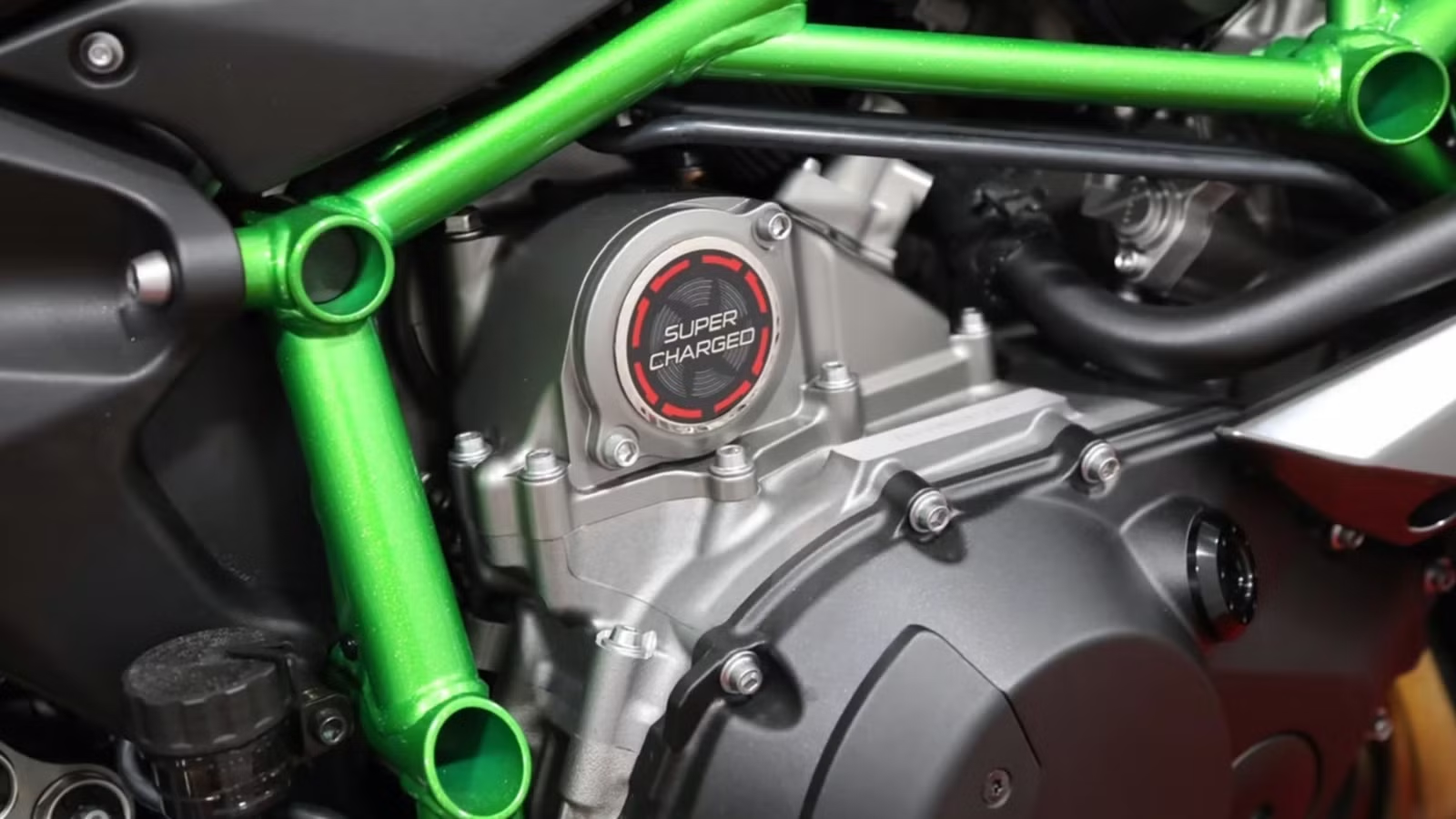
That motorcycle is the Kawasaki Ninja H2R, a closed-course machine built around a supercharged 998cc inline-four engine. Kawasaki rates it at 322 horsepower at 14,000 rpm and 121.5 lb-ft of torque at 12,500 rpm, a claim confirmed independently by the current order period announcement. Kawasaki’s own paperwork also notes that figure is measured to the ISO 4106 standard rather than the SAE standard used for most cars and many other bikes, a methodology that tends to read higher, a distinction the manufacturer discloses directly on its own product page rather than something buried in fine print elsewhere. At a wet weight of 476 pounds, verified by the current model’s spec sheet, the H2R produces output that would be remarkable from a naturally aspirated liter-class engine and borders on absurd from something this compact.
Kawasaki’s own published top speed claim for the H2R sat at 380 kilometers per hour, or roughly 236 mph. In 2016, World Supersport champion Kenan Sofuoglu pushed past that figure, riding a specially prepared H2R across a bridge in Turkey on race fuel and purpose-built high-speed tires, reaching 400 kilometers per hour, or roughly 249 mph, in 26 seconds. Sofuoglu described the gap himself in his own account of it, saying Kawasaki had told him the bike’s maximum speed was 380 km/h before he set out to beat it. The two figures are not interchangeable: one is the factory rating for a standard machine, the other a single, closely documented feat under conditions well beyond an ordinary track day. The H2R remains a closed-course machine only, without mirrors, lights, or the equipment needed to register it for public roads, a restriction Kawasaki states directly on its own product listing.
The Supercharger That Changed Kawasaki’s Engineering Playbook

Kawasaki did not source its supercharger from an outside specialist, an unusual choice in an industry where forced induction components are typically bought in. Instead, engineers from the company’s gas turbine, aerospace, and corporate technology divisions built a motorcycle-specific centrifugal supercharger entirely in-house, using a planetary gear step-up that lets the impeller spin at close to 130,000 rpm. Kawasaki describes this directly as an unprecedented collaboration between multiple divisions within Kawasaki Heavy Industries, rather than a single engineering team working alone. That approach let Kawasaki tune the supercharger’s characteristics to match the engine directly, rather than adapting an existing design meant for a different application, and it avoided the throttle lag that plagues turbocharged setups at speed.
What It Costs to Own the World’s Fastest Ninja

A new Kawasaki Ninja H2R currently carries an MSRP of $59,100, sold only through a limited annual order window rather than off a dealership floor. Its closest rival for outright spectacle is the Ducati Superleggera V4, an Italian hypersport machine built around a naturally aspirated 998cc V4 shared with Ducati’s homologation-special track machine, producing 224 hp in road-legal form and priced at around $100,000 for its limited run of 500 units. Where the Ducati leans on extreme lightness (its dry weight sits under 360 lbs) and a naturally aspirated engine for a similarly extreme experience, the Kawasaki leans entirely on forced induction to close the gap, making significantly more claimed power from an engine of nearly identical displacement.
Because the H2R is not street legal anywhere, ownership comes with logistics most buyers never think about with a normal motorcycle. It cannot be licensed, insured for road use, or ridden home from a dealership, meaning owners need a trailer, a truck, and typically a track day membership just to use the bike as intended. That reality keeps demand relatively contained compared with street-legal hypersport machines, and most sales still trace back to Kawasaki’s original limited order window rather than a conventional resale market.
Cementing the Ninja Name in Speed History

The H2R’s influence did not stay confined to the track. Kawasaki adapted the same supercharged platform into the street-legal Ninja H2, rated at 240 hp but otherwise sharing the H2R’s core engineering, currently priced at $32,700 according to the street-legal model’s spec listing. A few years later, the Ninja H2 SX extended that technology further into a sport-touring package, rated at 207 hp and priced from $29,999, trading outright peak power for a broader spread of usable torque suited to daily riding, per the touring variant’s current pricing.
Nothing else in Kawasaki’s modern lineup, or arguably in the wider motorcycle industry, has matched the H2R’s combination of in-house forced induction engineering and outright speed. Other manufacturers have chased comparable numbers with lighter, naturally aspirated engines, but none have replicated Kawasaki’s specific approach of borrowing directly from aerospace and gas turbine engineering. More than a decade after its debut, the H2R remains the reference point for what a production motorcycle can theoretically achieve, a title earned on a closed bridge and never seriously challenged since.
Sources: Motorcycle.com, Kawasaki, Mecum.

Related posts
Latest Post


No Comments