
The First Production Car To Break 400 Horsepower
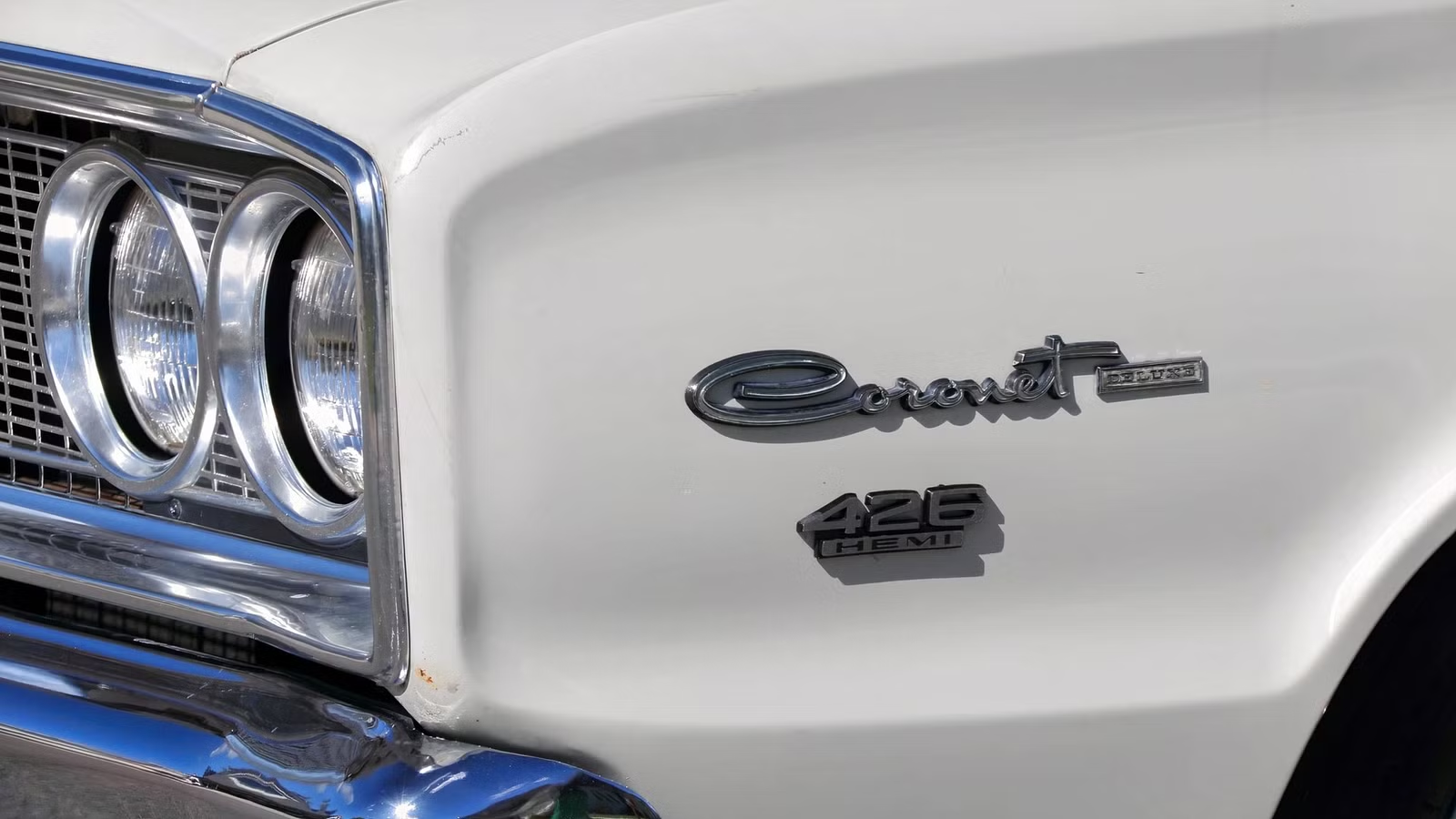
Few milestones in American automotive history carry as much weight as the moment a factory-built street car first cracked 400 horsepower. That moment arrived in 1966, and it had Chrysler’s fingerprints all over it. At a time when the muscle car wars were heating up and gearheads were demanding more from their machines than ever before, Chrysler didn’t just inch past the threshold — it blew through it with two different production models in the same model year.

While Chrysler is well known throughout the industry, most gearheads probably don’t know the role this brand played in bringing the first 400-horsepower mass-market production car to fruition. The 1960s were a time when horsepower was king and expectations among enthusiasts were climbing fast — and Chrysler was ready to step up and deliver something historic.
In fact, Chrysler didn’t just deliver one car that crossed the 400 hp threshold in 1966. It did one better by delivering two different models. This achievement marked a clear shift in the auto industry. There was simply no going back after gearheads got a taste for a factory-built performance car with this kind of capability. So, buckle up — you’re about to meet the two 1966 Mopars that introduced the world to the concept of 400-horsepower mass-produced cars.
426 Hemi: The First Mass-Market 400-HP Engine

Chrysler’s 426 Hemi was not created as a marketing exercise or a response to street-car trends. It was developed in the early 1960s as a racing engine, built specifically to dominate NASCAR at a time when high-RPM durability and airflow mattered more than civility. Introduced in competition form in 1964, this game-changing 426 cubic-inch V8 was engineered around hemispherical combustion chambers, large valves, and a cross-bolted bottom end designed to survive sustained abuse.
The hemispherical chamber design enabled straighter intake and exhaust port geometry, supporting efficient high-RPM operation. Combined with forged internals, high compression, and a dual four-barrel carburetor setup in street trim, the 426 Hemi delivered a level of performance that conventional wedge-head engines simply could not match. These 426 Hemi-powered machines were factory-rated at 425 horsepower and 490 lb-ft of torque under the SAE gross measurement system. Car historians note that this figure was likely understated at the time — the Hemi’s published numbers were conservative even by the standards of the era.
Hemi-Powered ’66 Dodge Coronet And Plymouth Satellite First Broke 400 HP

Chrysler’s decision to bring the 426 Hemi to the street was driven by homologation requirements rather than consumer demand. To remain eligible for racing, the engine had to be offered in production vehicles available to the public. That requirement led directly to the creation of the first mass-produced cars officially rated above 400 horsepower.

That’s where the 1966 Hemi-powered Dodge and Plymouth cars stand apart as the first 400-plus-horsepower mass-produced vehicles built and sold as true series-production street cars. In 1966, Chrysler installed the 426 Hemi into selected Dodge and Plymouth models, including the Dodge Coronet and Plymouth Satellite. These two muscle cars brought 400-plus horsepower into true mass production, where either model could be ordered through standard dealerships by the general public.
It’s important to note that these are not the first street-legal 400-hp cars (more on that later). However, the Hemi Coronet and Satellite were both warranty-backed and available through normal dealership channels. They marked the first time a mass-produced automobile carried a factory rating that exceeded the 400-horsepower threshold. The 426 Hemi’s transition from the track to the street didn’t just satisfy racing rules — it reset expectations for what a factory performance car could be, laying the foundation for the horsepower escalation that would define the muscle car era.
The 1966 Hemi-Powered Dodge And Plymouth Models

|
Engine |
Power |
Torque |
|---|---|---|
|
426 Hemi |
425 hp |
490 lb-ft |
Chrysler’s decision to install the 426 Hemi into production cars came in 1966, when the engine became available in limited numbers across Dodge and Plymouth’s intermediate platforms. The Dodge Coronet and Plymouth Satellite were not conceived as halo cars. They were mid-size models already in production, chosen because they could physically accommodate the Hemi and meet homologation requirements. What made it even more compelling for Chrysler was that the company didn’t need to start from scratch with a clean-sheet vehicle to make this dream a reality.
Both models received the 426 Hemi as a high-cost, low-volume option partway through the 1966 model year. Rated at 425 horsepower and 490 lb-ft of torque under SAE gross standards, these cars became the first widely produced vehicles to carry a factory rating above 400 horsepower. Power was routed through a heavy-duty four-speed manual transmission or a reinforced TorqueFlite automatic, backed by upgraded driveline and suspension components engineered to handle the Hemi’s considerable output.

Still, these 425-hp Hemi cars were extremely special — Chrysler ensured they remained available only in limited numbers. Across Dodge and Plymouth’s intermediate models, Chrysler built roughly 2,700 Hemi-powered cars that year. Of those, approximately 740 were Dodge Coronets and 840 were Plymouth Satellites equipped with the 426 Hemi. While they were aimed at everyday enthusiasts, Chrysler understood that it would take a special kind of driver to handle one of these machines on the open road.
These cars were extraordinary, but they were also expensive and demanding to maintain. So, while they were technically available to anyone, not everyone was suited to own one. As a result, production spanned only a short window before Chrysler shifted direction for later model years.

These 1966 Chrysler 426 Hemi cars made history, and performance will always be their defining trait. In the quarter-mile, these machines were capable of covering the distance in around 13.5 seconds. In straight-line acceleration, the 426 Hemi-powered cars were dominant. They also offered high-speed durability that was unmatched among street-legal competitors at the time.
However, it’s also important to recognize that the 1966 Hemi-powered Coronet and Satellite models aren’t special simply because of rarity or performance. These classic cars matter because of what they represent: the moment when racing-grade power crossed fully into production reality.
These machines were never softened interpretations of a competition engine — they were direct translations. They proved that factory-built street cars could legitimately exceed 400 horsepower without compromise.
Why 400 Horsepower Mattered

In the mid-1960s, horsepower was always top of mind among both gearheads and automakers. Yet most production cars of the era were still built around comfort, reliability, and cost control. The race among automakers to reach 400 horsepower represented a clear break from that philosophy. It marked the point where a factory engine crossed from “high performance” into territory previously reserved for race cars and specialty builds.
Reaching 400 horsepower mattered because it forced manufacturers to confront limits that couldn’t be solved with displacement alone. Engines operating at that level required serious airflow, robust bottom ends, and improved cooling. This wasn’t about short bursts of acceleration — it ushered in a new era in which factory cars for everyday enthusiasts could withstand real-world use while producing unprecedented output. When Chrysler officially rated the 426 Hemi above 400 horsepower, it demonstrated that those engineering challenges could be addressed within a production car.

Once the 400-horsepower barrier was broken, escalation was inevitable. Horsepower became a central weapon in the growing muscle car wars. Historically, the number matters because it signaled the moment when factory-built street cars reached a level of output that permanently redefined what gearheads would demand from production vehicles going forward.
Street-Legal 400-HP Cars Before The Hemi

Several earlier American performance cars flirted with the 400-horsepower mark during the early 1960s. However, most were ultra-low-production homologation specials or competition-focused factory race cars — and that distinction matters. Chrysler’s 426 Hemi was the first engine to deliver a verified 400-plus horsepower rating in a true series-production street car that any gearhead could order through a dealership.
The 1964 Ford Fairlane Thunderbolt, factory-rated at 425 horsepower, was built specifically for NHRA Super Stock competition. Only about 100 examples were produced, and it was never intended as a regular consumer model sold through everyday dealerships. Similarly, the 1962 Pontiac Catalina SD was a continuation of Pontiac’s factory racing program.

Produced in extremely limited numbers, those Super Duty Pontiacs were built for drag racing and stock-car competition rather than broad retail availability. Ford’s Galaxie 427 also predates the Hemi cars; however, many were built for fleet, police, or competition use and were never marketed as a clearly defined, widely available 400-horsepower consumer performance car.
How The 426 Hemi Changed Performance Cars Forever

The long-term impact of the 426 Hemi is still felt today, demonstrating that manufacturers could build factory engines capable of extreme output without aftermarket modifications or race-only components.
The Hemi forced competitors to respond as well. Both General Motors and Ford invested more heavily in their own high-output programs, introducing increasingly aggressive big-block options and pushing advertised horsepower figures higher throughout the late 1960s. Most of Chrysler’s rivals didn’t fully catch up until the early ’70s — GM being a notable example with the 1970 Chevelle SS, which was factory-rated at 450 horsepower thanks to its LS6 454 V8.
The 426 Hemi also shaped later engine architecture decisions across the industry. Its hemispherical combustion chamber design reinforced the importance of airflow and valve geometry. While few manufacturers adopted true hemispherical chambers, the underlying principles influenced cylinder head design, port layout, and high-lift valvetrain development for decades to come.
Today, the 426 Hemi’s legacy is measured less by its celebrated status among collectors and more by its genuine historical significance. Modern high-horsepower production cars owe their existence to the moment Chrysler proved that race-level output could exist — legitimately and reliably — on the street.
Sources: Allpar, Dodge Garage, FastestLaps, Hemmings, Hot Rod Magazine.

Related posts




Latest Post


No Comments