
The Supercharged Luxury Sedan With 470 HP And Used Toyota Camry Pricing
When shopping for a used vehicle with a budget of $10,000 to $15,000, most car buyers choose the safe option. They go for a dependable commuter car like the Toyota Camry, and this is a very understandable choice for practical transportation. However, settling for an everyday commuter isn’t your only option. If you step outside the traditional mindset of sensible A to B cars, that exact same budget unlocks an entirely different realm of automotive ownership. For the cost of a sensible family car, there is an exciting, supercharged V8 luxury sedan with great performance, wrapped in a sophisticated British suit.
Buying A Used Car Can Be A Great Financial Decision

The current used car market is one of the few places where proper research can pay off big time. Brand-new vehicles begin to depreciate as soon as their tires roll off the dealership lot, with the average car losing around 20 percent of its initial value within the first year alone. By the time a car is five to ten years old, the initial owner has taken most of that financial hit.
For savvy buyers, this steep initial depreciation creates an incredible opportunity. A car that’s a decade old doesn’t automatically mean it’s outdated or worn out; instead, it gives you access to a lot of great cars you could buy for far less than their original value. This levels the playing field for used car buyers, giving them access to premium cars with superior build quality and high-performance engines that would otherwise be very expensive.
Reliability Is A Big Factor Here

It is impossible to discuss the $10,000 to $15,000 price point without acknowledging why the Toyota Camry dominates the market. Toyota spent decades building a legendary reputation for bulletproof reliability, low cost of ownership, and stress-free maintenance. The XV50-generation Camry (2012-2017) from this era is a masterpiece, a very practical choice. It starts every single morning without complaint, runs efficiently on regular fuel, and requires little more than routine oil changes to cross the 200,000-mile mark. The facelifted version from 2015-2017 further improves on everything that makes this car great while looking like a new model rather than a midcycle refresh.

For millions of drivers, that peace of mind is worth every penny. However, while the Camry handles daily duties flawlessly, it lacks any semblance of passion or excitement. It is designed to be an appliance that simply works. Yet, within that same price category are used luxury sedans that once commanded eye-watering price tags, but now offer world-class driving dynamics and luxury to anyone brave enough to look past the obvious choices.
Luxury Cars Usually Depreciate the Most

While standard commuter cars hold their value relatively well due to steady demand from practical buyers, high-end luxury cars have worse depreciation. The price of a brand-new luxury car reflects all the premium features it offers, like exotic interior trim, leather, sophisticated air suspension, and powerful engines. They’re all great when new, but once the factory warranty expires, subsequent owners often shy away out of fear of potential expensive repair bills, causing market values to plunge off a cliff.
Vehicles that once sold for $70,000-$100,000 are suddenly competing in price with everyday family haulers. German luxury sedans like the BMW 5 Series or Audi A6 follow this trend, but few brands experience such steep depreciation quite like Jaguar. For buyers willing to do their homework, this could be an extraordinary opportunity to own a high-end luxury car for a bargain.
Jaguar Built One Of The Greatest Sleeper Sedans Of The 2010s

During the late 2000s and early 2010s, Jaguar underwent a complete design revolution under the guidance of legendary designer Ian Callum. Jaguar introduced a sleek, coupe-like sedan that looked fast even when parked. While the market was focused on executive cars from Munich and Stuttgart, Jaguar quietly created one of the best-looking performance luxury cars of its era. They built a car that blended sharp handling with luxury car levels of comfort. Through the power of depreciation, this once-exclusive flagship luxury vehicle has slid quietly into the price territory of everyday pre-owned Japanese sedans.
A 470-HP Jaguar For Camry Money

The vehicle in question is the 2010–2015 Jaguar XF Supercharged V8. This is the sweet spot of the XF lineup, since it has more power than the base naturally aspirated V8 but is far more comfortable than the ultra-aggressive XFR. The XF Supercharged combines the understated elegance of a luxury cruiser with the monstrous firepower of that V8 under the hood.
When it was brand new between 2010 and 2015, the Jaguar XF Supercharged had an original base MSRP between $67,000 to over $70,000 depending on options. Fast-forward to today, and well-maintained, clean examples now cost between $12,000 to $18,000. This is a handcrafted British luxury sedan that you can now cross-shop with a 2015–2017 Toyota Camry with more miles than the Jaguar XF. As for performance, they’re not even in the same league.
Supercharged V8 Performance For Less Than Its Engine Cost New

The party piece of this XF lies underneath its aluminum hood. It has Jaguar’s iconic AJ133 5.0-liter supercharged V8 engine producing a staggering 470 horsepower and 424 lb-ft of torque. This is a rear-wheel drive torque machine and, for context, the most powerful Camry with the V6 makes only 268 hp and 248 lb-ft to the front wheels.
To put its performance value into perspective, buying a replacement supercharged V8 directly from a dealer catalog today can easily cost over $15,000 to $20,000. This means you are essentially buying a world-class engine and getting the rest of a luxury car thrown in for free. Step on the gas pedal, and the 4,300-pound sedan rockets from 0 to 60 mph in just 4.9 seconds with a limited top speed of 155 mph. That is acceleration that will easily embarrass modern sports cars, all while carrying four adults in near-silence and comfort.
One Of The Most Charismatic Luxury Sedans

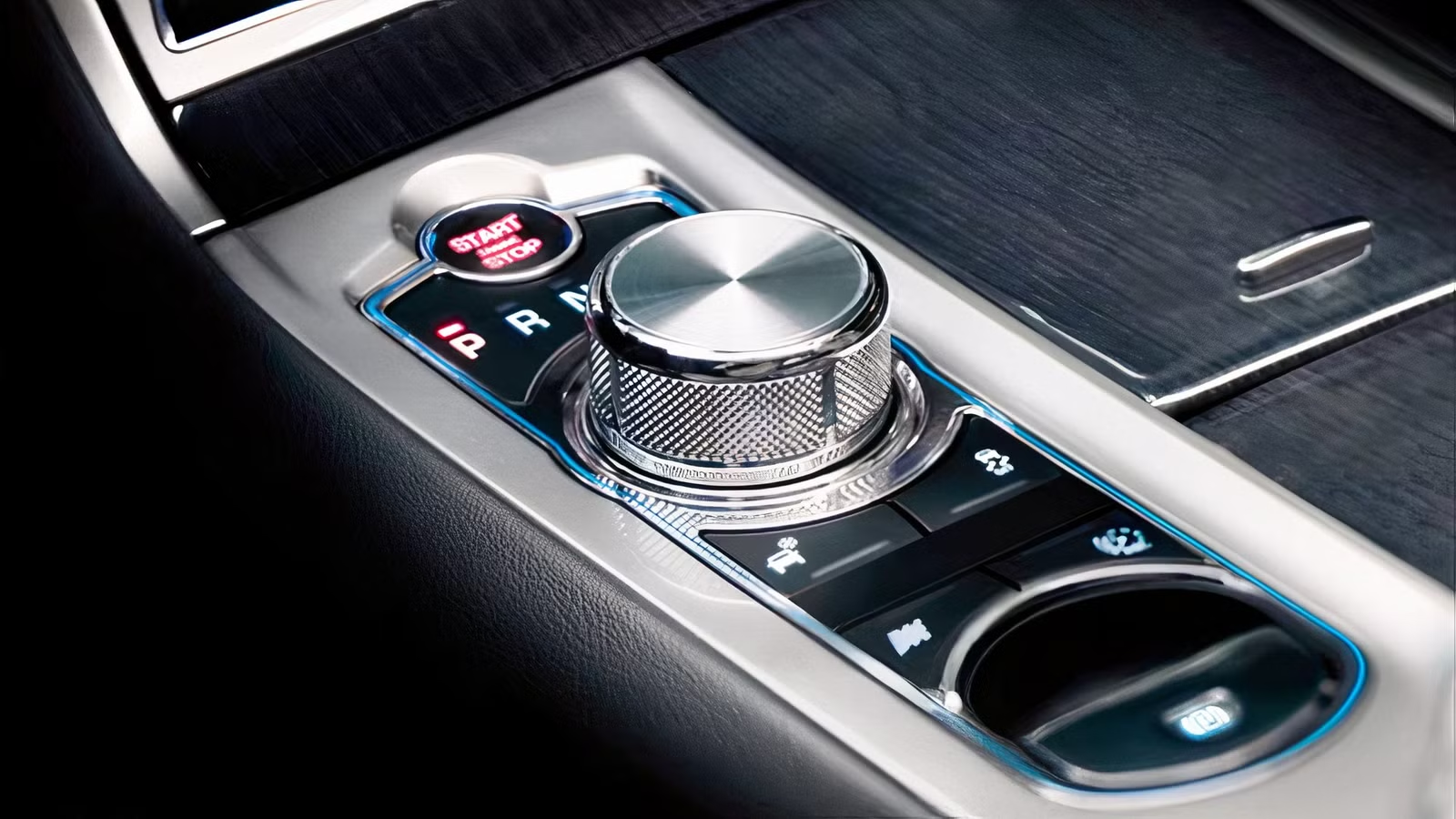
Beyond the sheer numbers on a spec sheet, the Supercharged XF possesses a distinct sense of occasion that regular commuters and even some modern luxury cars often lack. Pressing the pulsing red start button on the center console brings the engine to life with a deep, authoritative V8 rumble. As the engine fires up, the rotary gear selector slowly rises out of the aluminum center console while the flush air vents automatically rotate open in sequence. That sequence alone is genuinely impressive.
On the road, the power delivery is effortlessly smooth. Unlike modern turbocharged engines that require time to build boost, this has instant throttle response even at idle. Early models from 2010 had a six-speed automatic, but later models from 2013 received a faster ZF eight-speed automatic along with a facelift. This car can be calm but can also provide an engaging, visceral connection between driver and machine, and that V8 is the key player in that role.
The Jaguar XF Is A Proper Luxury Performance Sedan

Stepping inside the cabin reveals an environment crafted with high-end materials that make a commuter sedan feel mundane. Soft-grain leather covers the seats, dash, and door panels, accented by genuine wood veneers and knurling on the metal controls. It has standard features like a heated steering wheel, 16-way power-adjustable heated and ventilated front seats, power rear sunshade, Bowers & Wilkins (or Meridian in later years) premium surround-sound audio system, adaptive suspension, and much more. You’ll never find most of these features in your normal daily driver.
Now, you have to be realistic about owning a 470-hp British sedan. It requires premium fuel and will average 15 mpg in the city and 21 mpg on the highway if you drive responsibly. Maintenance costs will naturally run higher than a Toyota’s, and addressing known issues like plastic cooling pipes or timing chain tensioner wear on earlier models requires some patience. However, finding an example with a well-documented service history transforms what seems like a gamble into a manageable and, dare I say, rewarding ownership experience.
This May Be The Last Affordable Supercharged Jaguar Worth Chasing

The automotive landscape has shifted permanently. Jaguar has officially announced a transition toward fully electric powertrains, marking the end of its legendary internal combustion heritage. The era of characterful, supercharged V8 British sedans is over, and while they’re not attaining collector status any time soon, enthusiasts seem interested in them.
As enthusiast awareness grows, the window to acquire a 5.0-liter supercharged V8 Jaguar for under $20,000 is rapidly closing. While turbocharged six-cylinders and hybrids have become the norm, the instant torque, supercharger whine, and V8 exhaust note of the Supercharged XF represent a high point of Jaguar’s luxury performance sedans that will never be replicated.
The Best Bargains Aren’t Always The Safest Choices, But They’re Exciting

Returning to the original dilemma: there is nothing wrong with buying a 2015–2017 Toyota Camry. If your goal is to get from Point A to Point B with zero drama, the Camry remains the logical choice. It is safe, sensible, and utterly uninspiring. However, functionality shouldn’t be the only reason you own a car.
For those who view driving as an experience rather than a chore, taking the calculated risk on a used Jaguar XF Supercharged (preferably 2013–2015) delivers unmatched value. For the exact same money as a boring commuter car, you get 470 hp, luxurious leather, and an exhilarating drive every time you turn the key. This bold choice will leave a smile on your face every single time.
Sources: Jaguar, Classic.com.

Related posts




Latest Post


No Comments