
Ford’s Most Powerful Classic Muscle Car Wasn’t A Mustang
Every gearhead knows the Mustang’s greatest hits by heart — the Boss 429’s NASCAR-derived thunder, the mythical one-off Shelby GT500 Super Snake. The 1969 Boss 429 stands as the most powerful street-legal Mustang of its era, squeezing 375 horsepower from a race-bred V8, while that lone 1967 Super Snake prototype remains the rarest and most valuable Mustang ever built. But here’s what the pony car faithful don’t always want to hear: Ford’s most ferocious factory muscle car of the 1960s never wore a galloping horse on its grille.

Ford’s most powerful factory-built muscle car of the era didn’t wear a pony badge. It wasn’t designed for wide appeal or showroom glamour. Instead, it was engineered for one purpose — dominate the drag strip. Built in extremely limited numbers and sold only to serious racers, this car came stripped down and reinforced to handle brutal quarter-mile launches.
It used Ford’s most aggressive version of the 427 cubic-inch V8, and officially claimed an understated 425 hp; real-world output was substantially higher. This Ford was lightweight thanks to its stripped-down interior and fiberglass body panels.
This car’s mission was clear: a turn-key factory-built model that could win NHRA drag races on Sunday while remaining road legal for everyday use — at least on paper. Today, it remains one of the most extreme series production muscle cars Ford ever built.

Ford’s Total Performance Era Was Wild
In the late 1950s, the Automobile Manufacturers Association (AMA) passed a resolution banning factory-supported racing and performance-oriented advertising in a bid to improve safety and reduce government scrutiny. While Ford initially upheld the agreement, some of its fierce rivals quietly went against it, and the success they achieved on the track directly translated into more sales. Angered by his rivals dominating on the track and being rewarded handsomely for it, Henry Ford II tore up the agreement and decided to go all in on street and track domination, launching Ford’s Total Performance era.
Ford’s first weapon of choice to fulfill the Total Performance mandate was the Galaxie, a full-size cruiser that used the legendary 427 cubic-inch “High-Riser” V8 to win. As effective as the Galaxie was, rivals started switching to lighter midsize bodies to improve the power-to-weight ratio, leaving Ford in need of a better weapon to be competitive in the NHRA Super Stock. Dearborn’s skunkworks team pivoted to the midsize Fairlane platform and built a lightweight, stripped-down monster with Ford’s most powerful engine at the time. This brute was faster and more powerful than the Mustang that debuted just a few months later, but it never achieved the same level of star power.
The 1964 Fairlane Thunderbolt Was The Most Powerful Classic Ford Muscle Car
 1964 Ford Fairlane Thunderbolt – Engine And Performance Specs
|
Engine |
427 cu-in (7.0-Liter) |
|---|---|
|
Configuration |
Naturally Aspirated V8 |
|
Power |
425 hp (claimed) |
|
Estimated Actual Power Output |
Over 600 hp in race trim |
|
Transmission |
4-Speed Manual / 3-Speed Automatic |
|
0-60 mph |
4.6 Seconds |
|
1/4 Mile |
11.61 Seconds at 124.8 mph |
|
Top Speed |
124 mph |
(Source: Fastest Laps, Ford)
Ford built the 1964 Fairlane Thunderbolt with a singular goal: win in NHRA Super Stock drag racing. While the Mustang Boss 429 is often considered the most powerful series production Mustang muscle car of the 1960s, the Thunderbolt pushed further. It used Ford’s 427 cubic-inch High-Riser V8 — an engine derived from NASCAR and endurance racing programs — with a factory-rated output of 425 hp at 6,000 rpm and 480 lb-ft of torque at 3,700 rpm. In real-world drag racing trim, the engine could produce well over 600 hp.
The High-Riser engine featured large intake ports, high-flow heads, and a twin-Holley four-barrel carburetor setup mounted on an inline intake manifold. It ran a fairly high 12.5:1 compression ratio, requiring high-octane race fuel, and came paired with either a 4-speed manual or a heavy-duty 3-speed automatic transmission.
Fun Fact: Because the colossal 427 engine took up every millimeter of space in the front, engineers had no choice but to relocate the heavy car battery to the trunk.

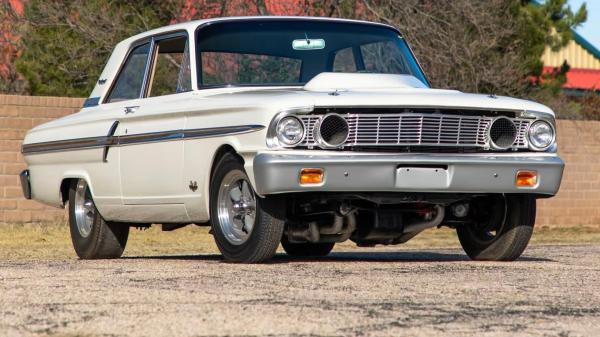
What made the Thunderbolt stand out wasn’t just power — it was its obsessive weight reduction. Ford engineers stripped out everything non-essential and replaced the front fenders, hood, and front bumper with fiberglass panels. Plexiglass windows helped shave valuable weight compared to conventional glass, and the interior featured lightweight bucket seats with no rear seat, heater, or sound deadening.
Only 100 units were built to meet NHRA homologation rules, and Ford sold them through select dealerships. The Thunderbolt was technically street legal, but its sole purpose was quarter-mile dominance. In competition form, the car could run mid-11-second quarter-mile times straight from the factory.
While the Boss 429 brought race tech to the street, the Thunderbolt brought the drag strip to the street — if only just barely. It remains the most powerful classic Ford muscle car ever built with direct factory involvement, and it set a high benchmark for what a production-based Ford could achieve in performance.
You Could Buy The Thunderbolt At A Dealership, But It Came With A Warning

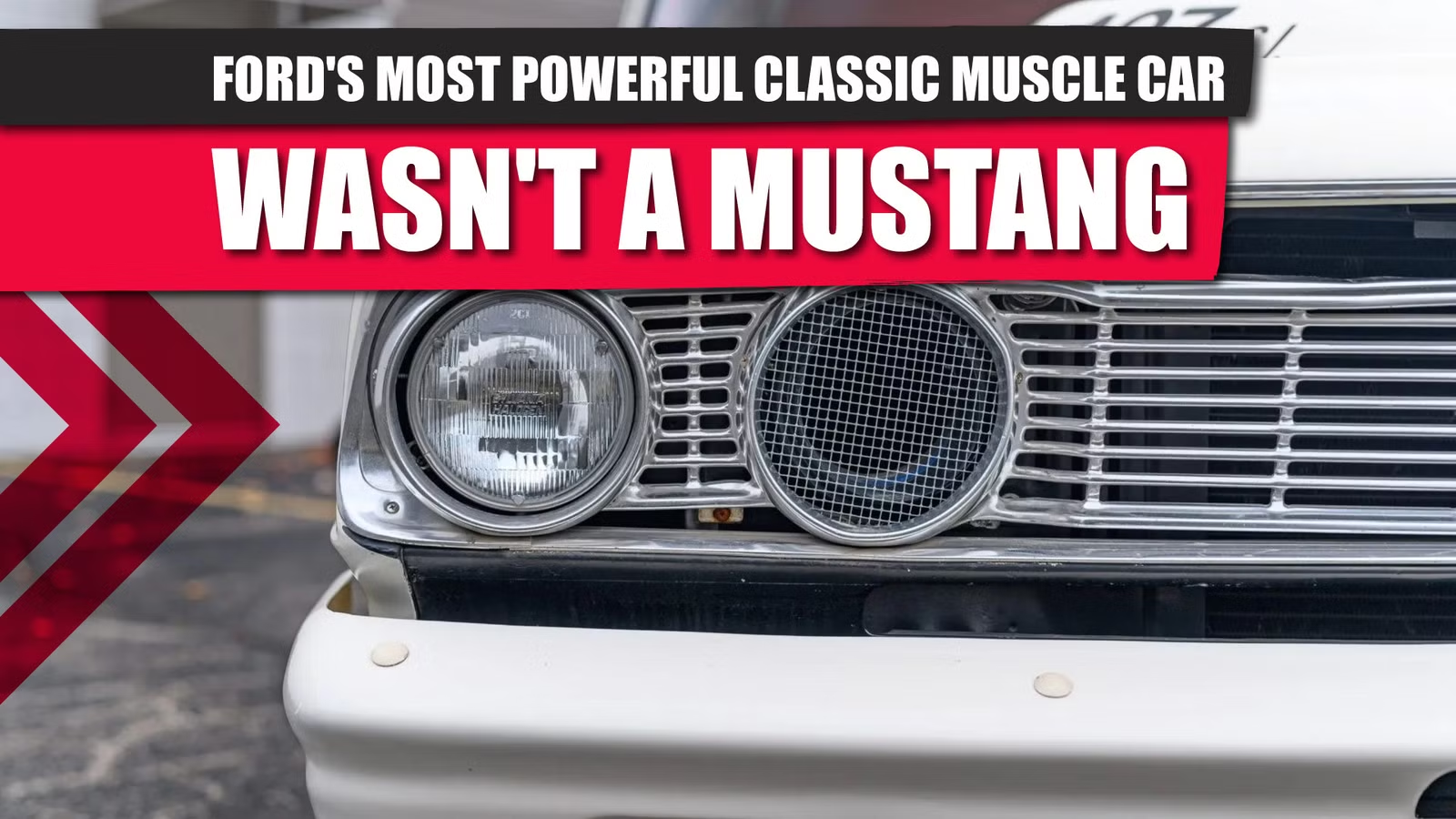
The Thunderbolt looked skeletal and unfinished: the inner headlights were replaced with mesh-covered openings, and a glance inside revealed a barren interior stripped of its radio, heater, carpets, sound deadening, and rear seats. The hood wore a bulge that no regular Fairlane could claim, and underneath sat a NASCAR-derived engine. You can imagine the double-take buyers did when they walked into a dealership and found the Thunderbolt parked alongside polished Galaxies and Falcons.
Ford had to sell at least 100 Thunderbolts to the public to satisfy NHRA homologation rules in 1964, and it did so through select dealerships. A buyer could walk in, hand over their cash, and drive home with a title, a VIN, and a genuine race car with enough power to warp the pavement. However, Dearborn knew that this vibrating, Plexiglas-windowed monster was only meant for serious racers and would be too hard to live with for the average buyer — which is why every Thunderbolt came with a clear disclaimer riveted behind the glovebox door.
“This vehicle has been built specially as a lightweight competitive car and includes certain fiberglass and aluminium components. Because of the specialized purpose for which this car has been built and in order to achieve maximum weight reduction, normal quality standards of the Ford Motor Company in terms of exterior panel fit and surface appearance are not met on this vehicle.”
This gave buyers a clear “enter at your own risk” warning and also gave Ford a legal shield if a Thunderbolt ended up in the wrong hands.
The Fairlane Thunderbolt Dominated The Drag Strip In 1964

The 1964 Ford Fairlane Thunderbolt made an immediate impact in NHRA Super Stock competition. The purpose-built Thunderbolt offered a factory-built turn-key solution for serious racers. Ford delivered the car ready to race, and it proved itself quickly on the drag strip.
In the NHRA Super Stock Eliminator, the Thunderbolt dominated the 1964 season. The car regularly posted quarter-mile times in the mid-11-second range at trap speeds over 120 mph, straight off the showroom floor with little more than tuning and slicks. Its performance gave Ford a decisive advantage over competing models from Chrysler and GM, many of which struggled to match its power-to-weight ratio and consistency on the strip.

Notable racers like Gas Ronda, Butch Leal, and Phil Bonner helped turn the Thunderbolt into a feared competitor. Ronda, in particular, became known for his wins in Southern California, helping build the Thunderbolt’s reputation as a race-ready muscle car. The car was so successful that NHRA officials reclassified it mid-season to prevent it from overwhelming the competition.
Ford’s factory-backed drag racing program used the Thunderbolt as a high-performance drag strip weapon. It not only helped Ford win races, but also reinforced the brand’s commitment to performance in the eyes of muscle car fans and weekend racers.
Fairlane Thunderbolt Racing Achievements
- Won the NHRA Super Stock Eliminator title in 1964
- Posted factory quarter-mile times in the mid-11s
- Helped Ford win the 1964 NHRA Manufacturers’ Cup
- Reclassified mid-season by NHRA due to dominance
- Campaigned successfully by top racers like Gas Ronda and Butch Leal
- Demonstrated consistent high-performance results with minimal modifications
The Thunderbolt Had To Fight Off The Baddest Big Blocks In Motor City

Guided by the company-wide “Total Performance” initiative, Ford took home the apex awards of the drag racing world in the 1964 season. The Thunderbolt achieved every major championship milestone available in its class, cementing its legacy as one of Ford’s most dominant race cars of the era. But don’t get it twisted. The Thunderbolt arrived when every big player in Detroit craved track glory, and it had to outrun some serious rivals to clinch podium positions.
The weakest competition the Thunderbolt faced came from GM. With the General’s corporate brass introducing a strict ban on factory racing support in 1963, nothing in its lineup came close to giving the Thunderbolt any real competition. Chevy’s frontline weapon was the full-size Impala SS with the famous dual-quad 409-cubic-inch big-block. While the 409 was a force to be reckoned with on the street, it was outclassed by the Thunderbolt on the strip. Desperate Chevy racers who wanted a real fighting chance against the Blue Oval had to rely on the mythical Impala Z11 from the previous year, but it still wasn’t enough.

Unlike the near-walkover against Chevrolet, tangling with Chrysler was a street fight. Chrysler started the season with Max-Wedge-powered mid-sized bodies like the Plymouth Savoy and Dodge 330. While these cars were already drag strip royalty, the aging Max Wedge lacked the top-end breathing power needed to beat the Thunderbolt’s radical 427 High-Riser. Chrysler responded by rushing a top-secret, nuclear-tier weapon into production: the legendary 426 Race Hemi. By mid-1964, Hemi-powered Plymouths and Dodges hit the staging lanes and spent the back half of the year winning a massive chunk of high-profile match races, effectively ending the Thunderbolt’s undisputed reign.
The Thunderbolt Probably Triggered One Of Detroit’s Most Ruthless Horsepower Wars
The Thunderbolt didn’t just dominate drag strips — it forced every major American automaker into panic mode. Ford had effectively dropped a factory-built NHRA missile into Super Stock competition, and suddenly Chrysler and GM were scrambling to answer back before Ford completely owned the headlines.
Chevrolet found itself in the toughest spot. GM’s corporate racing ban meant its engineers were fighting with one hand tied behind their backs while Ford openly weaponized its “Total Performance” campaign. Even powerful big-block Chevys like the Impala 409 struggled to keep pace with the lightweight Thunderbolt, especially once Ford racers started perfecting launch setups and tuning tricks.
Chrysler, however, refused to go quietly. The company answered Ford with its own drag-strip monster: the now-legendary 426 Race Hemi. By mid-1964, Hemi-powered Plymouths and Dodges were showing up at tracks across America, turning every major event into an all-out war between Ford’s high-rising 427 and Chrysler’s terrifying new elephant motor.
For a brief moment, the Super Stock class became less about production cars and more about factory-backed engineering warfare. Automakers weren’t just building muscle cars anymore — they were building barely street-legal missiles designed specifically to destroy each other in front of packed grandstands every weekend.
|
Car |
Engine |
Horsepower |
|---|---|---|
|
1964 Ford Fairlane Thunderbolt |
427 High-Riser V8 |
425 hp (rated) |
|
1964 Dodge 330 Ramcharger |
426 Race Hemi V8 |
425 hp (rated) |
|
1964 Plymouth Belvedere A864 |
426 Race Hemi V8 |
425 hp (rated) |
|
1963 Chevrolet Impala Z11 |
427 V8 |
430 hp |
|
1969 Chevrolet Camaro ZL1 |
427 Aluminum V8 |
430 hp (rated) |
|
1969 Dodge Hemi Dart LO23 |
426 Hemi V8 |
425 hp (rated) |
|
1969 Plymouth Hemi Barracuda BO29 |
426 Hemi V8 |
425 hp (rated) |
A Brutal Rule Change Handed The Thunderbolt An Early Retirement

By the end of the 1964 season, the NHRA recognized that the Thunderbolt and Chrysler’s Hemi monsters had turned the Super Stock class into an unsustainable, multi-million-dollar arms race. So, ahead of the 1965 season, the NHRA dropped a rule change that effectively ended the Thunderbolt program.
For 1965, the NHRA drastically increased the number of identical units a manufacturer had to build to qualify a car for Super Stock — from 100 units to 500 units. Ford was already losing an estimated $1,500 to $2,000 on every single Thunderbolt it sold, and scaling production to 500 units would have meant swallowing a massive financial loss. The NHRA also restricted the use of fiberglass body panels and Plexiglass windows going forward, meaning Ford would have had to re-engineer the Thunderbolt to keep racing it. Ford ultimately pulled the plug and shifted its factory-backed drag racing efforts to the higher-volume Mustang and Falcon platforms.
Fairlane Thunderbolt Imitations Can Sell For $80,000
Current Values
|
Condition |
1964 Ford Fairlane Thunderbolt |
|
Concours Condition |
$282,000 |
|
Excellent Condition |
$240,000 |
|
Good Condition |
$201,000 |
|
Fair Condition |
$165,000 |
(Source: Hagerty)
Original 1964 Ford Fairlane Thunderbolts consistently command high prices in today’s collector market. According to Hagerty, a verified Thunderbolt in Concours condition carries an estimated value of $282,000. Those in Excellent and Good condition are valued at $240,000 and $201,000, respectively. Even a car in fair condition is worth around $165,000, underscoring the lasting appeal of this purpose-built drag racer.
These values reflect both the rarity and racing heritage of the Thunderbolt. Ford produced just 100 units in 1964, all intended for NHRA Super Stock competition. They featured factory-installed 427 High-Riser engines, fiberglass body panels, and minimal interior trim — unique specifications that distinguish them from regular Fairlanes and drive strong collector interest.
Fun Fact: Of the 100 units produced, the first 11 cars rolled out in a dark maroon shade called Vintage Burgundy. The remaining 89 cars were all painted Wimbledon White.

Because of this limited production, many enthusiasts have built ‘Tribute’ or ‘Clone’ versions using standard 1964 Fairlane models as a base. These replicas often include visual and performance upgrades but do not match the value of a documented original. According to Classic.com, several tribute Thunderbolts have sold for between $30,000 and $80,000, depending on build quality and components used.
Verified originals with factory documentation continue to bring top dollar, sometimes listing for over $220,000. Collectors place a premium on authenticity due to the car’s historical role in Ford’s factory racing program. With its track success and unmistakable character, the Thunderbolt remains one of the most valuable and respected models in Ford’s muscle car legacy.
Sources: Ford, NHRA, Hagerty, Classic, Mecum Auctions.

Related posts

Latest Post


No Comments