
The Muscle Car Engines Detroit Deliberately Underrated To Dodge Insurance Surcharges
The golden age of the American automotive industry did produce a few controversies in its time. Perhaps none of them have caught the curiosity of enthusiasts more than the knowledge that many of their cars were more powerful than their automakers said they were. The true power outputs of Detroit’s most powerful cars have become a real point of debate. How did things end up this way? Why did they even do it in the first place? Well, we’re about to talk about that.
It Wasn’t Uncommon For Automakers To Lie About How Powerful Their Engines Really Were

We may be used to accurate power ratings from manufacturers these days. After all, a big selling point of Sports Carsand Supercars is advertising how powerful they are. But back in the ’60s and ’70s, things were very different. Different systems of measuring horsepower were used, and they weren’t the most accurate. There were also some manufacturers that simply refused to publish power outputs for their cars at all. A chief exponent of that was Rolls-Royce, which was happy to simply say that the power output of their cars was “sufficient”.
No manufacturers are more notorious for fiddling with power figures, though, than Detroit’s Big Three. That was especially the case when it came to their most powerful Muscle Cars. These cars already looked like performance monsters on paper. But the reality is that they were even more extreme than anyone would have expected.
Detroit Hid The True Power Of Its Most Feared Engines The Hardest


All those extraordinary golden-era muscle cars needed unbelievably powerful engines to achieve the outputs Detroit’s biggest automakers wanted. So, they all developed some of the maddest engines ever fitted into production cars. Then, they tactically hid their true outputs. The ones where the Big Three made the most effort to hide their true outputs were, obviously, the most extreme. Typically, these were the massive big-block V8s, which describes all but one of the engines discussed here.
Chevrolet 427 L88

Any enthusiast of classic Chevys will know all about the fearsome 427-cubic-inch L88 V8. Produced from 1967–1969 and only ever available in the C2 and C3 generations of the Corvette, it was officially rated at 430 hp and 450 lb-ft of torque. But it’s been estimated that the L88’s true power is somewhere between 540 and 580 hp. This is something that Hemmings claims to have achieved, getting 570 hp out of a mostly stock L88 (the engine Hemmings tested had a cam change). That would easily make it one of the most powerful classic big-block engines ever made, with a power figure that remains impressive to this day.
Chevrolet 454 LS6

Another terrifyingly powerful Chevrolet engine, the 454 LS6 is perhaps one of the best big-block V8s to ever come out of Detroit. An optional engine in the Chevelle SS and El Camino SS produced from 1970–1971, this engine was rated at 450 hp and 500 lb-ft of torque from the factory. This rating came from 1970, when the engine was at the peak of its power. Even that impressive figure was a significant under-rating, as Nick’s Garage managed to achieve nearly 500 hp out of them on dyno runs.
Chrysler 440 Six-Pack

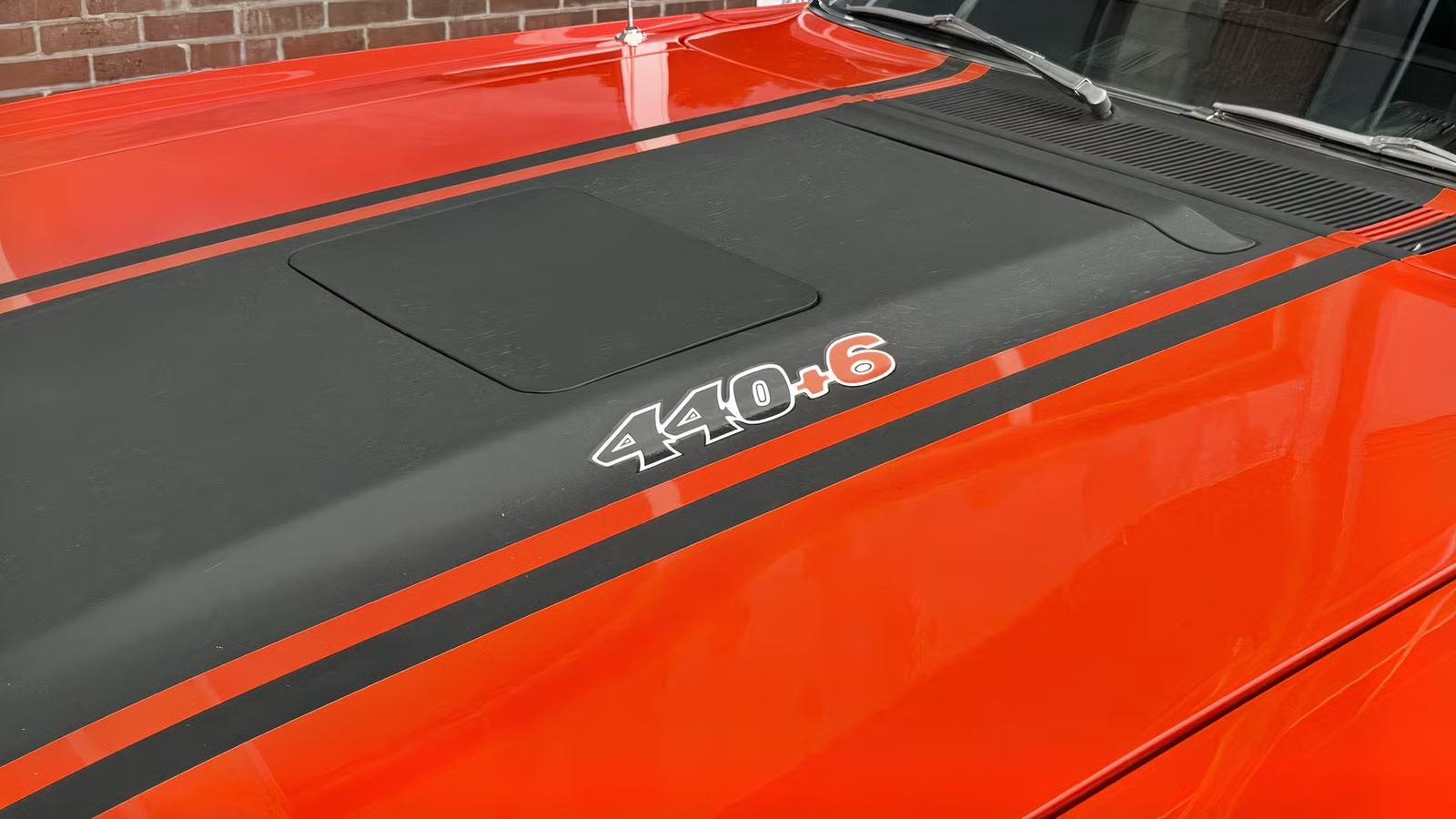
The 440 Six-Pack has to be one of the most loved Mopar engines of all time. Its name derived from its displacement and its carburetor setup (three 2-barrel Holley carburetors), this engine quickly gained a reputation as a performance powerhouse. Officially rated at 390 hp and 490 lb-ft of torque, it was an engine choice in the R/T versions of the Dodge Charger, Dodge Challenger, and Dodge Coronet, as well as the Super Bee and the Charger Daytona. It also powered several Plymouth models, including the Road Runner, GTX, ‘Cuda, and Superbird, where it was referred to as a 440 Six-Barrel.
While that factory-rated 390 hp is very impressive, the 440 Six-Pack has routinely been shown to produce over 400 hp on dyno tests. That can easily skyrocket, too, thanks to how easy it is to tune these engines.
Chrysler 426 Street Hemi

Muscle car enthusiasts the world over treat Chrysler’s 426 Hemi with absolute reverence. That’s because this engine truly was a performance monster. Designed to obliterate the competition in NASCAR, this 426 V8 used a hemispherical combustion chamber, and had massive cylinder heads and enlarged pistons. This allowed it to have much more power at the top end than a typical big-block V8, perfect for running at top speed for long distances on NASCAR’s superspeedways.
The street version of the 426 Hemi was rated at 425 hp and 490 lb-ft of torque. While its most famous use was in the Dodge Charger Daytona and Plymouth Superbird, it also ended up in the legendary Plymouth Hemi ‘Cuda. Those factory ratings alone make it a true monster of its era. But, when you take a look at what its true performance probably was, you’ll be absolutely amazed. Modern dyno tests have recorded readings as high as 500 hp on these engines. That puts them on a level with Chevrolet’s 454 LS6 in terms of their true outputs. One street-spec Hemi has been confirmed to produce 436 hp at just 5,000 rpm on the dyno at Nick’s Garage, so the potential is there.
Chrysler 340 Six-Pack

The only small-block V8 on this list, Chrysler’s 340 Six-Pack applied the carburetor format the 440 Six-Pack used into a smaller engine that was intended for a different purpose. Instead of being a drag racing engine, it was intended for the road course racing of the Trans Am series. That was illustrated in the car it was dropped into: the Plymouth AAR ‘Cuda Trans Am homologation special. The AAR ‘Cuda was officially rated at 290 hp and 345 lb-ft of torque. But many believe that its true power output is around 320 hp. That’s something that was backed up by Hot Rod’s test, which recorded 320 horsepower with the four-barrel and 356 hp with the Six-Pack bolted on. Headers dialed things up to 376.1 hp.
Ford 428 Cobra Jet

The first of two legendary Ford units here, the 428 Cobra Jet has become known as one of the blue oval’s greatest big-blocks. Available in a wide range of Ford and Mercury models (including the Ford Mustang, Ford Torino, Mercury Cougar, and Mercury Cyclone), this 428-cubic-inch V8 was officially rated at 335 hp and 440 lb-ft of torque. That is considerably less than the true power it’s believed to have, which is somewhere around 410 to 430 hp. Its torque output is also frequently claimed to be under-rated, producing as much as 460 lb-ft. Hot Rod’s test recorded 365 horsepower, so there’s definitely some weight to the claims.
Ford Boss 429

The Boss 429 engine was a direct response to Chrysler’s 426 Hemi that we mentioned earlier. Ford made the decision that if you can’t beat them, join them, and gave this monstrous 429-cubic-inch engine a “semi-hemi” combustion chamber with similarly huge pistons and cylinder heads. The result was an engine that had the same kind of top-end power as the 426 Hemi, exactly what Ford wanted to be able to keep up with Mopar on the superspeedways.
The Boss 429 engine only ever found its way into one street-legal car, the Ford Mustang Boss 429. In the street version of that car, it was rated at 375 hp and 450 lb-ft of torque. That is far less than estimates of its real power, which range from 500 to 550 hp. That makes this potentially one of the most powerful engines discussed here, and possibly more powerful than the 426 Hemi it was designed to compete against. It’s certainly able to hit 425 hp at just 4,800 rpm, according to this test.
How The SAE Gross System Allowed Automakers To Under-Rate (And Over-Rate) Their Engines

How were Detroit’s Big Three able to lie about the official power outputs of these crazy engines so convincingly? Well, it’s because the system that was used to measure horsepower at the time was deeply flawed. Up until the early ’70s, American automakers mainly used SAE gross horsepower measurements for official factory power ratings. Given how these measurements were conducted, it was common practice in the years before the golden era for automakers to manipulate the tests to over-rate their engines. This could include taking power-sapping accessories off, using pre-production blueprint engines instead of production engines, using open exhaust headers and running test engines on higher octane fuel.
With that in mind, it is not surprising that manufacturers would simply misrepresent their engines as less powerful than they actually were. If it was so easy to over-rate an engine’s power, it was even easier to officially under-rate them.
Why Did Detroit’s Big Three Lie So Much About Power Outputs?

It takes a lot of effort to hide the real horsepower numbers of a car. So, why did Detroit’s Big Three choose to lie about them so much? Well, there are actually some understandable reasons why they did that. Two of them are ones that applied across that Big Three. Another is the result of something that was only an issue at General Motors, and is the least discussed of all of them. All of them combined created a climate in which the Big Three felt it was not only acceptable but absolutely necessary to misrepresent the true horsepower of their most extreme muscle cars.
They Didn’t Want To Scare Insurers

One of the most well-known reasons why these automakers lied about how powerful their craziest muscle cars were was to not scare the insurance companies. They all wanted younger customers and customers who didn’t have millionaire budgets to be able to afford these cars. But if they were honest about how powerful their cars were, they knew that the insurance companies would demand massive premiums that those customers couldn’t afford. So, to keep those insurance companies quiet, they just lied.
They Wanted To Bend The Homologation Rules For Certain Categories Of Motorsports

Another reason why these automakers lied about the power outputs of their cars is due to the regulations surrounding homologation into motorsports categories. As is well established, the governing bodies that controlled NASCAR, the Trans Am Series, and the Super Stock category of drag racing all required cars to be based on road-legal models that had been produced in a minimum number of examples. Homologation specials arose from manufacturers recognizing that these rules could be bent by producing limited-production variants of existing road cars and offering them for sale in limited quantities or only for a single model year. Those homologation rules could also include power limits.
In an era when power outputs weren’t so stringently checked and tested, misrepresenting them was an easy way of getting an exceptionally powerful car past the scrutineers. That’s something Chrysler and Ford absolutely took advantage of with the 340 Six-Pack and the 428 Cobra Jet. By under-reporting their power, it could get them past the SCCA and NHRA scrutineers respectively and (in theory) allow them to be a dominant force in proper competition.
Sometimes, Internal Politics Got In The Way

The previous two reasons are ones that all of Detroit’s Big Three used to justify misrepresenting how powerful their cars were. This reason, though, only applied to cars that were built by General Motors. GM had an internal policy regarding power-to-weight ratios for their cars. Specifically, they wanted to ensure there were limits on them. GM stated that it couldn’t be more than 1 gross hp per 10 pounds of vehicle weight.
This meant that, under most circumstances, smaller cars were not permitted to be fitted with the most powerful big-block engines. This restriction could be circumvented simply by misrepresenting how much horsepower these engines had. This company-wide underreporting of horsepower could easily be seen by comparing the outputs of smaller cars to those of larger cars with the same engine.
Sources: Chevrolet, Chrysler, Dodge, Ford, Hemmings, Hot Rod Magazine, Mercury, Plymouth, YouTube (@429sluggo, @NicksGarage)

Related posts

Latest Post


No Comments