
The Rarest Engine Ever In A Pontiac Muscle Car
Few chapters in American automotive history burn as bright as the muscle car era, and at the heart of that story is an engine so rare that most enthusiasts have never seen one in the metal. While the 1949 Oldsmobile Rocket 88 is widely credited as the world’s first muscle car — the original compact body stuffed with a V8 — it was the arms race that followed that produced some of the most exotic performance hardware Detroit ever bolted together. These high-performance cars were developed largely as homologation specials so manufacturers could take them racing, built either for the drag strip or the NASCAR circuit.

Pontiac is credited with popularizing the term “muscle car” and launching the golden era when it introduced the GTO in 1964, but manufacturers had been following the same formula long before that. In its heyday, Pontiac built several automobiles around massive V8 engines — some in large volumes, others in only a handful of examples. Here is everything you need to know about the rarest V8 engine ever to power a Pontiac muscle car.
The 421 Super Duty Is The Rarest Engine In A Pontiac Muscle Car
Pontiac 421 Super Duty Production Numbers
|
Catalina Super Duty |
 33 autotech 155 |
|
Grand Prix Super Duty |
16 |
|
Tempest Super Duty |
14 |
(Source: Hemmings)
Between 1962 and 1963, approximately 185 cars were powered by the 421 Super Duty V8, making it the rarest Pontiac engine in a muscle car. In 1962, the 421 Super Duty powered just 155 Catalina and 16 Grand Prix models according to Hemmings, while the engine also found its way into the Pontiac Tempest in 1963 — only 14 of which were built with the 421 SD, according to Hagerty. The high-performance engine was designed specifically for drag racing and stock car competition.
Pontiac 421 Super Duty Engine Specs
|
Manufacturer |
General Motors |
|
Production Years |
1962-1963 |
|
Displacement |
421 cu-in (6.9-Liter) |
|
Configuration |
Naturally Aspirated V8 |
|
Power |
405 hp at 5,600 rpm |
|
Torque |
425 lb-ft at 4,400 rpm |
|
Transmission |
4-Speed Manual / 3-Speed Automatic |
|
Fuel Type |
High-Octane Gasoline |
|
Notable Application |
Pontiac Catalina, Tempest, Grand Prix |
(Source: Pontiac, Mecum)
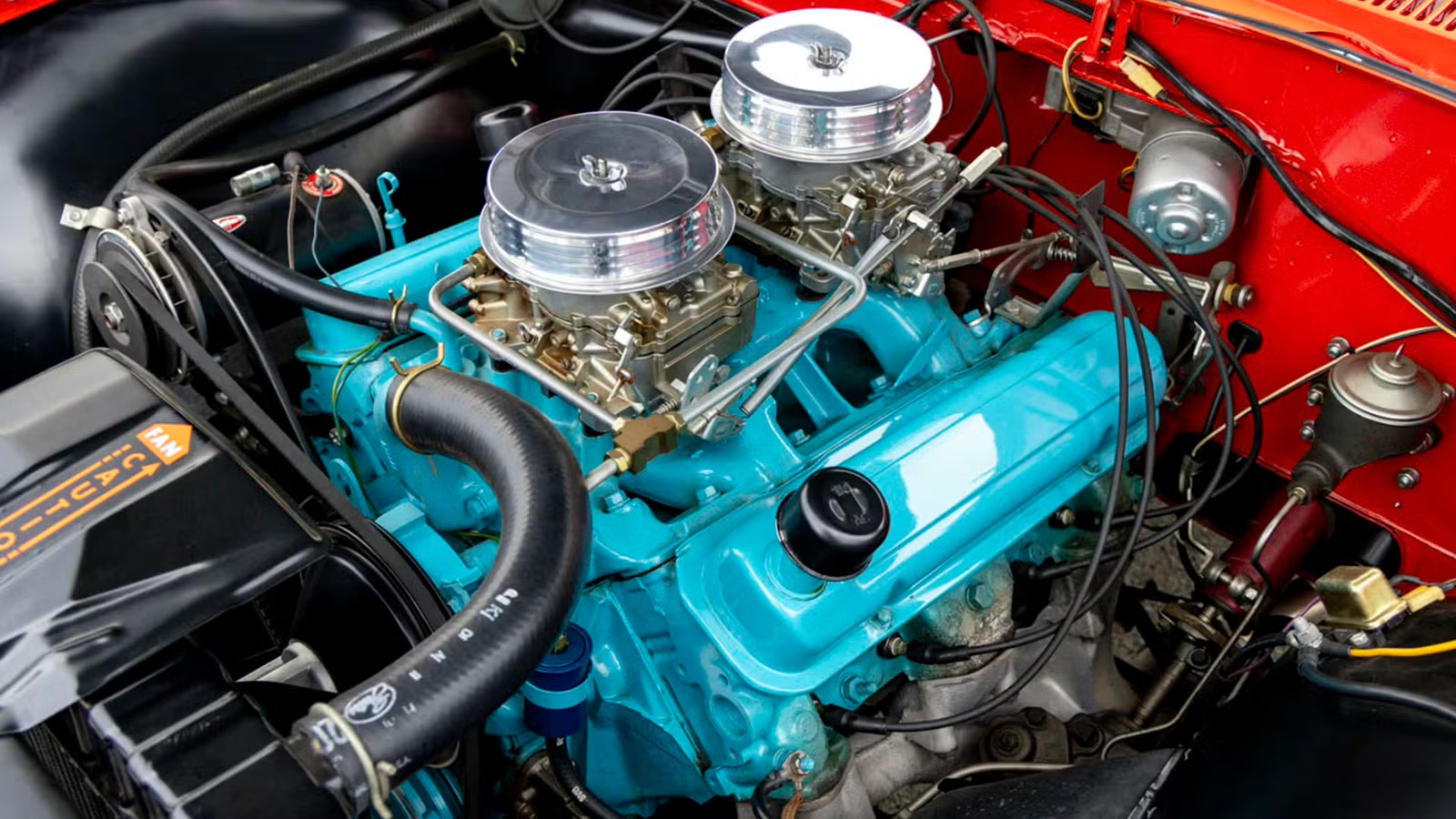
Pontiac’s 421 Super Duty is a 6.9-liter naturally aspirated V8 engine built around a cast-iron block and head. The engine used a 4.09-inch bore with a 4.00-inch stroke, yielding a 421 cu-in displacement. Running at a high 11.0:1 compression ratio, it produced 405 hp at 5,600 rpm and 425 lb-ft of torque at 4,400 rpm. Some variants ran an even higher 12.0:1 compression ratio, and racing versions with modifications generally made over 500 hp.
The valvetrain in the 421 Super Duty uses an overhead valve (OHV) design with two valves per cylinder. The fuel system consisted of a pair of Carter AFB 4-barrel carburetors feeding an aluminum high-rise intake manifold. Designed for racing applications, the Super Duty requires high-octane gasoline to run.
To handle the additional demands of the high-performance engine, Pontiac fitted a high-capacity oil system with an external oil filter and a cooling system featuring a high-flow water pump and an upgraded radiator suited for racing. Internally, the 421 Super Duty features a forged steel, cross-drilled crankshaft with solid lifters, high-strength forged steel connecting rods, and forged aluminum pistons.
The 421 Super Duty was a rare and highly sought-after engine, with Pontiac producing only a very limited number due to tightening racing restrictions. It remains a legend in muscle car history.
The Pontiac 421 Super Duty Offered Two Transmission Choices
The Pontiac 421 Super Duty engine powered various muscle cars, and both manual and automatic transmission options were available with this V8. Because the engine was built for all-out performance, it was paired with heavy-duty gearboxes capable of managing the high torque output while remaining durable under race conditions.
Pontiac 421 Super Duty – 4-Speed Manual Gearbox
The Pontiac 421 Super Duty came standard with a Borg-Warner T-10 4-speed manual gearbox. This close-ratio transmission was designed for high-performance applications, with a particular suitability for drag racing and street performance.
The T-10 was engineered to handle high torque output engines like the 421 Super Duty, while also enabling quick shifts and aggressive launches. While fewer than 300 Pontiac cars used the 421 Super Duty V8, the T-10 4-speed manual was the most popular choice among racers and street drivers alike.
Pontiac 421 Super Duty – 3-Speed Automatic Gearbox
Pontiac also offered the 421 Super Duty with a specially modified and strengthened 3-speed automatic gearbox. It was either the Hydra-Matic or the Roto-Hydramatic transmission. The Roto-Hydramatic was also known as the “Slim Jim” — a lighter, more compact unit that used a single planetary gearset with a split-torque design, compared to the Hydra-Matic’s multiple planetary gearsets.
The automatic transmission was primarily used in factory-built drag racing cars. The 3-speed gearbox delivered consistent performance for racers who preferred an automatic over a manual. Some Super Duty drag cars were equipped with further-customized automatic transmissions to handle the high torque and improve launch consistency.
These transmissions helped the 421 SD-powered Pontiacs dominate drag strips and NASCAR circuits in the early 1960s, cementing their status as legends among muscle cars of the era.
1962-1963 Pontiac 421 Super Duty Transmission Options:
- Borg-Warner T-10 4-speed manual gearbox
- 3-speed Hydra-Matic automatic gearbox
- 3-Speed Roto-Hydramatic automatic gearbox (lightweight option)
The Pontiac 421 Super Duty V8 Powered Several Iconic Muscle Cars

Notable 1962-1963 Pontiac Super Duty Models
- 1962-1963 Pontiac Catalina Super Duty
- 1962-1963 Pontiac Grand Prix Super Duty
- 1963 Pontiac Tempest Super Duty
The 421 Super Duty was manufactured for two model years — 1962 and 1963 — and was used in only a handful of cars. In 1962, Pontiac produced a total of 179 units with the 421 Super Duty engine. Among these, the 1962 Catalina Super Duty accounted for 162 units, while the Grand Prix Super Duty made up the remainder.

In 1963, Pontiac manufactured just 88 cars with the 421 Super Duty engine. Only 14 units of the Catalina Super Duty were built that year, and the engine also powered just 14 units of the ’63 Pontiac Tempest Super Duty, nicknamed the “Swiss Cheese.” Additionally, Pontiac built six 1963 Pontiac Tempest LeMans factory lightweight 421 SD coupes.
Between 1962 and 1963, Pontiac manufactured around 267 cars with the 421 Super Duty engine, encompassing both production cars sold to the public and factory-built racecars. Given their rarity and outright performance, Super Duty Pontiacs from those two years are among the most collectible and valuable examples of the muscle car era. Hagerty values a 1962 Pontiac Catalina Super Duty at around $125,000 in Concours condition, with good-condition examples listed in Hagerty’s valuation guide at significantly less — check current listings for the latest figures.

However, a 1962 Pontiac Grand Prix Super Duty is even more valuable due to its greater rarity. Hagerty values a good-condition ’62 Grand Prix Super Duty at a staggering $144,000, while a Concours condition example can fetch an eye-watering $267,000.
When it comes to the 1963 Pontiac Tempest Super Duty, one of six examples sold at Dana Mecum’s 2010 Original Spring Classic Auction for $455,000. Compared to a standard 1963 Tempest base model, nearly half a million dollars is an astronomical premium — a testament to just how special these cars are.
Sources: Mecum Auctions, Pontiac, Hagerty.

Related posts





Latest Post


No Comments