
BMW’s Motorcycle Division Is Now More Profitable Than Its Cars — Here’s What That Means For Riders
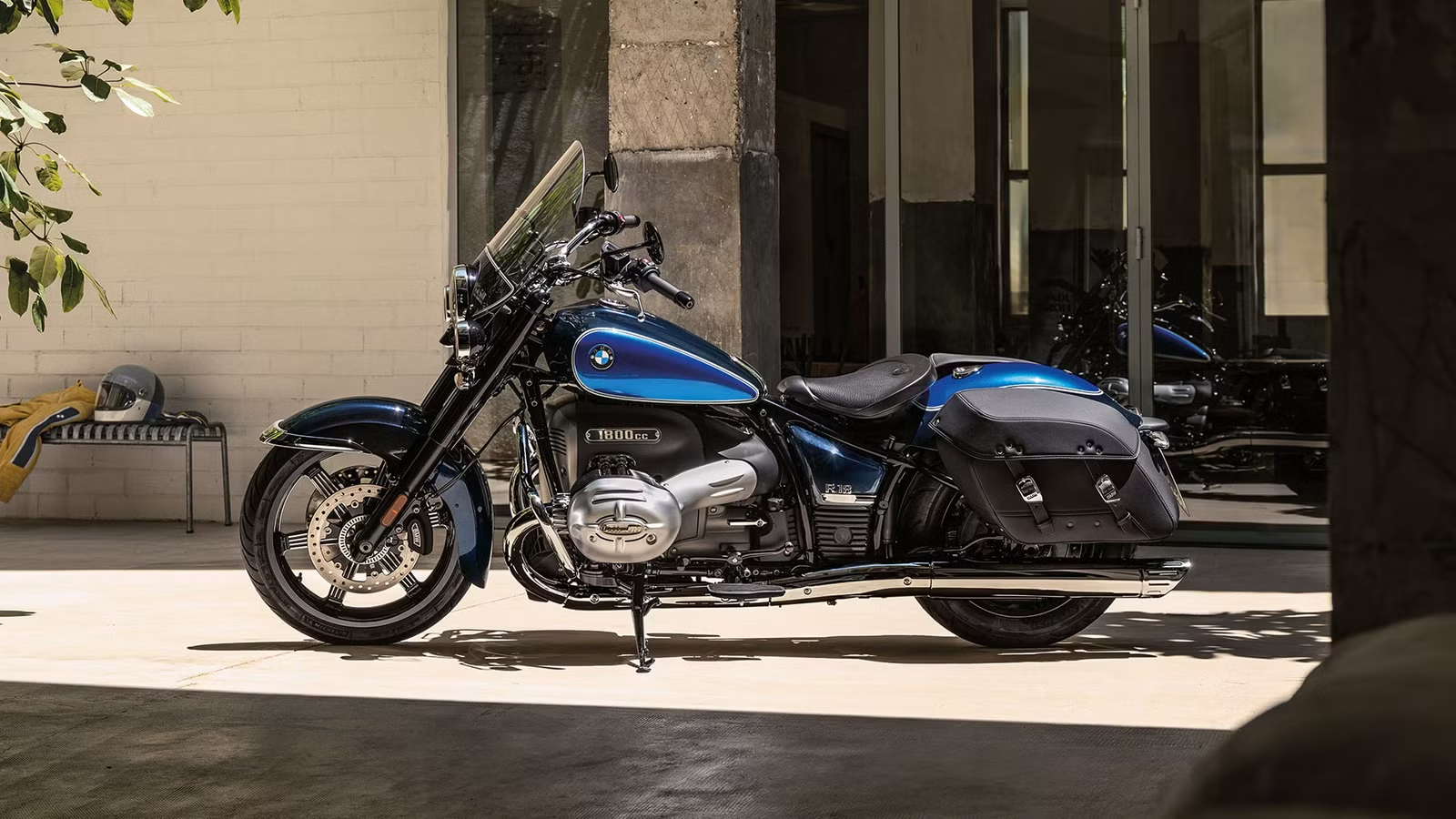
BMW’s half-yearly financial report, published August 3, 2026, contains a number that would have seemed unlikely a few years ago: the motorcycle division is now generating a higher profit margin than the automotive side. BMW Motorrad posted €230 million in profit for the first half of 2026, up 8.5% year-on-year, while the automotive division’s profit collapsed 45.6% — from €3,626 million to €1,974 million over the same period.

For riders, this isn’t just a corporate footnote. A leaner, more profitable motorcycle division signals sustained investment in the model pipeline, pricing discipline, and the kind of operational health that tends to produce better bikes rather than budget cuts. Here’s what the numbers actually mean.
Selling Fewer Bikes, Making More Money
BMW Motorrad delivered 102,847 motorcycles in the first half of 2026 — down 2.9% from 105,909 in the same period last year. Revenue slipped 3.3% to €1.71 billion. On paper, that looks like a modest retreat. But the profit line tells a different story.

The division’s EBIT margin expanded from 12.0% in H1 2025 to 13.5% in H1 2026. In Q2 alone, Motorrad hit a 15.2% margin — compared to just 2.3% for the automotive segment in the same quarter. The improvement didn’t come from selling more units. It came from a combination of pricing strength, a favorable model mix, optional equipment uptake, and tighter cost control: the cost of sales fell nearly 5% to €1.355 billion despite lower volume, and selling and administrative expenses dropped from €128 million to €120 million.
That’s a meaningful shift. BMW Motorrad didn’t need volume growth to become more profitable — it needed discipline, and the H1 numbers suggest it found it.
What’s Dragging the Automotive Side Down

The automotive division’s struggles are real and well-documented. China’s automotive retail market fell 30.2% in Q2 2026, and BMW’s exposure there is significant. Higher vehicle exports from China are also intensifying competition across Asia-Pacific, squeezing margins further. Tariffs added roughly 1.25 percentage points of margin pressure in Q2, and depreciation linked to BMW’s joint venture in China added another 1.2 points on top of that.
BMW still sells far more cars than bikes — 1,156,727 automotive units in H1 2026 versus 102,847 motorcycles — so the absolute profit figures aren’t comparable. But the trajectory is. The automotive division is fighting on multiple fronts simultaneously: China, tariffs, currency headwinds, and an accelerating EV transition. Motorcycles, by contrast, are operating in a smaller and more controllable market with modest capital requirements and a product mix that doesn’t depend on a single geography.
What Stronger Margins Mean for the 2027 Model Pipeline

A profitable motorcycle division is one that can fund its own future. BMW Motorrad has already been running a disciplined capital expenditure strategy — spending on motorcycle assets dropped from €64 million to €36 million half-on-half — which suggests the division is generating returns without heavy reinvestment pressure right now.
For riders eyeing the 2027 and 2028 model years, that financial health matters. Adventure variants built on the R 1300 GS platform, continued development of the S 1000 RR and M 1000 RR sport lineup, and whatever BMW Motorrad has planned for its mid-displacement segment all require a division that isn’t being raided to cover automotive losses. The H1 2026 numbers suggest Motorrad has the runway to keep those programs moving.
Pricing stability is the other side of the equation. BMW motorcycles have climbed steeply over the past decade — a rider who bought an RT in 2010 for around $19,000 out the door is looking at mid-$30,000 territory for a comparable bike today. A division with healthy margins and controlled costs has less pressure to push prices further just to maintain profitability.
How BMW Motorrad Stacks Up Against Honda and KTM

Honda is the most direct parallel here. Like BMW, Honda operates both automotive and motorcycle divisions under a single corporate umbrella, and its motorcycle business has similarly provided a cushion against automotive-side pressure. KTM is a different case — a pure-play motorcycle manufacturer that recently sold nearly 50,000 bikes in Q2 2026 alone, though questions remain about how much of that volume represents fresh demand versus older inventory moving through the channel.
BMW Motorrad’s advantage over both is margin quality. A 13.5% EBIT margin in H1 is strong for any motorcycle manufacturer, and the fact that it was achieved on slightly lower volume reinforces that the division’s pricing power is real. Against KTM’s volume-driven model and Honda’s sheer scale, BMW is playing a premium game — and the H1 results suggest that game is working.
BMW Group’s full-year 2026 guidance projects motorcycle EBIT margin in the 4–6% range — conservative relative to the 13.5% H1 figure, which suggests management is building in caution for the second half. But the first half shows what BMW Motorrad looks like when it’s running well: fewer bikes, better margins, and a division positioned to invest in the models riders actually want.

Related posts

Latest Post


No Comments