
Subaru’s First True Rally Weapon Wasn’t The Impreza WRX
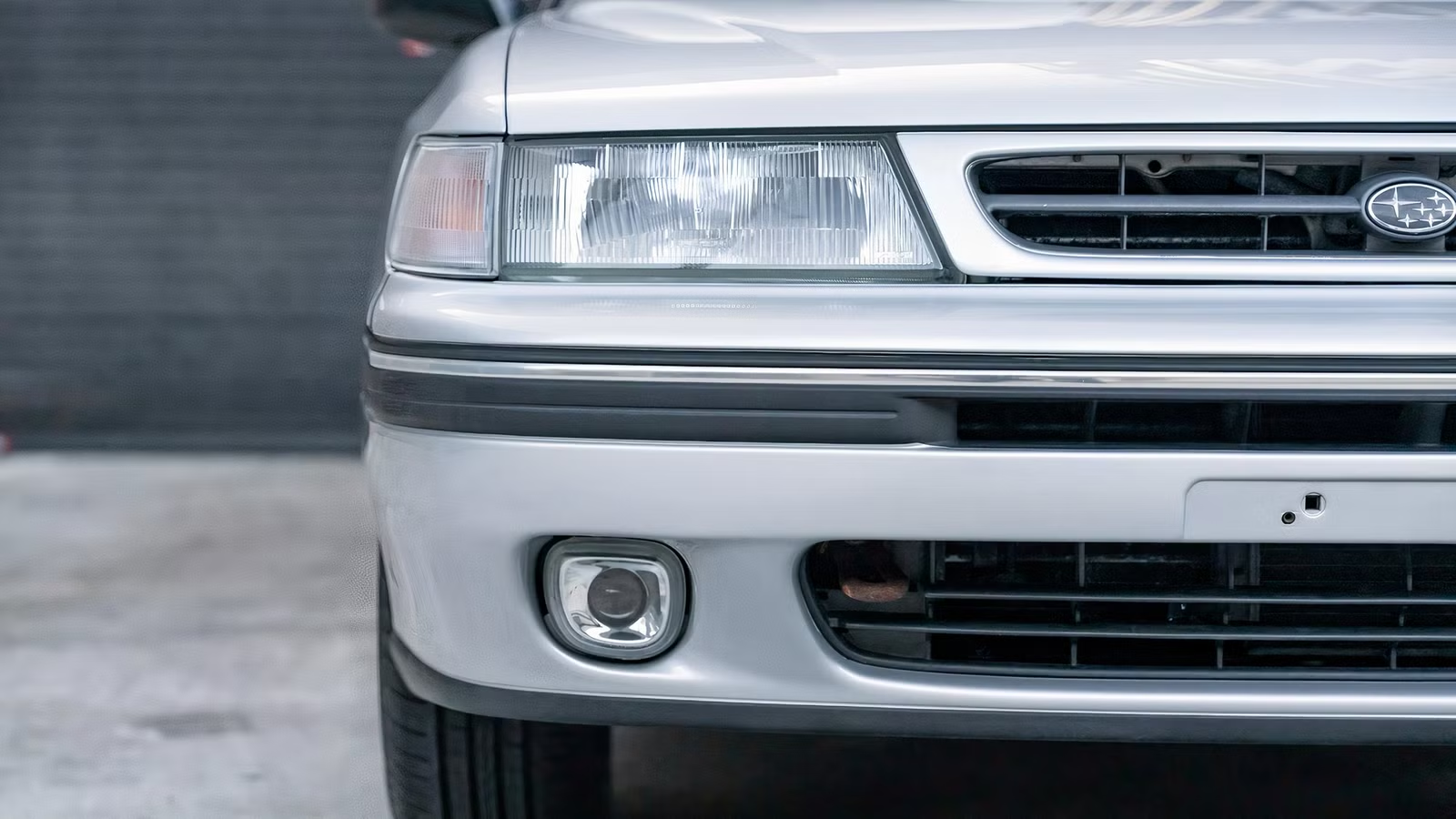
Rally racing is deeply intertwined with Subaru’s brand identity, and the car at the forefront of it all is the Impreza WRX. Nowadays, the WRX is a standalone model as opposed to a performance trim for the Impreza, from which it was separated starting with the model-year 2015. It no longer competes at the elite level in WRC, and the golden days with Colin McRae going flat-out when in doubt are but a distant memory. Nonetheless, the Impreza WRX will forever be remembered as a legend thanks to its past achievements, which reverberated throughout the rallying world during the nineties.
The Impreza WRX Will Forever Be Among The All-Time Greats

As you probably know, McRae’s reputation wasn’t built purely on his outstanding racing skills. It had just as much to do with him being a massive risk-taker, seemingly determined to either win or crash in spectacular fashion. He gave us plenty of memorable moments behind the wheel of his rally-prepped Impreza wearing that legendary blue and yellow 555 livery, but the most iconic of them all came in 1995. That’s the year when McRae famously won the World Rally Championship after a fierce rivalry and title battle with his teammate Carlos Sainz, which was only decided at the final round in the UK. This gave Subaru the first of its three manufacturers’ titles, as well as one of just as many drivers’ championships. The following two seasons ended with the Japanese brand topping the manufacturers’ standings yet again, and subsequent drivers’ titles were won with Richard Burns in 2001 and Petter Solberg in ‘03.
Subaru’s Rally Aspirations Predate The Impreza

Whereas the Impreza brought about Subaru’s glory days in WRC, an important stepping stone leading toward that success came a bit earlier on. It’s a chapter often forgotten by fans, despite being an essential prologue to the Impreza’s future achievements and giving Subaru its first round win. So that’s what we’re here to talk about today, because one cannot fully grasp the company’s rally identity without acknowledging the model that laid the groundwork for it all. And just like the Impreza, the car’s racing variants were developed in collaboration with racing specialists over at Prodrive in Banbury, England, with specific instructions provided to Subaru regarding technical blueprints and parts usage. Now then, let’s get straight into the nitty-gritty and see how an unassuming family sedan became a Group A weapon.

The Legacy RS Was A Sign Of Great Things To Come

Enter the Legacy RS, Subaru’s first serious attempt at becoming a feared contender for the WRC crown. It gave Colin McRae his maiden WRC victory at the 1993 Rally New Zealand, which also marked the inaugural win for Subaru and the first time a British driver won a World Rally event since 1976. Clearly, it was a pretty big deal, but the most exciting part for us regular folks was that FIA required each Group A vehicle to be homologated with 5,000 production copies during the first year at the time. This meant everyday buyers could walk onto the showroom floor and go home with a car closely connected to its race-spec counterpart — what a great time for a gearhead to be alive!
The first-gen Legacy RS debuted in 1989, powered by a two-liter EJ20G flat-four engine that made up to 217 horsepower on JDM variants. This turbocharged beast featured a closed-deck block engineered to withstand all that rally abuse, and it was coupled with a five-speed manual transmission sending power to a permanent all-wheel drive configuration. Export models had the same force-fed EJ-series mill, though they were slightly detuned to 197 ponies — still very respectable, but not quite at the same level as domestic Japanese variants. And even if the RS only managed a single event win in WRC before getting retired to make room for the Impreza WRX, its achievements went much further.
In 1989, it set the 100,000-kilometer FIA land endurance record with an average speed of 138.78 mph, an honor it still holds to this very day. The Legacy RS also dominated the British Rally Championship during the early nineties, taking three consecutive titles with two of them going to McRae and one to Richard Burns. But most importantly, it walked so that the later, more successful WRX could run, which makes it a vital part of Subaru’s racing history even if it doesn’t always get all the credit it deserves. Although the RS model’s rally career ended after McRae’s win in New Zealand, it remained available to the public as a production car while the Impreza took over its WRC duties, albeit revamped in its second generation from ’93 onward.
The engine became the EJ20H and was now kitted with twin sequential blowers to make turbo lag a thing of the past. Power output grew to 247 horses, and the second-gen RS could also be bought with a four-speed automatic gearbox besides the five-speed manual. Oomph rose yet again in 1996, reaching 276 hp with the manual while the engine code changed to EJ20R. And as for the automatic option, the twin-turbo powerplant was still known as EJ20H just as it had been since 1993, but the four-cylinder boxer was now capable of producing 256 ponies at its peak. What’s more, the Legacy performance lineup grew to encompass yet another cool variant in 1996.
Wagon Fans, Rejoice: The Subaru Legacy GT-B Is The Perfect Sleeper For You
Even though the Legacy could be had as a wagon since its debut, the beefed-up GT-B version came in ‘96 with premium Bilstein suspension and the same powertrain options as the RS sedan. It famously set the FIA speed record for turbocharged station wagons in 1998, reaching 270.532 km/h (168.1 mph) over a one-kilometer distance. That’s utterly bonkers for a car that looks like nothing more than a humble family hauler on the outside, making the Legacy GT-B a great sleeper with rally roots and tons of undercover potential. But whereas the Impreza WRX will nowadays command some serious dough at auction, the models that laid the foundation for its WRC success remain fairly cheap on today’s used car market.
Absolute Bargains, But Not Exactly Easy To Come By

As appealing as these old-school Legacy variants might be, though, you’ll have a pretty hard time getting your hands on one. You see, the Legacy RS was never sold in America and its GT-B cousin was a JDM-only model, so your best bet is importing one from abroad if you live stateside. U.S. customers did get a 2.2-liter turbo version called the Legacy Sport Sedan, but it made considerably less power at just 160 ponies. So if you’re after that rally-bred EJ20 goodness, you’ll want to keep an eye on listings from markets like Japan, Europe, or Australia and arrange to have it imported once you find one. That won’t exactly be straightforward, of course, yet your perseverance will likely be rewarded with something fantastic.
Used GT-Bs are generally priced below $10,000, while the RS variant is just a little pricier at $10,000–20,000. Now, compare that to the first-gen Impreza WRX with its $51,000 average price currently shown on Classic.com, and you can probably see what makes performance Legacy models so enticing. They give you a nice piece of that old-school WRC homologation heritage at a steep discount, which seems to justify all the hassle of getting them imported to the States. That’s up to you to decide, though; just be sure to give them some serious thought before you pull the trigger on an Impreza.
Sources: Subaru, Collecting Cars, Iconic Auctioneers, Classic.com

Related posts

Latest Post



No Comments