
Cadillac Is Killing Its 668-HP Manual Sedan — And There’s No Replacement Coming
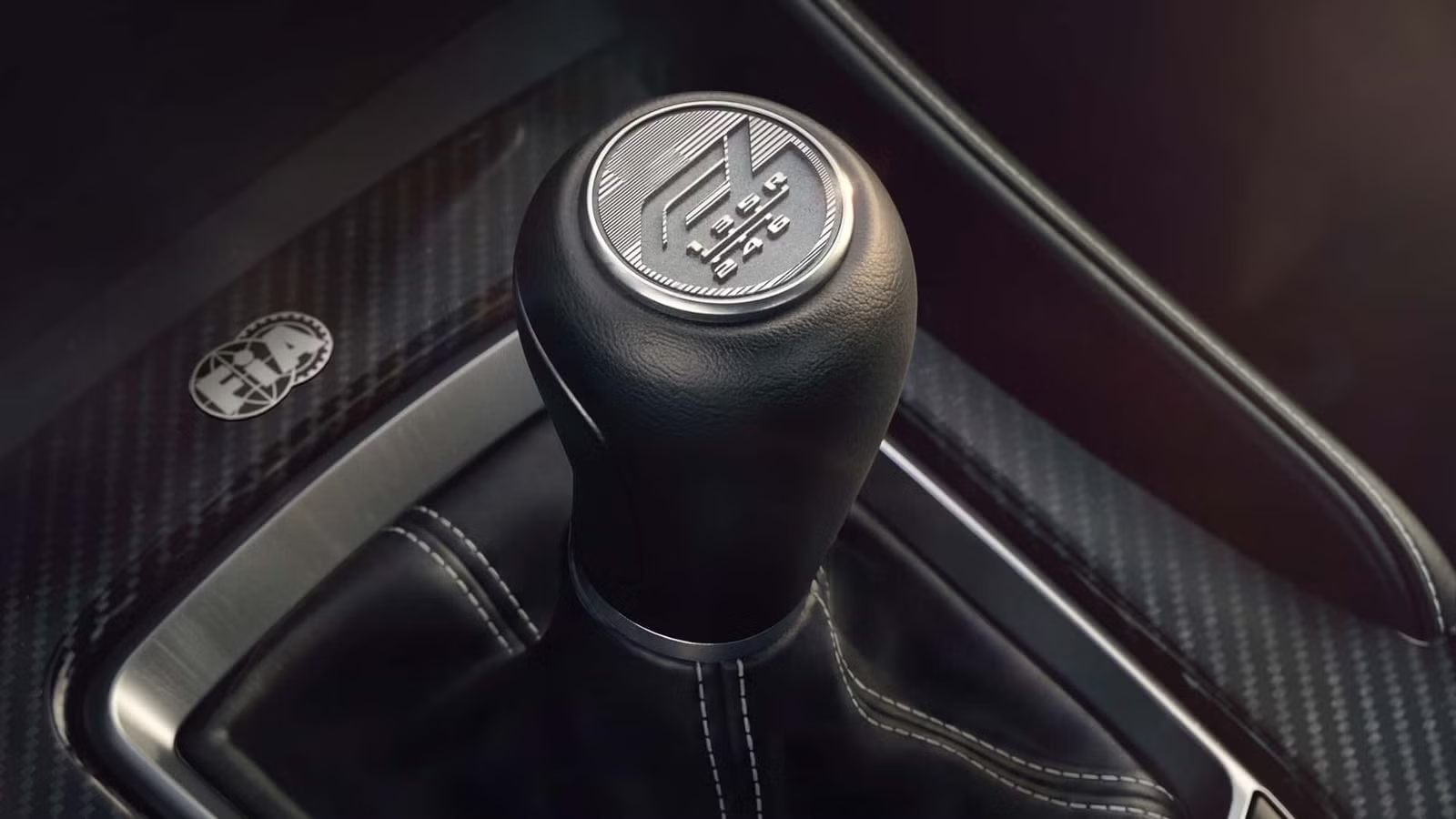
The clock is running out on one of America’s most singular performance cars. Cadillac has confirmed the CT5-V Blackwing ends production after the 2026 model year, and with only 64 manual-equipped examples sitting in U.S. dealer inventory right now, the window to buy one is closing fast. Prices range from $105,542 to $152,777 for those remaining stick-shift cars — a premium over the base $100,695 automatic — but for three-pedal devotees, the money is almost beside the point.

This isn’t simply the end of a trim level. The Blackwing’s departure marks the functional extinction of the manual V8 performance sedan in America. No successor has been confirmed, Cadillac’s trajectory is pointed firmly toward electrification, and the broader market is shedding manual options faster than most enthusiasts want to acknowledge. Once the last Blackwing rolls off the line, that particular recipe — supercharged V8, rear-wheel drive, six-speed manual, four doors — disappears from new-car showrooms entirely.
A Lineage That Traces Back to the CTS-V
The Blackwing didn’t arrive in a vacuum. Its roots go back to the original CTS-V, which established Cadillac as a genuine performance brand rather than a luxury nameplate coasting on heritage. The formula was consistent across generations: take a large-displacement GM V8, force-feed it with a supercharger, drop it into a rear-wheel-drive sedan, and offer a manual transmission for buyers willing to row their own gears.

The current CT5-V Blackwing represents the most refined version of that idea. Its supercharged 6.2-liter LT4 V8 produces 668 horsepower and 659 lb-ft of torque — figures that put it in legitimate supercar territory — while the six-speed manual keeps it honest in a way no paddle-shift system can replicate. The CTS-V Wagon, a related collector’s piece from 2011–2014 that produced fewer than 1,800 units, now commands $60,000 to over $90,000 at auction. The Blackwing manual, with its own limited inventory, seems destined for a similar trajectory.
After 2026, the Mustang GT Stands Alone

Strip away the Blackwing and the landscape for manual V8 buyers becomes remarkably sparse. The Ford Mustang GT will be the only manual V8 production car left in America — a distinction that would have seemed absurd even a decade ago. Dodge’s new Charger dropped the Hemi in favor of an inline-six or an electric powertrain; the only way to get a V8 under a new Charger’s hood is the track-only Hustle Stuff Drag Pak, which costs nearly $235,000, requires race fuel, and has no VIN for street use.
The manual-transmission retreat extends well beyond V8s. Several cars that offered stick shifts at the start of the 2026 model year won’t carry the option into 2027: the Volkswagen Jetta GLI, Honda Civic Si, and Acura Integra A-Spec are all dropping the manual. The Toyota Supra and its BMW Z4 sibling have already disappeared altogether. The segment isn’t contracting — it’s collapsing.
Why a Blackwing Successor Is Far From Guaranteed

Reports suggest a next-generation CT5-V Blackwing is being planned alongside the new CT5 platform, which GM CEO Mary Barra confirmed will begin launching in spring 2027 with production continuing into 2028. The next CT5 is expected to share its evolved Alpha 2 architecture with a potential Camaro revival and possibly a new Buick sedan.
But platform-sharing is where the optimism ends. There is no confirmation that a next-generation Blackwing would retain either the supercharged V8 or the manual transmission — and Cadillac’s broader push toward electrification makes both increasingly unlikely. GM is developing a new generation of V8 engines, which means the hardware exists in theory. If Chevrolet pairs that engine with a manual in a revived Camaro, Cadillac would at least have access to the right ingredients. Whether it chooses to use them in a performance sedan is a different question entirely — and right now, there’s no answer.
Six Months, 64 Cars, and a Hard Deadline

For buyers who’ve been watching the Blackwing from the sidelines, the math is stark. Sixty-four manual examples in stock nationwide, a confirmed end date, and no announced replacement. The enthusiast case for acting now is about as clear as it gets in the new-car market.
The broader context makes it sharper still. The V8 engine itself is in long-term decline across the industry — from 762 models offering V8 power in 1972 to a figure likely in the several dozens today. The manual transmission is on a parallel trajectory. The specific combination of the two, in a four-door luxury performance package, may genuinely be a once-in-a-generation proposition. When the last CT5-V Blackwing manual leaves a dealership lot, there is no scheduled replacement waiting in the wings. Enthusiasts have roughly six months to buy the last new manual V8 sedan America will ever build — and the clock is already running.

Related posts




Latest Post


No Comments