
The Rallye 350 Was The Cutlass Oldsmobile Fans Forgot To Defend
Few Oldsmobile nameplates carry the legacy of the Cutlass. While the Cutlass badge alone doesn’t stir the same excitement as names like GTO or Chevelle SS, it served as the foundation for some of Lansing’s finest Muscle Cars, most notably the iconic 442 W-30. For many enthusiasts, that’s where the story begins and ends. The 442 became the undisputed hero of the Cutlass family, and rightly so.

However, the 442 isn’t the only Cutlass worth remembering. The Rallye 350 should have shared the spotlight, but its humble “350” badge and polarizing styling left it forgotten in the 442’s shadow.
1970 Marked The Beginning Of The End For Detroit’s Horsepower Wars
By 1970, Detroit’s horsepower wars had reached their absolute zenith. Every automaker wanted the quickest quarter-mile time, the biggest V8, or the wildest headline, culminating in machines like the Dodge Charger Daytona breaking the 200-mph barrier on NASCAR superspeedways and big-block bruisers dominating stoplight battles across America.

Then came 1970, when reality caught up with Detroit. Insurance companies began hammering young buyers with steep premiums on big-block performance cars, while looming emissions rules and increasingly cautious executives started questioning the business case for ever-bigger V8s. Even buyers started putting their hard-earned money elsewhere, choosing cars that measured fuel economy in miles per gallon, not gallons per mile. Almost overnight, the industry turned against the big-block formula that had made muscle cars famous in the first place.
The 442 W-30 Was Oldsmobile’s Halo Car, But Lansing Knew Not Every Buyer Needed A 455

The 1970 model year gave us some of the greatest muscle cars ever built, but it also marked the genre’s last glorious stand. Few embodied that better than the Oldsmobile 442, which reached its peak after GM finally scrapped its self-imposed ban on engines larger than 400 cubic inches in intermediate cars. The new 455 V8 made 365 horsepower and a stump-pulling 500 lb-ft of torque, while the W-30 package raised output to 370 horsepower with Force-Air induction and other go-fast upgrades, cementing its place among the era’s finest muscle machines.
While the 442 W-30 represented the pinnacle of Lansing’s muscle car program, insurance companies, regulators, and corporate bean counters were all pushing Detroit away from big-block performance. The next great performance Oldsmobile couldn’t rely on cubic inches alone. It needed to look, sound, and drive like a true muscle car while fitting the new realities of 1970. So Oldsmobile went back to the Cutlass drawing board and built exactly that, only to discover buyers still had their hearts set on the 455.
1970 Oldsmobile Cutlass Rallye 350: Oldsmobile’s Smartest Performance Car That Fans Forgot To Defend

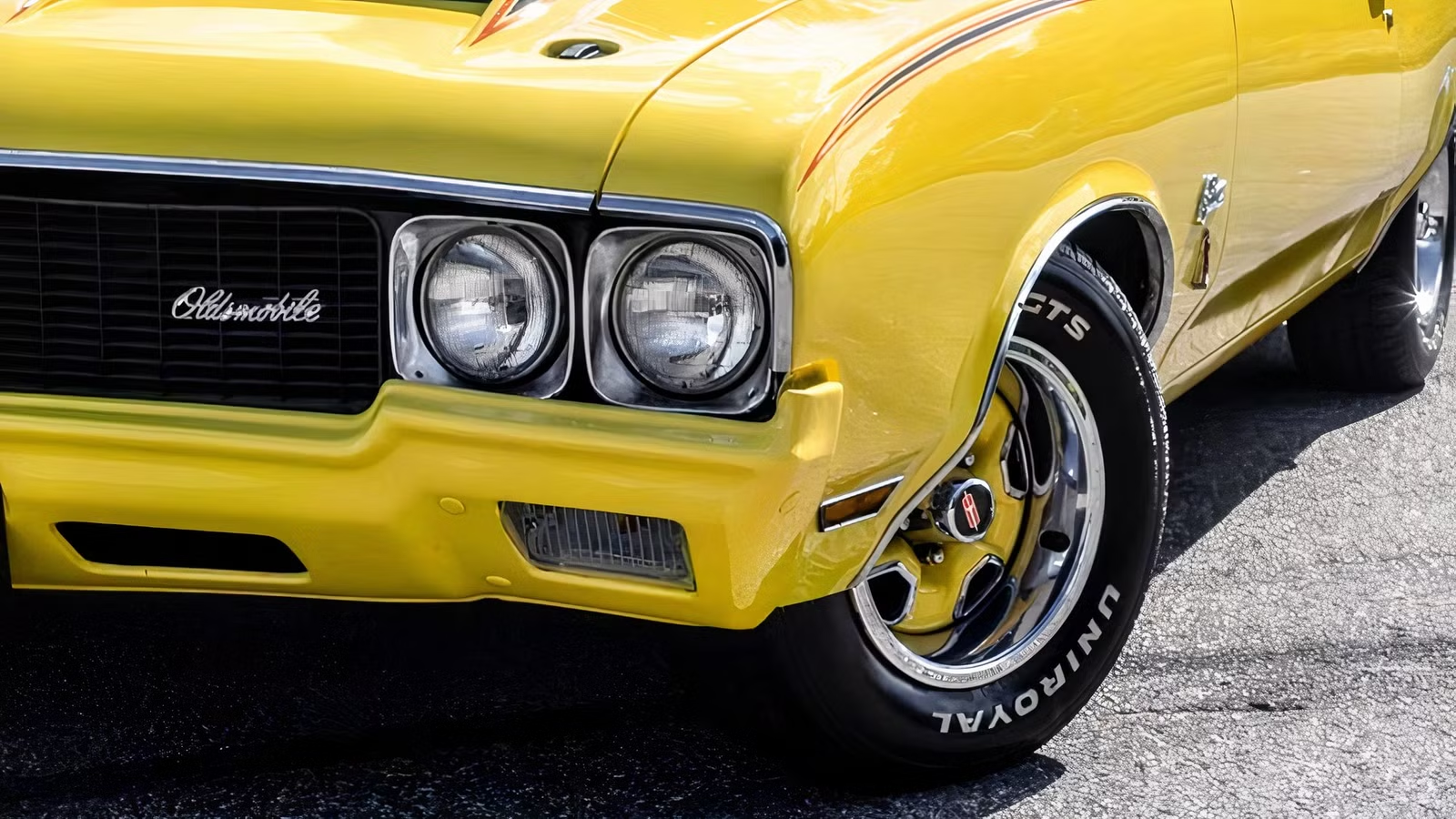
That car was the 1970 Oldsmobile Rallye 350, a mid-year, one-year-only model built around the idea that performance didn’t have to start with a big-block engine. Based on the Cutlass and available with the W-45 package, it paired a 310-hp Rocket 350 V8 with Force-Air induction, a fiberglass hood, Rallye suspension, and styling cues borrowed from the 442. Then came the part nobody could ignore: every Rallye 350 wore Sebring Yellow paint from nose to tail, including its color-keyed urethane bumpers and wheels.
The Rallye 350 was Oldsmobile’s attempt to deliver big-block attitude without the insurance headache. It was a clever response to a changing market, but buyers weren’t really feeling it. Most still wanted a gargantuan 455 under the hood, many hated the monochromatic styling, and as the muscle car market shifted beneath Detroit’s feet, the Rallye 350 quietly bowed out after just one model year.
The Rocket 350 Was The Heart Of The W-45 Package

When the Rallye 350 arrived, the old saying “there’s no replacement for displacement” was the law of the land. If the engine badge didn’t start with a four, many enthusiasts didn’t even bother taking a closer look. Oldsmobile knew a plain-Jane 350 wouldn’t cut it, so it made sure the Rallye’s 350 engine had the credentials to win over skeptics.
That engine was the Oldsmobile-exclusive L74 Rocket 350, not a generic GM small-block. Oldsmobile engineered it for effortless street performance, favoring big torque over sky-high revs. Its oversquare 4.057-inch bore and 3.385-inch stroke, combined with a hefty flywheel, helped produce 310 ponies and 390 lb-ft of torque, with peak twist arriving at just 3,200 rpm to deliver the immediate shove that buyers normally associated with larger engines. The Rocket 350 also had a 10.25:1 compression ratio, No. 6 cylinder heads, and a specially calibrated Rochester Quadrajet four-barrel carburetor that helped it become the most powerful naturally aspirated production version of Oldsmobile’s 350. Later smog-era Rocket engines would never quite match its output.

Lansing didn’t stop there. Standard Force-Air induction used the W25 fiberglass hood’s functional scoops to channel cooler air into a sealed intake system, while the engine itself was engineered for longevity. Thanks to a high-nickel block and oversized 2.5-inch main journals, the Rocket 350 earned a reputation for exceptional durability.
The W-45 package wasn’t all about the engine, though. Buyers also received the FE2 Rallye suspension, dual exhaust, rear spoiler, Super Stock II wheels, sport mirrors, custom steering wheel, and distinctive fiberglass hood, creating a package that gave the Cutlass genuine muscle car credentials.
Oldsmobile Went All-In On Sebring Yellow — Buyers Didn’t

The first thing that grabbed your attention about the Rallye 350 was the paint job. Every example left Lansing wearing Sebring Yellow, with matching urethane bumpers, painted wheels, and black-and-orange graphics that made it look louder than almost anything else on the road. In all fairness, Lansing wasn’t inventing a trend. High-impact colors and bold graphics were all the rage in 1970 as automakers fought for younger buyers. The problem was that the Rallye 350 crossed the line from bold to overwhelming.
Buyers thought it was too much. The monochromatic look proved too loud for many shoppers, and some dealers even removed the factory yellow bumpers in favor of chrome Cutlass units just to move inventory. Others added black vinyl roofs or bright trim to tone down the endless sea of yellow. Ironically, the styling that hurt sales in 1970 is one of the biggest reasons enthusiasts stop and stare at a Rallye 350 today.
The Rallye 350 Was Never Meant To Beat The 442 W-30

The Rallye 350 may have shared the Cutlass platform and targeted the same performance-minded buyers as the 442 W-30, but it was never intended to dethrone Oldsmobile’s halo car. Its 310-hp small-block punched well above its weight, but asking it to go head-to-head with a 370-hp 455 producing 500 lb-ft of torque was always going to be an unfair fight.
That gap became obvious in period road tests. Contemporary magazines recorded the Rallye 350 covering the quarter mile in 15.27 seconds at 94.3 mph, while a 1970 442 W-30 blasted through in the high-13-second range at over 100 mph. On the drag strip, there was no substitute for an extra 105 cubic inches and another 110 lb-ft of torque.
But comparing the two solely by elapsed times misses the point entirely. The Rallye 350 was a response to a changing market, targeted at enthusiasts who still wanted a proper muscle car but couldn’t justify the insurance premiums or ownership costs attached to a 455. Rather than replacing the 442, the Rallye 350 complemented it by proving that performance in 1970 didn’t necessarily require a big-block.
The Sales Numbers Show Why The Rallye 350 Became An Afterthought

Affordability was supposed to be the Rallye 350’s greatest advantage. With a base price of around $3,400, it delivered the looks and hardware of a serious muscle car without the financial sting of a fully optioned 442 W-30, which could climb beyond $4,500. For enthusiasts squeezed by rising insurance premiums, it should have been an easy choice.
The market had other ideas. Oldsmobile managed to sell only 3,547 Rallye 350s for 1970, remarkably close to the approximately 3,100 examples of the far more expensive 442 W-30 produced that year. Today, those numbers make the Rallye 350 a genuinely rare muscle car, but that wasn’t the plan. Buyers simply weren’t ready to embrace a small-block alternative, forcing Oldsmobile to abandon the experiment after a single model year.
Collectors Finally Appreciate What Buyers Missed In 1970

The Rallye 350 may have struggled to find buyers in 1970, but collectors have finally begun giving it the respect it deserved all along. As more enthusiasts learn about its one-year-only story, values have steadily climbed. Classic.com currently places the 1970 Rallye 350’s market benchmark at $40,029, while a beautifully restored example showing just 7,907 miles crossed the block at Mecum Indianapolis in May 2026 for $50,600, proving that savvy collectors are willing to pay a premium for exceptional cars.
Even so, the Rallye 350 remains one of the better bargains in the muscle car world. While the best 442 W-30s routinely command blue-chip, six-figure prices, the Rallye 350 offers much of the same Oldsmobile character, exclusivity, and period charm for a fraction of the cost. For collectors willing to look beyond cubic inches, it may be one of the smartest muscle car investments of the era.
The Rallye 350 Deserves More Than Life In The 442’s Shadow

The Rallye 350 deserved better than becoming the “other” performance Cutlass. It wasn’t a failed 442 W-30 or a consolation prize for buyers who couldn’t afford a 455. It was Oldsmobile’s clever answer to a rapidly changing muscle car market. The qualities that worked against it in 1970—a smaller 350, a lower price, and that unapologetic Sebring Yellow paint—are the very reasons enthusiasts celebrate it today.
More than 50 years later, collectors finally recognize what Oldsmobile was trying to achieve. It’s about time Oldsmobile fans gave the Rallye 350 the credit it earned but never received when it was new.
Sources: Hemmings, Classic.com, Mecum

Related posts

Latest Post


No Comments