
The Rare, Track-Ready Sports Car That Solidified 90s Performance
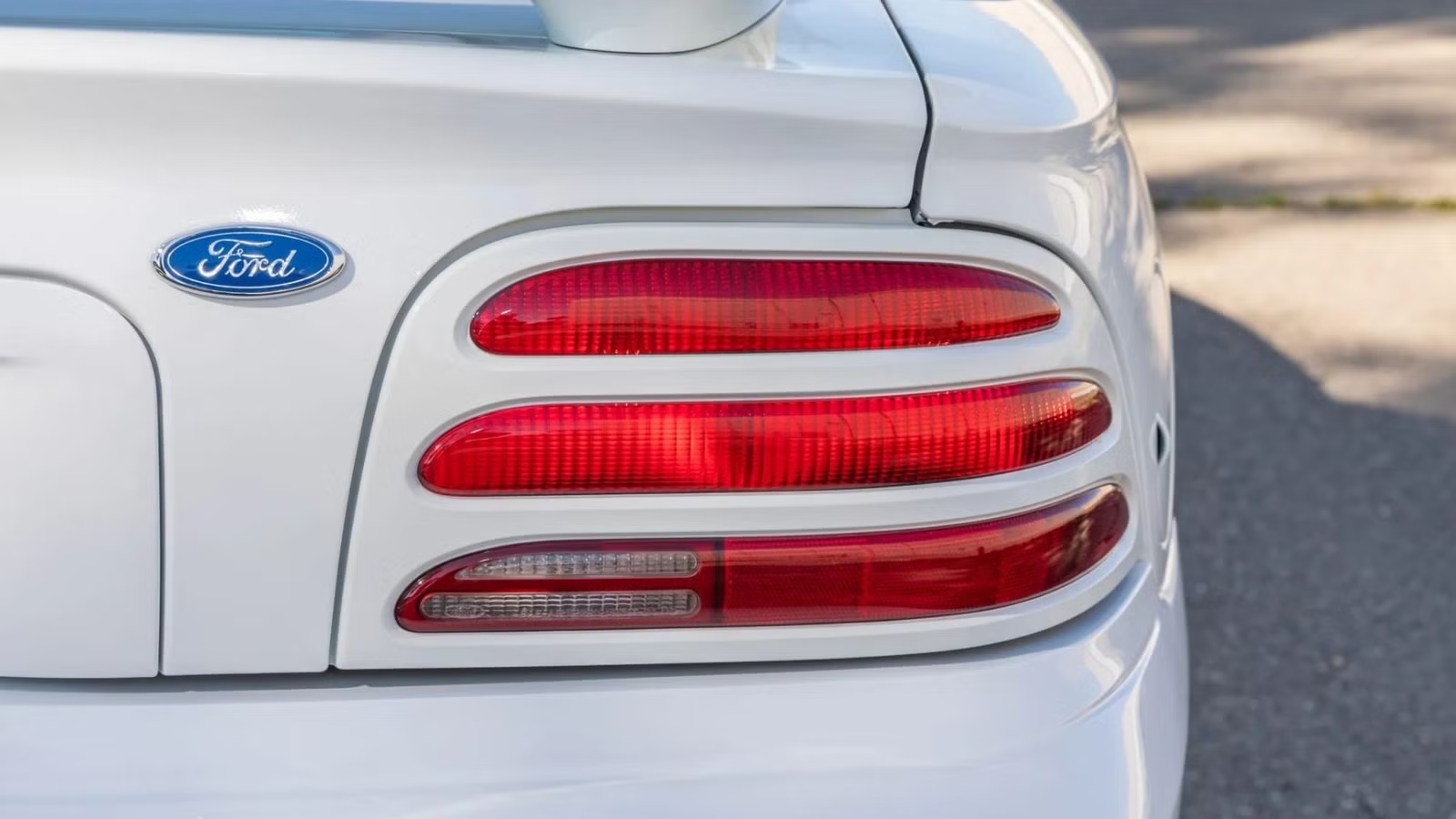
The age of the American muscle car has recently been shaken to its core. With the abandonment of the Dodge Challenger and Charger, the Chevrolet Camaro, and the untimely death of Pontiac in the late 2000s, what’s left? Sure, you have the Ford Mustang and the new Dodge Challenger Six Pack, but there’s no HEMI in it. At this juncture, there’s really only the Ford Mustang GT to speak of with its naturally aspirated 5.0-liter V8.

The Ford Mustang is the last bastion of a forgotten time that took its last breath in the mid to late 90s. Back then, building a track-ready muscle car required sacrifice. Stripped interiors, deleted creature comforts, all the things that make a car bearable, especially on a track, are gone. Ford, however, purpose-built a track weapon that wasn’t meant to sell to everybody, but for people serious enough to race it. Before we tell you what that is, let’s understand what it was developed into.
The Mid-90s Were A Strange Time For American Performance Cars
The early 90s were like the 70s all over again. There were stricter emissions regulations, insurance premiums were skyrocketing, and there was still a groan leftover from the malaise muscle car era of the 70s and 80s. The fourth-generation Ford Mustang came onto the scene after being what felt like abandoned for 15 years by Ford. Therefore, when the SN95 came into production, it was held under a microscope when it came to scrutiny. Many believed that the Mustang wasn’t the answer.
The Camaro Z28 Was Setting The Pace


Chevrolet really said, “hold my beer,” when they made the fourth-gen Z28, however, in 1993. It was powered by a small-block V-8 that just ran laps (literally and figuratively) around the Mustang GT. It was legitimately fast and left the Mustang in the dust, according to outlets at the time. Is it coming back for 2027, though? Here’s what the now iconic Z28 really had under the hood:
|
Powertrain |
NA 5.7-Liter V8 |
|---|---|
|
Horsepower |
275 hp |
|
Torque |
325 lb-ft |
|
Transmission |
6-speed manual or 4-speed automatic |
|
Drivetrain |
RWD |
|
0 to 60 MPH |
5.5 seconds |
Ford’s Standard Mustang GT Couldn’t Keep Up

Now, the Ford Mustang wasn’t ALL bad. It has the same size V8 that you can find in it today, just with much, much less horsepower. Compared to the Chevrolet Camaro, it really only had about 50 fewer horsepower, but with a stark difference in the zero to 60 MPH time, those fifty ponies really counted. Enthusiasts and Ford alike were embarrassed that they had been beaten at their own game and knew something had to be done.
|
Powertrain |
NA 5.0-Liter Windsor V8 |
|---|---|
|
Horsepower |
215 hp |
|
Torque |
285 lb-ft |
|
Transmission |
5-speed manual or 4-speed automatic |
|
Drivetrain |
RWD |
|
0 to 60 MPH |
6.7 seconds |
10 Muscle Cars And Sedans From The 2000s Worth Every Penny Today
These models from the 2000s represent the return of muscle to America – they are also relatively -affordable for now and well worth saving in 2025.
SVT Was The Team Ford Built To Answer The Problem

Sure, it could’ve been Shelby-a-fied, or they could’ve outsourced their precious product to Roush or someone else, but Ford knew they had to hoist themselves up by their bootstraps and do something themselves. That’s why they created a small, focused team of engineers with the authority, ability, and mandate to make something truly ferocious and to be wielded on the track.
A Small In-House Group With A Performance-Only Mindset

Their new philosophy was simple, but it wasn’t a new one: take what’s great and make it even better. Their budgets were rumored to be tighter and their creative know-how tested to the limit. They had to find performance gains through unsuspecting areas on the car, like suspension tuning or component upgrades, as opposed to a full overhaul of the vehicle itself. If Ford is excellent at one thing, it’s superb at listening to customer feedback to improve upon what they’ve already made.
The 1993 Cobra R Proved The Stripped-Down Formula Worked

In order to ensure that their first rendition of the Cobra R was actually driven, Ford made sure that every buyer wanting one had an active racing license. There were only 107 units built in Vibrant Red. There were huge upgrades like 13-inch front and 10.5-inch vented disc brakes, an upgraded radiator, a power steering cooler, and an engine oil cooler. Again, it wasn’t just a bump in power; it was a bump in overall track performance.
|
Powertrain |
5.0-liter Windsor V8 |
|---|---|
|
Horsepower |
235 hp |
|
Torque |
280 lb-ft |
|
Transmission |
5-speed manual |
|
Drivetrain |
RWD |
|
Notable Deletions |
A/C, rear seats, radio, and sound insulation |
1992 Chevrolet Camaro: A Look Back At The End Of A Generation
Unleashing power and style, the 1992 Camaro is a true ’90s icon. With bold looks and the legendary Z28 trim, it roars into muscle car history.
The 1995 Follow-Up Pushed The Concept Further

If the 1993 Cobra R was proof of concept, the 1995 iteration made a loud, uproarious statement. As stated earlier, Ford is great at feedback, and they listened to every critique, criticism, and highlight. One of the great qualities of the 1995 Ford Mustang Cobra R was that it mirrored that of its predecessor, the 1965 Shelby GT350R. It was still considered street legal and even came with safety equipment. To call it a halo car would mean it was untouchable. Ford wanted this thing to get down and dirty, and it did.
Stripped To The Frame For Pure Track Duty

1995 Ford Mustang SVT Cobra R interior
Bring a Trailer
Deletions on the Ford Mustang Cobra R were aplenty in the ’95 model as it was in the ’93, from the air conditioning, power windows, to the back seat, the stereo, and even the sound insulation (maybe bring some earplugs). They weren’t just extracted willy-nilly either. The fog lights, for example, were deleted to make way for air ducts for extra cooling of the large front disc brakes. There was even a large Kevlar 20-gallon fuel tank, as well as progressive-rate Eibach coil springs, adjustable struts, and a larger anti-roll bar.
A Racing License Was Required Just To Place An Order

1995 Ford Mustang SVT Cobra R rear shot
Just like the 1993 version, the 1995 Ford Mustang SVT Cobra R was required to be purchased with a racing license as well as proof that you were going to use it to compete in competitions like the NHRA or the IHRA. Ford not only said that this thing was made for the track, but they also meant it seriously, as much as they tried to keep it out of casual collectors’ hands, that’s where they ended up going. For the production, there were only 250 cars made in total. Ford knew that this was going to be another iconic model added to the collection of iconic Mustangs.
10 Cheap Sports Cars That Could Skyrocket In Value Soon
Now could be the best time to collect one of these performance cars while they are still reasonably priced and enjoy all the fun on offer.
Build Specs Typically Saved For A Race Car

1995 Ford Mustang SVT Cobra R side shot
Typically, when you go to buy a brand-new car, there’s a whole host of colors, interior trims, upholstery, and options to choose from. With the 1995 Ford Mustang Cobra R, there were only engineers’ wishes made on the car, and not so much for the product planner. There was nothing to speak of in terms of creature comforts, and you only had Crystal White and a cloth interior to choose from. The entire laundry list of modifications was sold at $13,699 on top of the MSRP. Ford stated that it was sold out in the matter of five days, which speaks volumes about their accomplishments.
The Specifications

While we have praised the SVT team for not just relying on a bigger engine for the 1993 model, they actually did make the engine bigger in the ’95. It received an engine as large as something seen from the 1970s, the 351 Windsor. To handle the torquey beast, there was a five-speed manual transmission with a limited-slip differential on the rear axle. There was also a fiberglass (a true mark of 90s cars) hood that was made larger to clear the massive rig.
|
Engine |
NA 5.8-liter V8 |
|---|---|
|
Horsepower |
300 hp |
|
Torque |
365 lb-ft |
|
Compression Ratio |
9:1 |
|
Drivetrain |
RWD |
|
0 to 60 MPH |
5.2 seconds |
A Rare Beauty And A Snarling Beast

1995 Ford Mustang SVT Cobra R wheel
According to Motor Trend, the Cobra R was seven mph faster and an entire second quicker in the quarter-mile in comparison with the regular Cobra. Ford capped the production of the 1995 Cobra R at 250 units in order to keep it special, exclusive, meaningful, and rare. The Cobra R currently has a value of anywhere between $35,000 and $60,000, depending on the condition, mileage, and how original it was kept. That goes to show that the 1995 Ford Mustang SVT Cobra R not only made a name for itself in the history books, but ultimately brought the brand back from the grave, from a reputation standpoint.
Sources: Ford, Classic.com, Motor Trend

Related posts



Latest Post


No Comments