
Best Of The Best: Greatest Mercedes S-Class Models Of All Time
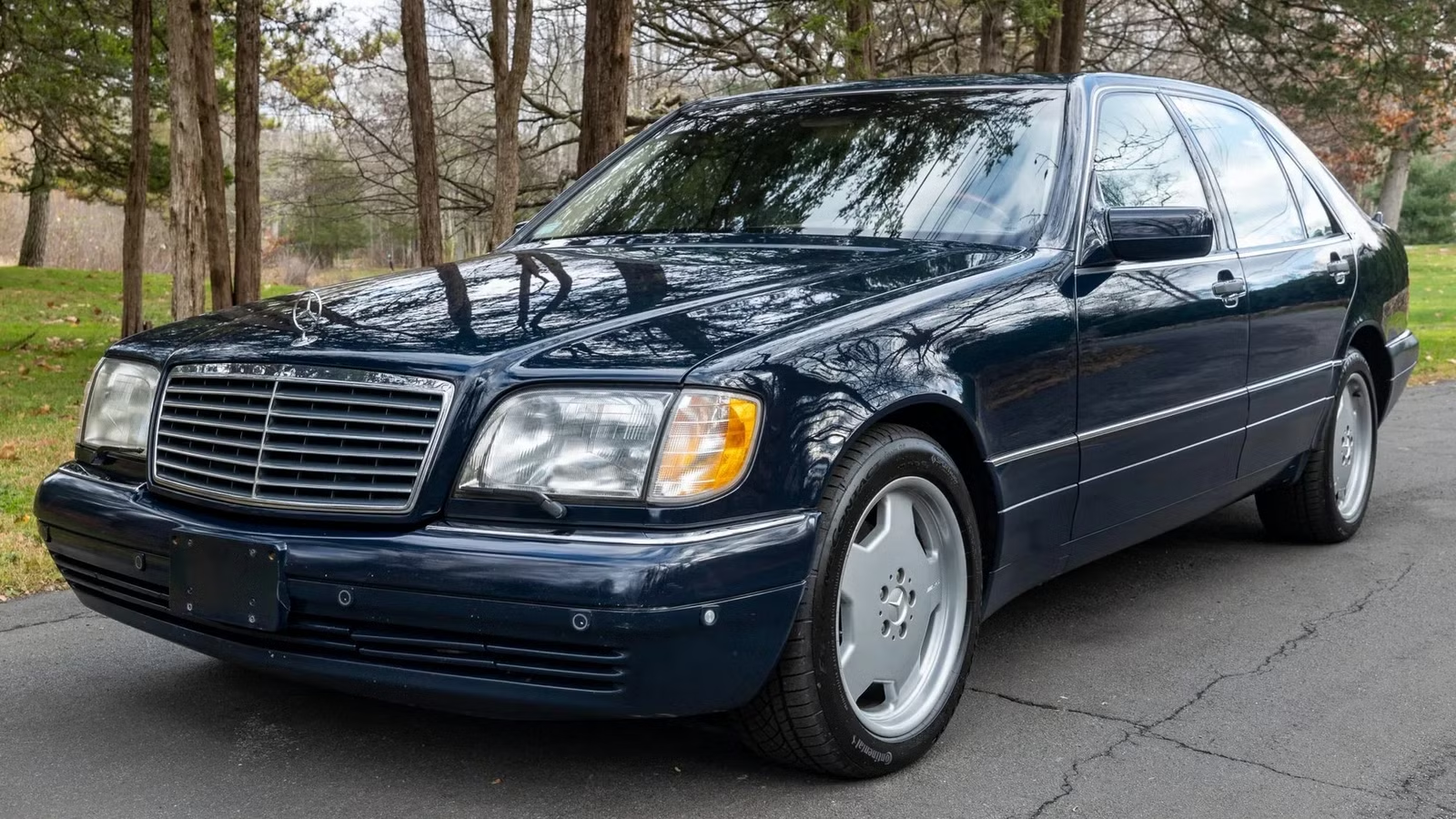
Few nameplates carry as much weight in the automotive world as the Mercedes S-Class. Decade after decade, it has defined what a luxury sedan can be — setting benchmarks in comfort, technology, and performance that rivals spend years trying to match. The name itself tells the whole story: “S-Class” is short for Sonderklasse, German for “special class” — a designation that signals something apart from the ordinary, not just within the competition but within Mercedes’ own lineup.

Although the origins of the Mercedes S-Class go back to the 1950s, the first chassis generation to carry the “S-Class” name debuted in 1972 with the W116 generation. Since then, seven distinct generations and dozens of individual models have carried the badge. Choosing the greatest among them is no small task — but we’ve done our best to identify the S-Class models that truly earned their place in history. Here’s the breakdown of which models made the cut and why.
1977 Mercedes-Benz 450 SEL 6.9
Horsepower: 250 hp
The first S-Class on our list is the ultimate performance variant of the first W116 generation, the 1977 Mercedes-Benz 450 SEL 6.9.
1977 Mercedes-Benz 450 SEL 6.9 Performance Specifications
 50 autotech Engine |
6.8-liter V-8 |
|
Transmission |
3-speed automatic |
|
Horsepower |
250 horsepower |
|
Torque |
360 lb.ft |
|
Driveline |
RWD |
|
0-60 MPH |
7.4 seconds |
|
Top Speed |
140 mph |
The 450 SEL 6.9 — marketed in the U.S. simply as the Mercedes-Benz 6.9 — was an unapologetic statement of confidence from the German brand, featuring the largest post-war Mercedes engine ever fitted to a production car at its debut. The 6.8-liter M100 V-8 delivered performance that was genuinely extraordinary for its era. Alongside that remarkable engine, the 6.9 also introduced hydropneumatic suspension, a novel feature that would soon become standard equipment on long-wheelbase S-Class models.
The 6.9 also gained the first modern ABS system from 1978 onward — a true pioneer that set the stage for future S-Class greatness. Only about 1,800 examples ever reached the U.S. market, and collector prices have climbed steadily for years. Expect to pay a significant premium for a well-sorted example today — it’s worth it.
1984 Mercedes-Benz 500SEL
Horsepower: 228 hp

Moving forward to the First Series (1979–1985) of the W126 generation, we have one of the finest S-Class models ever made: the 1984 Mercedes-Benz 500SEL.
1984 Mercedes-Benz 500SEL Performance Specifications
|
Engine |
5.0-liter V-8 |
|
Transmission |
4-speed automatic |
|
Horsepower |
228 horsepower |
|
Torque |
299 lb.ft |
|
Driveline |
RWD |
|
0-60 MPH |
8.0 seconds |
|
Top Speed |
130 mph |
Although there was no true successor to the final-boss status of the Mercedes-Benz 6.9, the 5.0-liter V-8-powered 500 model offered comparable performance and was far more accessible than the low-production 6.9. This V-8 was still significantly strangled by emissions regulations in the U.S., yet it remained meaningfully better than the underwhelming 3.8-liter unit found in the 380 model.
1990 Mercedes-Benz 560SEL
Horsepower: 238 hp

Next on our list is the standout entry from the Second Series (1986–1991) of the W126 generation: the 1990 Mercedes-Benz 560SEL.
1990 Mercedes-Benz 560SEL Performance Specifications
|
Engine |
5.5-liter V-8 |
|
Transmission |
4-speed automatic |
|
Horsepower |
238 horsepower |
|
Torque |
287 lb.ft |
|
Driveline |
RWD |
|
0-60 MPH |
7.0 seconds |
|
Top Speed |
150 mph |
Despite also being constrained by emissions regulations, the all-new 5.5-liter V-8 still delivered better performance than the 500 model it succeeded — and was officially quicker than the high-performing 6.9 that had set the S-Class benchmark years earlier.
The hydropneumatic suspension also received its third revision in the Second Series, though it was plagued by unreliability and steep maintenance costs, leading many owners to swap it for the standard setup. Despite this, the W126 generation remains the most successful S-Class ever built, with the longest production run of any S-Class generation — 892,123 units over 12 years.
1997 Mercedes-Benz S600
Horsepower: 389 hp

Following the W126 generation came the W140 (1992–1999), which introduced the first V-12-powered S-Class: the S600.
Performance Specifications
|
Engine |
6.0-liter V-12 |
|
Transmission |
5-speed automatic |
|
Horsepower |
389 horsepower |
|
Torque |
420 lb.ft |
|
Driveline |
RWD |
|
0-60 MPH |
6.5 seconds |
|
Top Speed |
155 mph (limited) |
The S600’s 6.0-liter V-12 was developed in direct response to BMW’s 5.0-liter V-12 offered in the S-Class’s German rival, the 7 Series — and it marked the opening salvo in what would become a full-blown horsepower war. Mercedes landed the first decisive blow: the M120 V-12 comprehensively outperformed BMW’s unit, producing substantially more power from only a modest displacement advantage. Even in its detuned state — full power was only available for the 1992 model year — it remained the clear winner in the battle for German performance engineering supremacy.
2005 Mercedes-Benz S55 AMG
Horsepower: 493 hp

With the W220 generation, Mercedes officially entered an era of pure flamboyance and excess, driven in no small part by AMG.
2005 Mercedes-Benz S55 AMG Performance Specifications
|
Engine |
5.4-liter supercharged V-8 |
|
Transmission |
5-speed automatic |
|
Horsepower |
493 horsepower |
|
Torque |
516 lb.ft |
|
Driveline |
RWD |
|
0-60 MPH |
4.6 seconds |
|
Top Speed |
155 mph (limited) |
Despite the W220 being slightly smaller than its predecessor, the S-Class was more powerful than ever — even in variants that weren’t considered top-trim models. The S55 AMG delivered performance figures that felt almost too outrageous for a car as distinguished as the S-Class, courtesy of its supercharged V-8.
Yet the S55 AMG was a genuine all-around performer, because the Active Body Control hydropneumatic suspension came standard. This system works brilliantly — though, as expected, it is very expensive to maintain, even compared with the Airmatic suspension offered elsewhere in the same generation.
2006 Mercedes-Benz S65 AMG
Horsepower: 604 hp

Just when you thought the W220 couldn’t get any more absurd, the generation went out with a bang in the form of the S65 AMG.
2006 Mercedes-Benz S65 AMG Performance Specifications
|
Engine |
6.0-liter twin-turbo V-12 |
|
Transmission |
5-speed automatic |
|
Horsepower |
604 horsepower |
|
Torque |
738 lb.ft |
|
Driveline |
RWD |
|
0-60 MPH |
4.2 seconds |
|
Top Speed |
155 mph (limited) |
Produced for only two years, this twin-turbo V-12 Mercedes was by far the most powerful S-Class ever built at the time. The S65 AMG held the title of most powerful four-door sedan in the world for nearly a decade, until a 707-horsepower Dodge came along to claim it. As far as big, bad engines in S-Class sedans go, the S65 AMG’s extraordinary powerplant is entirely befitting of its $170,000-plus MSRP — and the mere thought of pointing one down an unrestricted stretch of Autobahn is enough to quicken the pulse.
2008 Mercedes-Benz S63 AMG
Horsepower: 518 hp
Next came the W221 generation of the S-Class (2007–2013), which arrived at a pivotal moment for Mercedes’ entire vehicle lineup.
2008 Mercedes-Benz S63 AMG Performance Specifications
|
Engine |
6.2-liter V-8 |
|
Transmission |
5-speed automatic |
|
Horsepower |
518 horsepower |
|
Torque |
465 lb.ft |
|
Driveline |
RWD |
|
0-60 MPH |
4.6 seconds |
|
Top Speed |
155 mph (limited) |
The 2006 to 2010 S63 AMG models would be the last time a naturally aspirated AMG-tuned V-8 was offered in the S-Class. Bittersweet as that may be, the 6.2-liter M156 V-8 was a legendary send-off to the naturally aspirated V-8 platform and remains one of AMG’s finest engines to this day. The more powerful and expensive S65 AMG carried over into this generation largely unchanged from the previous iteration — which makes the pre-facelift S63 AMG the most compelling W221 choice, even if it wasn’t the range-topper.
2015 Mercedes-Benz S63 AMG 4MATIC
Horsepower: 577 hp
The W222 generation is widely regarded as a return to form for the S-Class, and the S63 AMG variant stands as one of its finest expressions.
2015 Mercedes-Benz S63 AMG 4MATIC Performance Specifications
|
Engine |
5.5-liter twin-turbo V-8 |
|
Transmission |
7-speed automatic |
|
Horsepower |
577 horsepower |
|
Torque |
644 lb.ft |
|
Driveline |
AWD |
|
0-60 MPH |
3.8 seconds |
|
Top Speed |
186 mph (limited) |
Despite having two fewer cylinders and less displacement, the S63 AMG managed to surpass the twin-turbo V-12-powered S600 of the same generation in power, torque, and fuel efficiency. The exhaust note may not have carried the same drama as before, but the performance was well beyond what its naturally aspirated predecessor could muster. Were it not for the occasionally temperamental seven-speed automatic, the W222 S63 AMG would be a near-perfect modern S-Class.
2019 Mercedes-AMG S63 4MATIC
Horsepower: 603 hp

In 2018, the W222 generation received a substantial mid-cycle refresh that brought a revised engine range to the S-Class lineup.
Performance Specifications
|
Engine |
4.0-liter twin-turbo V-8 |
|
Transmission |
9-speed automatic |
|
Horsepower |
603 horsepower |
|
Torque |
644 lb.ft |
|
Driveline |
AWD |
|
0-60 MPH |
3.5 seconds |
|
Top Speed |
186 mph (limited) |
The S63 AMG became the sole AMG V-8 option for the remainder of the W222 generation, now powered by a 4.0-liter twin-turbo V-8. Despite its smaller displacement, this engine produced more power and greater efficiency than its predecessor. The nine-speed automatic transmission was a welcome improvement over the seven-speed unit it replaced — one of the pre-facelift W222’s most frequently cited weaknesses.
2023 Mercedes-AMG S63 E Performance
Horsepower: 791 hp

We thought AMG had reached its ceiling when it built a twin-turbo V-12 producing over 700 pound-feet of torque — but the W223 generation represents an entirely new dimension of Mercedes performance.
2023 Mercedes-AMG S63 E Performance Performance Specifications
|
Engine |
4.0-liter twin-turbocharged V-8 + electric motor |
|
Transmission |
9-speed automatic |
|
Horsepower |
791 horsepower |
|
Torque |
1,055 lb.ft |
|
Driveline |
AWD |
|
0-60 MPH |
3.2 seconds |
|
Top Speed |
155 mph (limited) |
Yes, it’s true: the highest-performance S-Class is now a plug-in hybrid — but one that generates 1,055 pound-feet of torque and delivers instant response thanks to its combined electric motor and combustion powertrain. Should a car designed to serve as a chauffeur-driven limousine really be this powerful or this entertaining to drive? Probably not — but at over $170,000, “unreasonable” isn’t the exception. It’s the standard.
If the Mercedes-AMG S63 E Performance tells us anything, it’s that the S-Class may have evolved dramatically over the decades, but the world’s ultimate luxury sedan has never stopped pushing the boundaries of what a four-door vehicle can be.
Sources: Mercedes-Benz, Bring-a-Trailer

Related posts

Latest Post


No Comments