
The Only 426 Hemi-Powered Pickup Truck Ever Is A Rare Monster
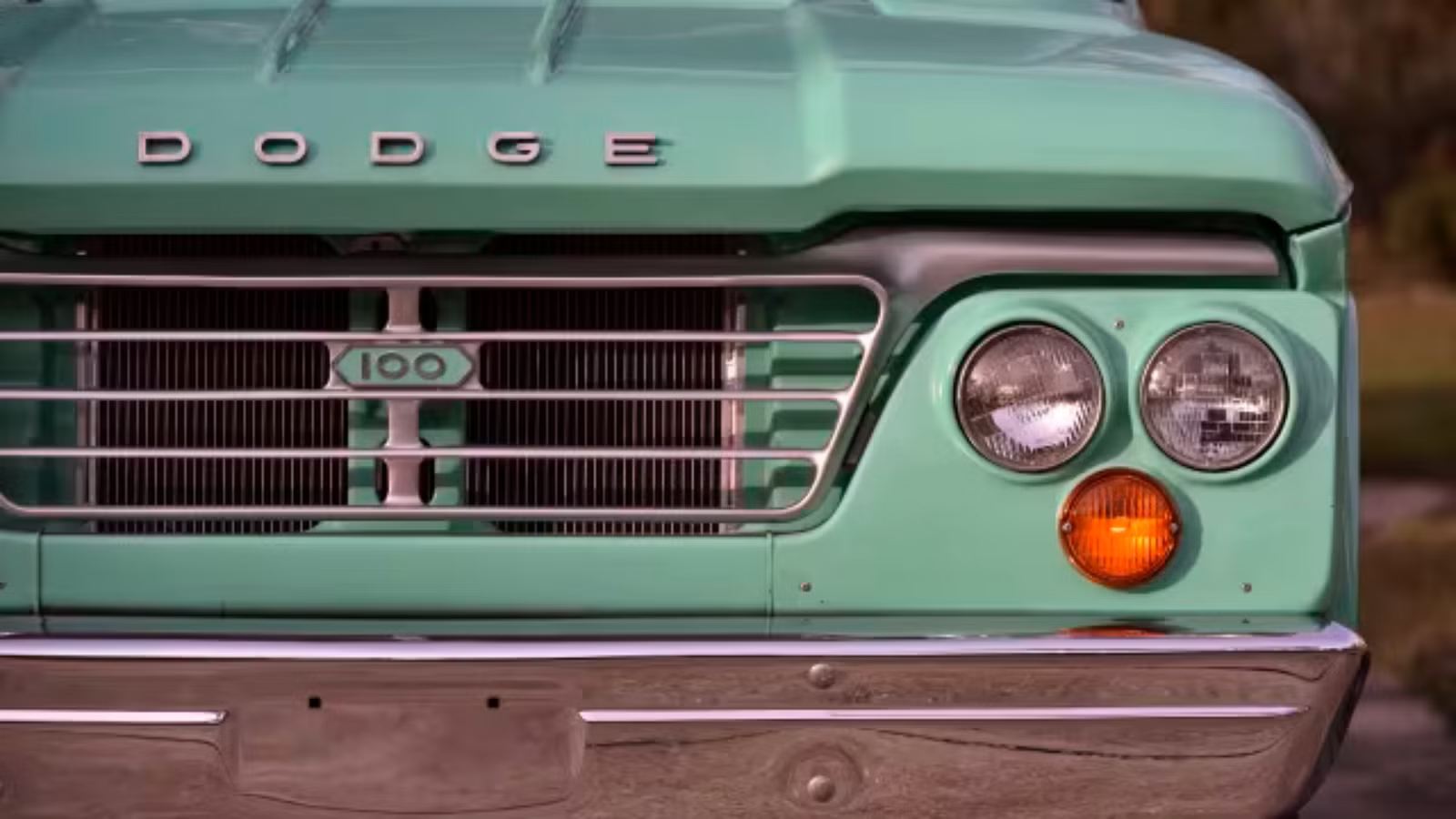
Few automotive legends are born in a factory truck bay — but that’s exactly where this one started. Dodge has always had a talent for breaking its own rules, and nowhere is that more apparent than in the story of a certain 1964 pickup that left the plant with something no production truck had any business carrying under its hood. It wasn’t built for hauling lumber or towing a trailer. It was built to embarrass sports cars at the dragstrip and leave onlookers questioning everything they thought they knew about pickup trucks.

What follows is the story of one such machine. It was part muscle car, part workhorse, and all outlaw energy. Built for the strip but disguised as something else entirely. Here’s the story of the only Hemi-powered pickup truck to ever roll out of the factory.
The Only Factory 426 HEMI Truck Ever Built: Meet the 1964 Dodge D100 That Broke All The Rules

You might think the NASCAR-bred 426 HEMI was only reserved for Chargers, Road Runners, Super Bees, or winged Daytonas. But in 1964, Dodge did something that even Mopar purists still argue about. Chrysler quietly dropped the infamous “Elephant Engine” into a Dodge pickup truck. No fanfare. No press release. Just raw, street-legal fury wrapped in steel.
Enter the 1964 Dodge D100 “HEMI” Custom Sports Special — the only known production pickup ever built at the factory with a 426 Street HEMI under the hood. According to Hot Rod, this 426 HEMI-powered pickup wasn’t a catalog option. You couldn’t just walk into a dealership and tick a box labeled “426.” Instead, Dodge funneled the engine into trucks through a backdoor special-order process intended for drag racers and insiders who knew how to work the system.
Why did it happen? According to Mac’s Motor City Garage, by the mid-’60s, Dodge was throwing everything it had at the NHRA and NASCAR scenes. The HEMI had already made a name for itself on the track, and the company wanted to extend that dominance wherever possible — even if it meant slipping the engine into a lightweight truck chassis for maximum shock value at the strip.
As for how many were made? That’s part of the legend. According to Classic Industries, the Custom Sports Special (CSS) package trim was available from 1964 to 1967. However, the 426 Street HEMI option was limited to special-order channels. Most historians estimate that fewer than 50 units were built, and only about 11 to 30 have ever been confirmed by VIN and factory documentation. It’s possible that as few as a dozen ever reached customers’ hands, making it one of the rarest HEMI-powered vehicles Dodge ever produced.
And the specs? They’re just as brutal as you’d expect. The 426 Street HEMI produced 425 horsepower and 490 lb-ft of torque, breathing through dual four-barrel Carter AFB carburetors and backed by either a 727 TorqueFlite automatic or a 4-speed manual. Drop that into a short-wheelbase, rear-wheel-drive truck weighing under 4,000 pounds, and you had a burnout machine capable of drag racing straight from the loading dock, according to Allpar.
The 1964 Dodge D100 “HEMI” Custom Sports Special wasn’t just a pickup. It was a statement — and one Dodge never made again.
Why Dodge Never Built Another 426 HEMI Pickup Truck Again
There’s no question: the 1964 Dodge D100 “HEMI” Custom Sports Special was a wild swing. A bold experiment, if you will. It was a factory-built pickup with the heart of a muscle car. That kind of move doesn’t just happen by accident. It was Dodge at full send — epic, without a doubt. So why was this a one-off? After taking such a bold stance, why did the company never offer the 426 Street HEMI in a production pickup ever again?
Several factors contributed to Dodge’s decision to abandon the 426 HEMI pickup concept.
First, the 426 HEMI was expensive to produce and maintain. It was engineered for racing, not for everyday driving or hauling loads. The engine’s high compression ratio and dual four-barrel carburetors made it poorly suited to typical truck use.
Second, the mid-1960s brought rising insurance premiums for high-performance vehicles, along with growing pressure around emissions and fuel economy. Trucks were primarily seen as work vehicles, and a fire-breathing engine like the 426 HEMI didn’t fit that mold.
Finally, shoehorning the HEMI into the D100 demanded extensive modifications — custom brackets, plus significant changes to the frame and firewall. That level of hand-built customization simply wasn’t viable for any kind of volume production.
As a result, Dodge shifted its focus to more practical and cost-effective engine options for its trucks. While the brand continued to produce performance-oriented pickups in later years, none would ever feature the 426 HEMI again. The 1964 Dodge D100 “HEMI” Custom Sports Special remains a singular, irreplaceable artifact of Dodge’s muscle car era experimentation.
Hunting A Classic D100? Here’s What A 1964 Dodge Pickup Costs Today
Alright, now that we’re done marveling at the awesome science experiment that is the 1964 Dodge D100 “HEMI” Custom Sports Special, it’s time for a reality check.
With fewer than 50 ever built and only about 11–30 confirmed by VIN, these factory freaks are unicorns. They rarely hit the open market, and when they do, prices easily soar into six figures. So if you’re dreaming of owning a 1964 Dodge D100 “HEMI” Custom Sports Special, you’d better have deep pockets and even deeper connections.
That’s the bad news. But hold on — there is a silver lining. If you love the look of the D100, there are still plenty of classic 1964 examples out there, and they’re far more attainable.
Back in the day, a base-model D100 carried an MSRP of around $2,036, according to J.D. Power. Today, you’ll pay considerably more — though perhaps not as much as you’d fear. Per Classic.com, the average auction price of a 1964 Dodge D Series has hovered around $27,000, though market values shift regularly and current listings should always be checked.
|
Average Auction Price |
$27,117 |
|
Top Sale |
$40,100 |
|
Lowest Sale |
$17,050 |
(Source: Classic.com)
So, while the HEMI-powered D100 is a rare beast, the standard 1964 D100 offers a genuine slice of Mopar history without breaking the bank. Whether you’re after a restoration project or a weekend cruiser, the D100 is a solid choice for classic truck enthusiasts.
Not Just A Workhorse: D-Series Oddballs Worth Collecting
The D100 “HEMI” may be the mythmaker, but it’s not the only Dodge D-Series deserving of a shout-out. Dodge has a long history of sneaking wild ideas into its truck lineup — some experiments were style-forward, others were pure performance sleepers, and a few, somehow, managed to be both.
If you’re hunting for rare Mopar iron, these two D-Series oddballs are absolutely worth keeping on your radar.
A D-Series Oddball: Meet The 1970–1971 Dodge D100 “Dude”
Yep. The Dude was real, man. Long before Jeff Bridges made it iconic, Dodge released a limited-edition trim package for the D100 aimed at younger buyers looking for something with a little swagger.
Sporting a two-tone paint job, “The Dude” came with decals on the bed, bucket seats, and a tailgate that proudly shouted its name. This was decidedly not your granddad’s farm truck.
Under the hood, buyers could spec a Slant-Six or step up to a V8 with the 318 or 383. It was less about outright horsepower than attitude. With production estimates hovering around 1,500 to 2,000 units, it’s one of the rarest nameplates Dodge ever put on a truck — and today it’s a cult classic with serious retro appeal.
A D-Series Oddball: Meet The 1978–1979 Dodge D150 “Lil’ Red Express”
The Lil’ Red Express wasn’t just flashy. It was fast. According to Hemmings, in 1978 it was the quickest American-made vehicle from 0 to 100 mph. Take a minute to let that sink in.
Built during an era when emissions regulations strangled most muscle cars, Dodge found a loophole by classifying the truck as a “commercial vehicle.” That designation meant no catalytic converters, fewer emissions restrictions, and the freedom to install a high-output 360 V8 producing 225 horsepower, backed by a 727 TorqueFlite transmission, chrome exhaust stacks, and a 3.55 rear axle. Per Hot Rod, it ran the quarter-mile in the high 15s — quicker than a Corvette of the same year.
Only 2,188 units were produced in 1978 and 5,118 in 1979, making this truck a rare, fire-breathing oddity from the smog era that collectors are increasingly eager to track down.
At the end of the day, the 1964 Dodge D100 “HEMI” Custom Sports Special wasn’t just a truck. It was a moment — a freak occurrence where muscle car madness collided with workhorse practicality, and something legendary rolled off the line. Dodge never made another like it, and they probably never will.
But the spirit of that one-off monster lives on in the oddballs, loopholes, and high-octane misfits that followed. Whether it’s The Dude’s Western swagger or the Lil’ Red Express lighting up the strip, the D-Series proves that sometimes trucks weren’t just built to work. Sometimes, they were built for pure fun — and we can all appreciate a little bit of that.
Sources: Allpar, Classic.com, Classic Industries, Hemmings, Hot Rod, J.D. Power, Mac’s Motor City Garage

Related posts




Latest Post



No Comments