
The American Supercar With A Lamborghini V12 Heart That Only 14 Buyers Got
To count as legit Champagne, it needs to come from a specific region of France. To be a real anime, it can only come from a studio in Japan. Anything else is just a pretender, a pale imitation. That’s also how people used to talk about supercars. If they weren’t European, and especially if they weren’t Italian, they had about as much pull as a glorified New Jersey crew has over the legitimate Cosa Nostra. But nobody who told that to Michigan native and former Big 3 Detroit OEM consultant Jerry Wiegert ever got through to him. Instead, he went out and built a supercar anyway. When he did, he shocked the world, and then it disappeared.
An American Man’s Love of Supercars Turns Into a Real Business
Born in Dearborn, Jerry Wiegert was a man who loved just about anything with wheels or wings. A lover of aviation as well as the automotive world, he earned engineering degrees from the ArtCenter College of Design in California, and later studied aeronautics at the former Northrop University. Northrop, of course, being one half of the modern-day Northrop-Grumman. By the 1970s, Wiegert was doing the rounds across Detroit, consulting with all three of the Big 3 OEMs.
Wiegert freelanced on and off for Ford and Chrysler, and completed a fruitful internship with General Motors separately. Notably, this internship yielded Wiegert a full-time job offer from GM that would have no doubt set him up for life. But because he was a man who would rather design high-end performance cars than whatever GM directed him to, Wiegert turned the offer down. Instead, in 1971, Wiegert founded the Vehicle Design Force, with the express intention of building the first all-american supercar.
To help with the endeavor, Wiegert enlisted Hollywood-based auto body expert Lee Brown to design the exterior of a mid-engine sports prototype. So the legend goes, the car was supposed to feature a dual overhead-cam Porsche engine and use styling cues clearly borrowed from Lamborghini. A one-to-one scale mockup of the Vector appeared on the front cover of Motor Trend magazine in April 1972, and the company even displayed a prototype at the 1976 LA Auto Show. For reasons unknown, the project never moved forward, and Wiegert would go on to rename the company to Vector Aeromotive without Lee Brown’s help.

Quietly Building America’s Wildest Cars

Vector’s first true non-static prototype, the W2, made its debut in 1978, and then with a full running gear in 1979. Sporting a twin-turbocharged 5.7-liter small-block Chevy engine, the W2 clearly borrowed styling cues from the Lamborghini Countach. Admittedly, with its pinched waist and distinctive side profile, the W2 did have some merit on its own. The W2 even featured in Nintendo’s Formula One: Built to Win, where it shared the limelight with, of all things, the Ferrari F40.
Follow-ups like the Rodeck-engined W8, and its successor, the WX-3, improved on the looks and the styling, adding features like scissor doors and aerospace-grade carbon-Kevlar bodies with jet-inspired cockpits inside. By most accounts, the WX-3 was set to enter production sometime around 1990. Instead, the company was purchased outright by a Bermuda-based Indonesian firm called Megatech. Notably, the same company would purchase Lamborghini as well. In buying Vector, they put the company founder and leading man out of a job.
The very man who dreamed of the first American supercar, then tried to make it happen in the ’70s, was out on his own at the very same company he founded. Subsequent copyright battles in court prevented the WX-3 from being sold, but now that Vector and Lamborghini were under the same roof at the same time, the floodgates were open for the two to start collaborating with one another. What they came up with was, by all accounts, the world’s first American-Italian supercar.
This Supercar Had More Power Than A Bugatti… Now No One Remembers It
This American monster produced 2000 HP and was supposed to rival the world’s fastest hypercars.
Vector M12: American Body, Italian Heart, the Opposite From Usual

How many iconic Italian cars made use of American engines over the years? The mid-engine icon the De Tomaso Pantera, the Bizzarrini 5300 GT, and the incomparable Dual-Ghia immediately come to mind. That’s the formula we’ve all come to expect: the Americans provide the engine, the Italians build the body, and everyone goes home satisfied. Well, not this time around. When the time came for Vector to replace the WX-3, Megatech leveraged its ownership of Lamborghini to port their 5.7-liter V12, straight out of the new Diablo, and retrofit it for a Vector product called the M12.
Vector M12 Engine Specs
|
Displacement |
Horsepower |
Torque |
|
5.7 Liters |
492 HP |
425 LB-FT |
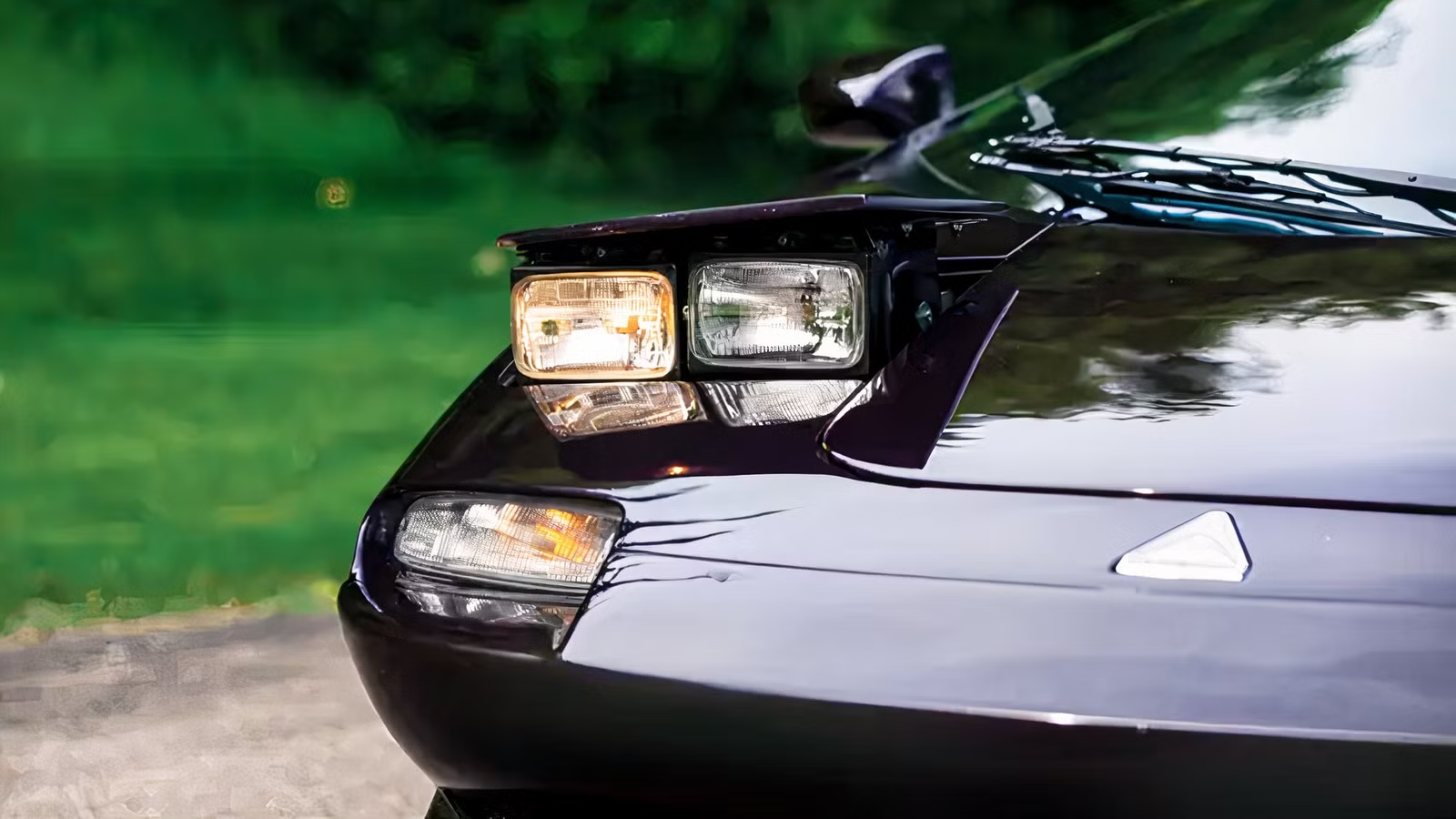
With Jerry Wiegert out, Megatech brought former McLaren F1 contributor Peter Stevens onto the Vector team with the mission of giving the M12 a body all its own. The end result still looked quite a bit like a Lamborghini. But this time, its curves were more rounded, its wing was more smoothly blended into the bodywork, and from the side, functional air vents fed cool air directly to the Lambo V12 engine. The chassis underneath may have also started life as a Lambo product, but by the time Vector was through, it was fine-tuned, extended, and modified to fit the more exaggerated proportions that separated it from a Diablo.

Using a five-speed ZF manual gearbox, the M12 produced in the neighborhood of 492 hp to the rear tires. Effectively, it was the same amount of power as a Diablo, and performance figures were fairly similar between the two. Mounted centrally in the car, in front of the gearbox, the engine made the M12 wider, longer, and, to many minds of the time, far more visually enticing. By all accounts, the M12 had everything it needed to stay a relevant supercar platform. It had a great engine, scissor doors, and a cockpit like the Batmobile. Still, they only ever made 17 of them.
Maserati Won’t Abandon The Third Pedal—And Enthusiasts Should Care
Maserati says the manual isn’t dead yet, and that matters more now than most enthusiasts realize.
Gone in a Flash

The last Vector M12 left the firm’s relocated Florida facility in 1999. With a sticker price of between $184,000 to $189,000, the M12 was actually cheaper than a Diablo by a fair margin. Even so, that didn’t stop the slightly heavier, longer M12 from failing to draw the curb appeal the company wanted out of the product. Simply put, without being objectively faster than a Lamborghini, an American offshoot running the same powertrain in an unconventional configuration is little more than a curiosity. After 1999, Vector continued to operate for a time.
Another prototype, the SRV8, used a race-tuned M12 chassis with reworked aero, a new front splitter, and new styling. It didn’t save Vector, and the company closed its doors soon after the big reveal. Years later, Jerry Wiegert revived the brand, hoping to introduce another supercar called the WX-8 at the 2007 LA Auto Show. The project never came to fruition, and Wiegert passed away in 2021.
The M12, the most famous creation associated with the company he founded, remains a high-six-figure collector’s item even three decades later. On its backstory alone, it’s earned its place in history multiple times over. If you’ve never even heard of Vector before, consider this your crash course. In fairness, they barely made enough cars for people to notice, even back during Vector’s peak of influence. Sometimes, the difference between memorable and unmemorable is pure production volume.
Source: Bring a Trailer

Related posts




Latest Post


No Comments