
The Wood-Paneled Mercury That Inherited Lincoln’s 460 At The Worst Possible Moment
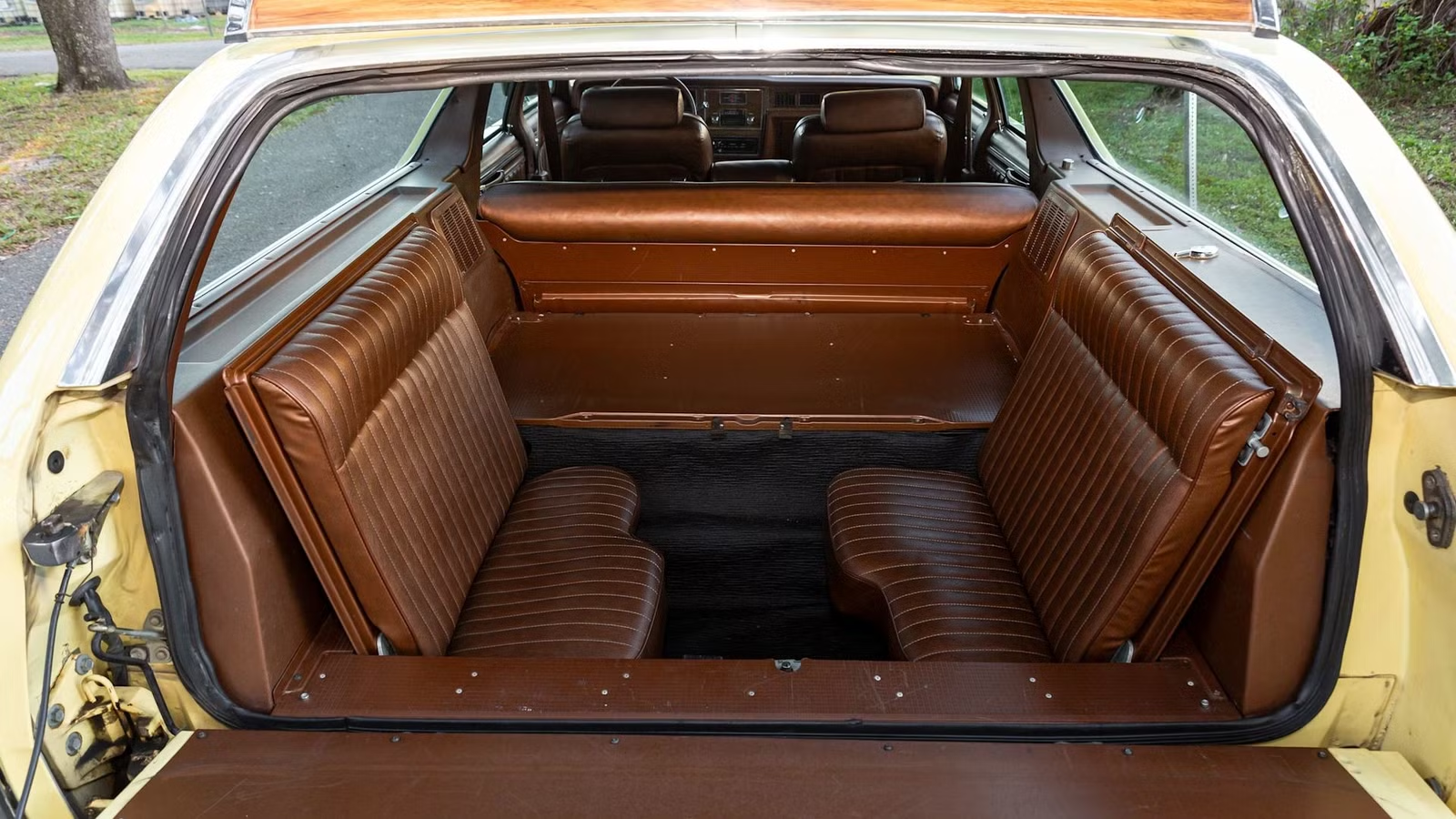
Detroit’s station wagons of the 1960s and 1970s are one of the most uniquely American vehicle segments of all time. Think wood paneling, a rear-facing seat accessed through a swing-out tailgate, and a big-block V8 that can really launch you from a stoplight. Mercury may have finally perfected the formula, months before the big block long-roofs went extinct. Now its opus is becoming a popular weekend ride for classic car enthusiasts.
The Big Block Long-Roofs Were A Uniquely Detroit Segment

By the late 1960s, U.S. drivers wanted it all: Room for the entire family, luxurious interiors, and gnarly straight-line speed. And for a few short years, Detroit truly could give them everything in one package. That package was a luxury station wagon powered by a big block V8.
Chrysler pioneered the segment. When Dodge first introduced the 345-horsepower big block V8, it offered this “Super D-500” package in its Sierra station wagon. Another Mopar pioneer was the 1961-65 New Yorker Town & Country wagon with its 413 V8.
For 1969, Ford entered the fray. It dropped the 429 “Cobra Jet” from the Shelby GT500 into its Country Squire wagon.


The same year, Chevrolet took a remarkably similar strategy. It borrowed the Corvette’s 427 cu-in “Turbo-Jet” V8 for its Kingwood Estate.
Ford fired back with the 1970 Oldsmobile Vista Cruiser 455. The massive displacement proved an excellent fit for the family wagon. It made 500 lb-ft at just 3,200 rpm. That sort of low-end grunt doesn’t care if the vehicle’s packed with seven passengers and luggage, or even towing a trailer. All the while, Mercury was taking notes.
The 460 V8 Was An Exclusive Lincoln Engine

Ford’s 460 V8 is exceptional for several reasons, one of which is its longevity. It debuted in Lincoln’s 1968 lineup and lasted through 1997 F-Series pickup trucks.
You can think of the 460 V8 as a stroker version of the 429. It shared the racing engine’s 4.36-inch bore and wedge-shaped combustion chamber. But while the 429 had a 3.59-inch stroke for higher revs, the 460 had a 3.85-inch stroke. The result was a whopping 7.5 liters of displacement.

The 460 debuted with a 10.5:1 compression ratio and a factory rating of 365 horsepower @4,600 rpm/485 lb-ft @2,800 rpm. Stricter emissions regulations eventually forced the automaker to reduce the engine’s compression ratio to 8.5:1. Ford also swapped over to SAE-style output ratings, which tested the engine with all peripherals attached (such as AC compressor and power steering pump). Because of the switch, it’s tough to judge how much the engine’s output had actually dropped. Suffice it to say, the 1972 brochure read 212 hp @4,400 rpm/342 lb-ft @2,800.
The Mercury Colony Park Was Detroit’s Ultimate Big Block Long-Roof

Lincoln never built a station wagon. The closest thing FoMoCo offered was the Mercury Colony Park. The fifth-gen of Mercury’s Colony Park station wagon lasted from 1969 through 1978. It was the top trim station wagon offered by FoMoCo. Its front end actually had a tall grille and hideaway headlights inspired by Lincoln’s luxury sedans.

The Colony Park was resplendent with top-trim options, such as woodgrain paneling and a pair of tall “twin comfort lounge seats” up front instead of the standard bench. Even though it was a bit narrower than the previous generation of full-size Ford/Mercury vehicles, the fifth-gen Colony Park would be the longest and heaviest wagon the company ever offered.
In mid-1972, FoMoCo gave the Colony Park Lincoln’s exclusive 460 cu-in big block V8 to propel that 4,740 curb weight. Sounds like the ultimate big block long-roof had finally arrived. Unfortunately, what had seemed like a good idea at the time would backfire massively.
The 1974 Colony Park Inherited Lincoln’s Thirsty 460 At The Worst Possible Moment

Emissions regulations and a shift to unleaded gasoline forced all the Detroit automakers to reduce compression and essentially detune their V8s in the early 1970s. Mercury’s mid-1972 engine shakeup is telling: the detuned 429 V8 under the Colony Park’s hood simply wasn’t delivering the performance expected. American automakers had one more trick up their sleeve: if they couldn’t build high compression engines, they’d rely on massive displacement.
The trick worked for a few months. With all of its low-end torque, the 460-powered Colony Park certainly had strong off-the-line performance. It also managed only about 13 mpg on the highway, and less around town. But with an average gas price of $0.36 a gallon, few buyers were concerned.

In 1972, Mercury sold 20,192 Colony Park wagons. The mid-year engine changeover appears to have worked because by the end of 1973, that number climbed to 25,747 wagons. But that’s not all that happened in 1973.
In October 1973, the Yom Kippur War began. When the U.S. supported Israel, the Arab OPEC nations cut oil production and embargoed the U.S. By the beginning of 1974, Americans were waiting in line for gas, and the price of a barrel of crude had quadrupled.

In 1974, Mercury sold just 11,913 Colony Park wagons. During the gas crisis, sales collapsed 54% in a single model year. No model year of the fifth-gen Colony Park would again touch 1973’s 25,747 sales record. When Mercury redesigned the wagon for 1979, it made the vehicle smaller and moved the 460 to an option instead of a standard engine.
All told, FoMoCo sold 7,850,000 vehicles on its full-size platform between 1969 and 1978. It was one of the Blue Oval’s most successful automobile platforms ever, second only to the Model T.
The V8 Wagon Renaissance

Big-block-powered muscle coupes may have made sense as commuters. But today, enthusiasts looking for V8-powered classics often want a weekend car they can enjoy with the entire family. They don’t expect said classic to be lightweight, fuel efficient, or to corner especially well. A wagon offers the added benefit of room for the entire family. Choosing a luxury wagon may not cost much more, but could drastically improve the build quality of your classic. It’s no wonder that big block luxury wagons are seeing a bit of a renaissance among enthusiasts.

A 1975 Mercury Colony Park 460 with 26,000 miles sold in 2026 on Bring a Trailer for $16,750. A 1977 sold on Mecum back in 2023 for $17,600. A 1975 460 sold on Bring a Trailer in 2023 for $20,000. Finally, the 1975 pictured sold on Mecum in 2024 for $27,000.
Sources: 460 Ford Forum, Ford Heritage Vault, History.com

Related posts


Latest Post


No Comments