
The Collector Car Gen-Z Has Never Heard Of
Despite popular opinion, Gen Z is not just interested in baggy jeans and wired earphones. It turns out that those born between 1997 and 2012 are into cars too, especially those that they faintly remember growing up. These recent classics fit perfectly with the Y2K vibe and evoke memories of a not-too-distant past. But there is one model that you’re probably less likely to find twenty-somethings hunting out. It is mad, it is bad, and it comes from another world. But can you guess what it is?
Gen-Z has An Interest In Classic Cars — But Only Certain Ones
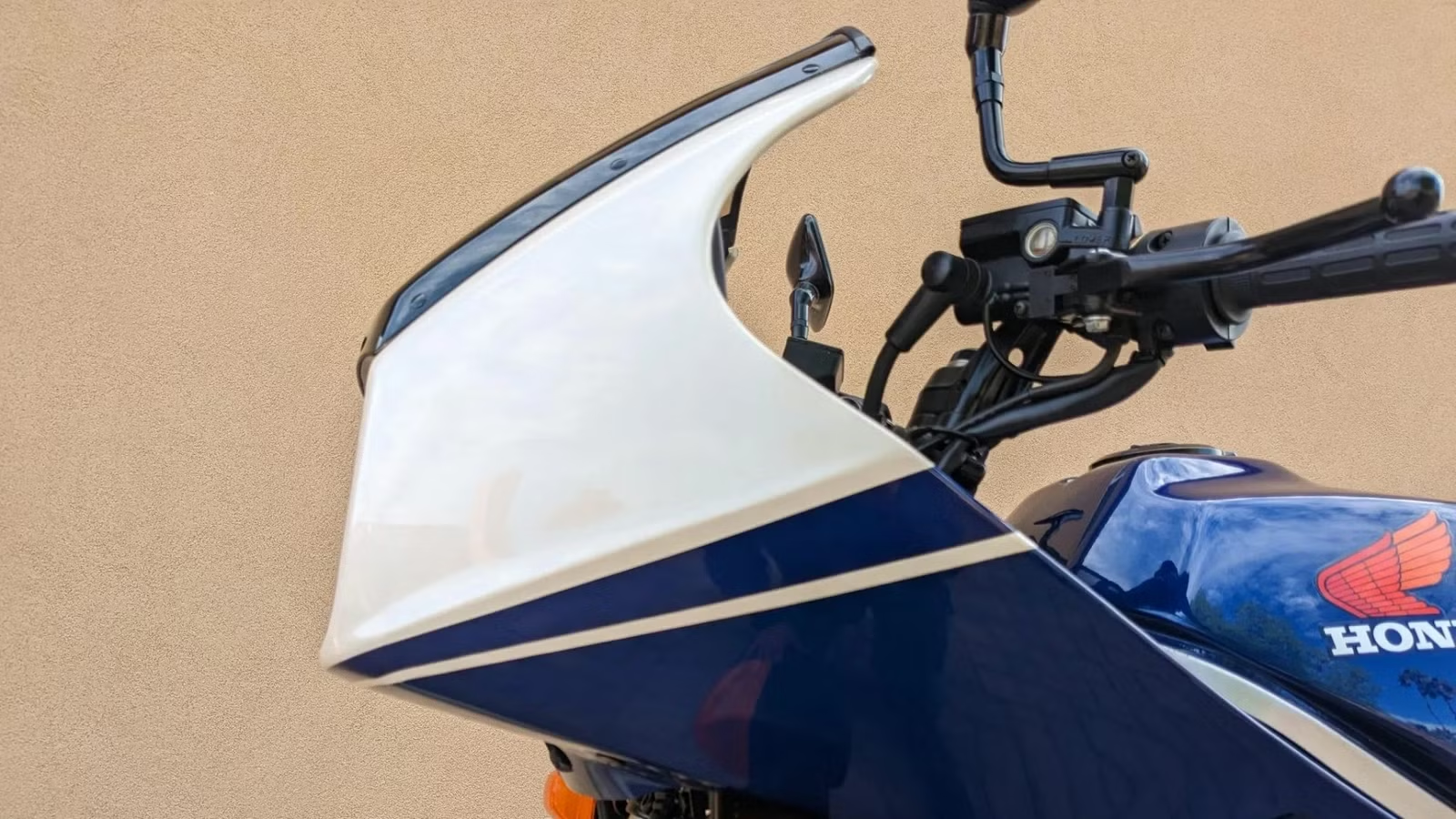
There is plenty of research looking at what cars Gen Z are into, and it’s likely their tastes are slightly different to those of their grandparents. According to Hagerty’s insurance quote data, which looks for the vehicles that are disproportionately popular with Gen Z, it seems that the most popular cars are generally from the ’90s and almost exclusively come from Japan. Cars like the diminutive Honda Beat, seen by many as the ultimate kei car, the grand Toyota Celsior (or Lexus LS), the Mitsubishi Lancer Evo VI, and the Acura RSX all feature at the top. The only non-Japanese car on Hagerty’s list is the Chevrolet Cobalt SS, although this supercharged front driver (or turbocharged, starting in 2008) certainly embodied a lot of what made many JDM cars great. Other research has pointed out that Gen Z prefers gadgets and tech over exterior looks, and is interested in practicality and fuel economy.
The 1970 Chevelle SS 454 LS6 Is None Of Those Things

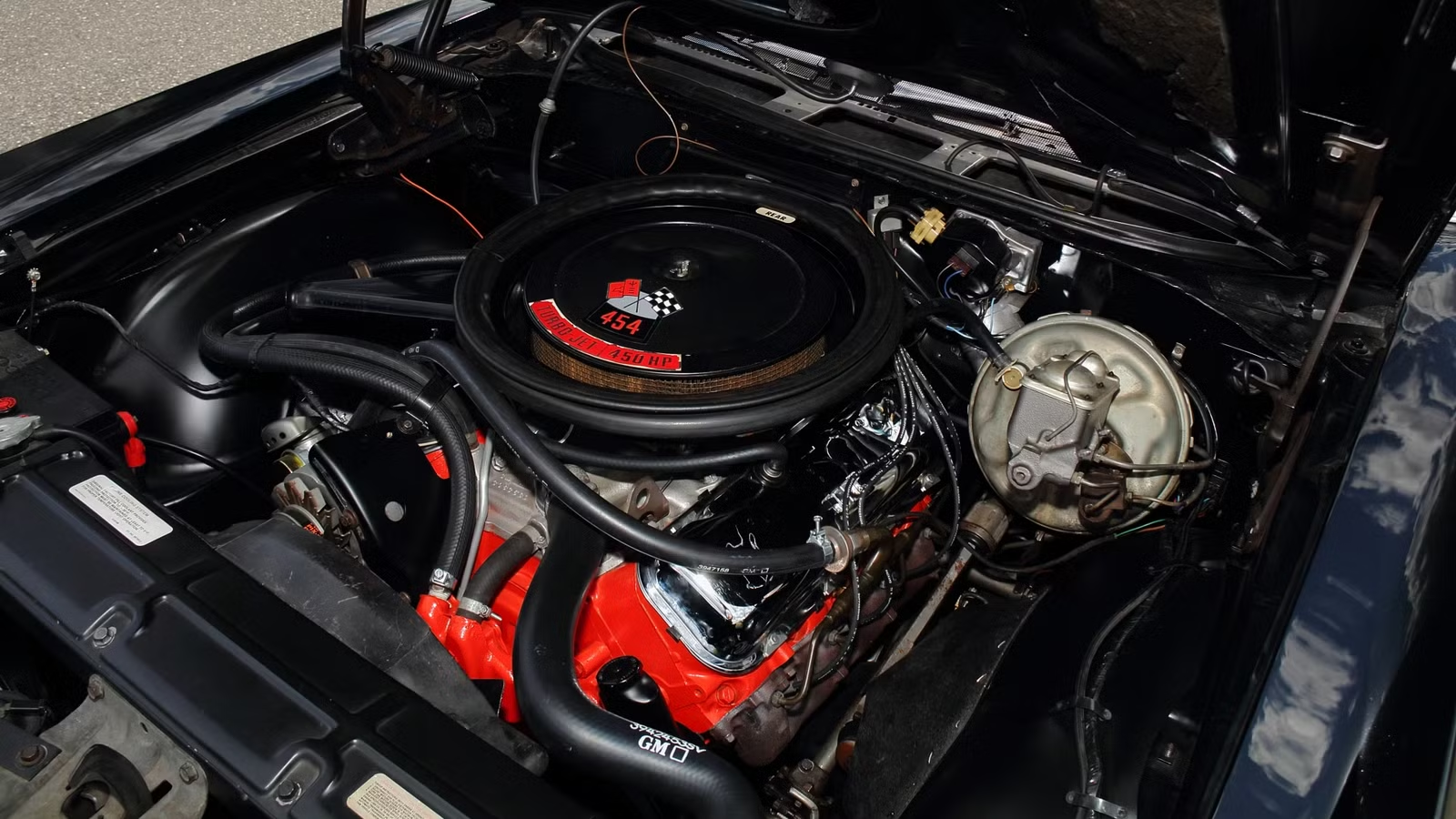
A long time ago in a galaxy far, far away, Muscle Cars ruled the streets. OK, the galaxy wasn’t that far away, it was more like the local drag strip, but old-fashioned V8s were pretty much the only way to go. These days, analog cars, where control over the right foot was the only driver aid, are a rare thing indeed. The 1970 Chevrolet Chevelle 454 LS6 could not be more different from the apparent car tastes of Gen Z, and represents a look into a long-lost past. Buyers of the 1970 Chevelle could spec a straight-six unit making 155 horsepower, with 307s and 402s also available.

But with the muscle car wars still smoldering, Chevy decided to go all in and offered a 454 big-block. If you picked the LS5, you got 360 hp, but the top of the range LS6 was arguably the baddest V8 ever fitted in a muscle car. This mill made an incredible 450 hp and 500 lb-ft of torque—pure ’70s muscle flex. The tech was limited to power windows and a radio.
The SS 454 LS6 Is Born Of A Different Time

This engine was born into a time when there was no replacement for displacement. It was an unrestricted monster, with engineers given free rein to extract as many gee-gees as they could. Inside the LS6 are forged-aluminum pistons, forged-steel connecting rods, and a forged-steel crankshaft, with four-bolt main caps to make the mill more robust. The cam has .520 lift and 316 degrees duration, with solid lifters, and rectangular port heads with 2.19-inch intake valves.
The compression was set at a heady 11.25:1. The engine is fed by a 780-cfm Holley four-barrel. The transmission options were a M-22 four-speed manual or a Turbo Hydra-Matic 400 automatic. Option code Z15 cost $503, and got you heavy-duty suspension, SS wheels, power front disc brakes, and the LS5 in 1970. It cost an additional $263 to spec the hotter LS6 engine.
The LS6 Chevelle Can Stand Up To ’90s and 2000s JDM Classics

The LS6 is a 3,759-pound dinosaur from a time when the answer to any question was “add more power”, but its performance still stands up. Many tests got the LS6’s quarter mile time to the mid to high 13s, but some reviews hovered just above 13 seconds. That is quick enough even by today’s standards, let alone 50 years ago in the 1970s. When a Mitsubishi Lancer Evolution VI was tested in 2000, packing a 276 hp turbocharged four and all-wheel-drive, it covered the quarter mile in 13.9 seconds. A 2002 Subaru Impreza WRX needed 14.7 seconds to cover the quarter-mile. But the brute force of the LS6 Chevelle, and its peers such as the 1970 Dodge Charger Hemi, couldn’t last. The days of freewheeling power and torque were numbered.
The LS6 Chevelle Spelled The Beginning Of The End For Powerful Big Block Muscle

The end of the so-called first muscle car golden age came as quickly as the genre started. And it wasn’t just a single element that killed off muscle cars, it was a number of reasons. By the end of the ’60s, insurance companies had caught on to the fact that almost anyone with a decent job could get their hands on one of the fastest cars on the planet — after all, it was affordability that had made muscle cars popular in the first place. Premiums were going up at a time when the economy was starting to cool, and buyers didn’t have so much money to throw around.
Then there were a number of regulations aimed at improving car safety, fuel efficiency, and emissions, making muscle cars less powerful, followed by an Oil Crisis which bumped up the price of gas significantly. All of this meant that big block powerhouses weren’t as popular, with cars like the Toyota Celica filling the gap with style and economy. The days of the ultra-powerful muscle car were coming to an end.
The LS6 Is Catnip For Old School Collectors

Chevrolet produced 4,475 LS6-equipped Chevelles and El Caminos for 1970, says Hemmings, and the Chevelle with this engine remains one of the most sought-after muscle cars from the golden era. Prices are very high, naturally, with Hagerty’s Valuation Tools saying that an LS6-equipped 1970 Chevelle will cost $122,000 in good condition. Hagerty notes that prices for the LS6 have risen a massive 23.7% in the last year alone. The two-door convertible version will cost considerably more in 2026, coming in at $269,000 in the same condition.
If you can make do with 360 horsepower, then a 1970 Chevrolet Chevelle SS 454 with the LS5 option is a lot cheaper. Expect to pay $73,800 for the coupe, and $104,000 for the rag top. By comparison, a 2000 Mitsubishi Lancer Evolution VI GSR Tommi Makinen Edition will still cost a lot less. These cars go for $50,000 in good condition, says Hagerty. Two different cars, two different ways of covering ground quickly. The old school approach of muscle cars couldn’t be more different to a 2000s rally car for the road, but in the end, both are stone-cold classics. We would not be upset to have either in our dream garage.
Sources: Hagerty, Hemmings, Chevrolet

Related posts



Latest Post


No Comments