
Ferrari’s EV Sold Out Before Most Purists Even Accepted It Existed — What That Means For Lamborghini And McLaren
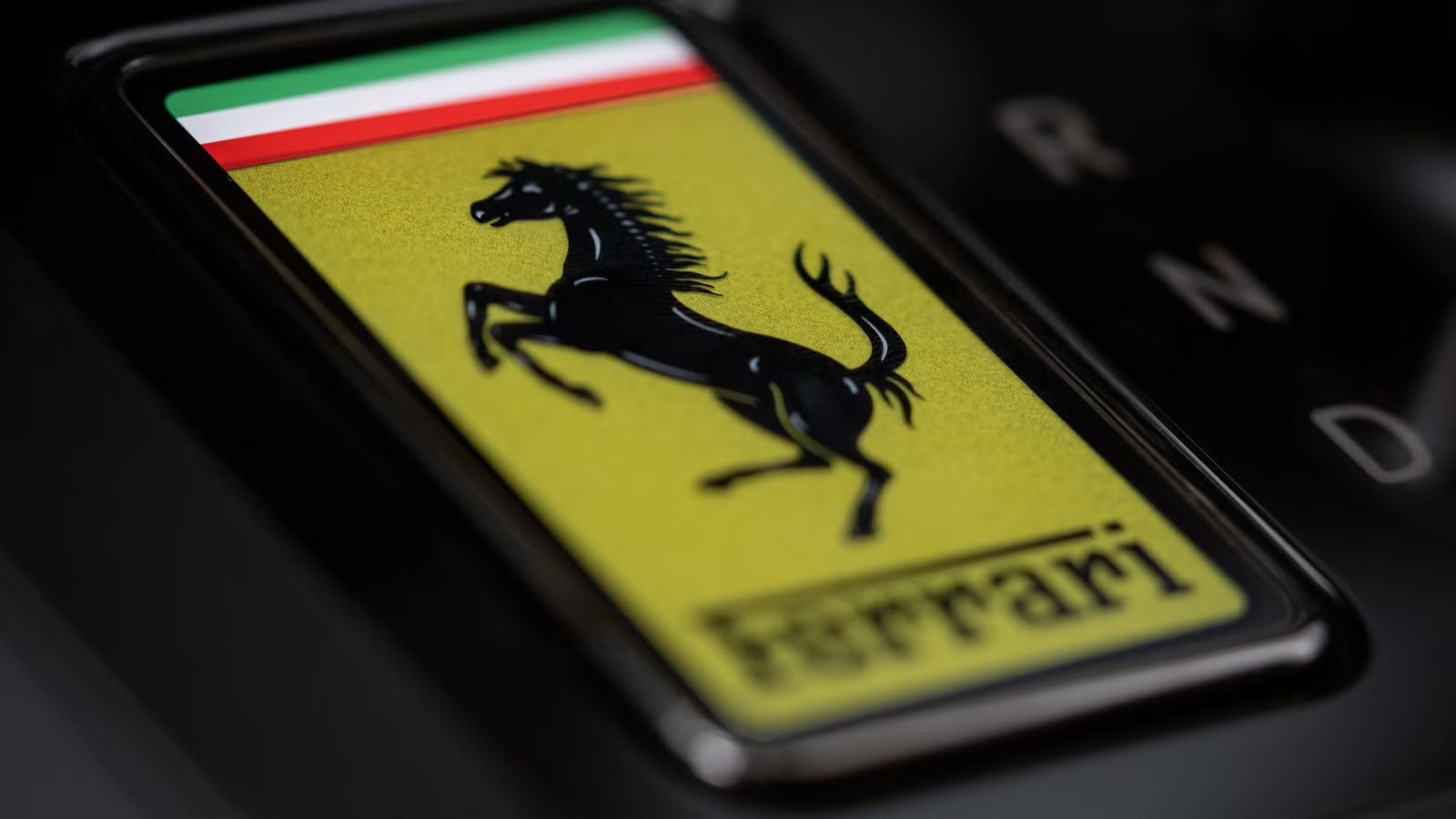
Ferrari’s first fully electric car, the Luce, has reportedly sold out — and the market didn’t wait for the purist debate to settle before making its decision. Reported on July 30, 2026, the sell-out follows an earlier wave of instant allocation closures in China, painting a picture of demand that has outpaced the skepticism that greeted the car’s reveal.

The Luce’s commercial success is more than a Ferrari story. It’s a signal to every other supercar brand watching from the sidelines — particularly Lamborghini and McLaren — that their customers are ready to follow where Ferrari leads, whether the loudest voices in the enthusiast community approve or not.
The Ferrari Luce Sell-Out: What The Numbers Say
The Ferrari Luce drew immediate controversy when it was unveiled — a fully electric Ferrari struck many in the collector community as a philosophical contradiction. Those objections didn’t translate into empty order books. The car reportedly sold out its allocation, with an earlier report from Electrek noting it had already achieved an instant sell-out in China before the broader global picture came into focus.

The Luce was shown publicly at the Goodwood Festival of Speed in July 2026, where live photos gave the wider enthusiast world its clearest look yet at the car’s design. The reception to the physical car appeared to soften some of the resistance that had built around renderings and announcements. Whatever the aesthetic verdict, the allocation figures tell their own story: demand absorbed supply before most of the criticism had time to land.
Lamborghini Is Moving — But On Its Own Terms

Lamborghini’s position on full electrification has been consistent: not yet, and not without a fight. The brand has leaned into hybridization through models like the Temerario, a plug-in hybrid supercar that represents Sant’Agata’s current answer to the performance-EV question. The Temerario’s design language was recently showcased through a pair of Ad Personam commissions that wore their own development sketches as liveries — a signal that Lamborghini is investing in the Temerario as a halo product, not a stopgap.
A June 2026 analysis framed the contrast starkly: Ferrari took the EV leap while Lamborghini and Pagani won’t — at least not on the same timeline. But the Ferrari Luce sell-out changes the competitive pressure calculus. If Ferrari’s customers absorbed a full EV without hesitation, the argument that Lamborghini’s buyers would resist a similar move becomes harder to sustain.
McLaren’s Electrification Timeline Faces New Pressure

McLaren has been navigating its own electrification path under significant financial and structural constraints in recent years. The brand has signaled a hybrid-forward approach as the near-term bridge, with full electrification positioned further down the road. That measured pace made sense in a market where the appetite for an electric supercar was still theoretical.
The Ferrari Luce sell-out makes it empirical. McLaren’s buyers overlap significantly with Ferrari’s — the same collector profiles, the same performance expectations, the same initial EV skepticism. If that skepticism didn’t suppress Ferrari’s demand, McLaren’s product planners have less cover for a slow walk toward electrification. The question is no longer whether the supercar market will accept EVs; it’s whether McLaren can afford to let Ferrari define what that acceptance looks like.
Why This Sell-Out Matters Beyond Ferrari

The Luce’s sell-out is a proof of concept the entire segment needed. Ferrari occupies a unique position — it carries enough brand authority to absorb the risk of being first, and enough pricing power to attract buyers who treat allocation as a prestige signal in itself. But that dynamic doesn’t diminish the result; it amplifies it. If Ferrari’s customers, widely regarded as among the most tradition-conscious in the supercar world, moved quickly on a full EV, the assumption that performance-car buyers are fundamentally resistant to electrification no longer holds.
For Lamborghini and McLaren, the competitive read is straightforward: Ferrari has validated the demand, absorbed the early-adopter risk, and set a market expectation. Both brands now face a narrowing window to define their own electric identities before Ferrari’s head start becomes a structural advantage in a segment where allocation waitlists and collector cachet are as important as lap times.
The purists haven’t gone quiet — they rarely do. But the order books have spoken, and in the supercar business, that tends to be the conversation that matters most.

Related posts


Latest Post


No Comments