
The Ducati Riders Keep Dreaming About
In a broad sense, every Ducati is someone’s dream. A newbie would dream about a Scrambler Icon to get his Ducati journey started, while an experienced superbike owner would dream about taking home the $35,595 Panigale V4 S to break his lap record plateau. The Multistrada V4 Rally serves a similar purpose in the adventure bike space.

However, even in Ducati’s own lineup, there are some bikes that serve as the top-drawer gold standard for nearly all kinds of enthusiasts. Part of their appeal is game-changing technologies and mechanical equipment. Whereas, the other part is their eye-wateringly expensive MSRPs that even the rich will think twice about spending. Out of these, a certain homologation superbike is the one most folks keep dreaming about.
Ducati Has No Shortage Of Dreamy Motorcycles In Its Lineup
Ducati has always had two assortments of motorcycle lineup. The first caters to the normal customer who has dreamt about Ducatis, wants to take one home, and enjoys it regularly. The other lineup is for true fanatics of the brand. These customers have been loyal to Ducati for years, have big pockets, and want something special to set them apart from the usual taxpayers.


This is why nearly all of Ducati’s regular bikes have special variants, priced at scarcely believable prices. Take the Panigale V2 for example. Its base price is $16,995–a figure that’s largely attainable by most sports bike buyers. But for the true fanatics, the brand sells three limited edition variants: Panigale V2 MM93, Panigale V2 FB63, and the Panigale V2 S 100.

Likewise, the Diavel V4 has an RS version, while the Multistrada V4 has the Pikes Peak and RS variants. Heck, even the cheapest Ducati–the Scrambler–has a limited edition Formula 73 version costing almost $20,000. That’s almost 2x the regular Scrambler Icon. As special as all these are, a Ducati that keeps everyone dreaming needs to be top-of-the-line in nearly all regards. That’s where the WSBK-spec Panigale comes in.
The Panigale V4 R Is The Ducati That Riders Keep Dreaming About

The ‘R’ suffix has always been sacred to top-drawer Ducati superbikes. These bring racing-derived elements to production bikes, be it in terms of aerodynamics, electronics, and pure firepower. This has been the case for over two decades now (remember the 999R?), and the 2026 Panigale V4 R serves as the most recent representation.
The homologation-spec superbike brings some never-before-heard technologies to the production world, putting it in a different league to its rivals. All of that works flawlessly on the racetrack, as evidenced by the sheer domination of the V4 R in the 2026 WSBK championship. These things make the flagship Panigale a dream for all.

Now, you could argue the Superleggera V4 Centenario justifies the title better. But that’s an ultra-limited machine, which we believe is already sold out. It also costs over $160,000, which is simply exorbitant—even if you are swimming in dollars. So we’re pretty sure no one in their right mind will actually enjoy such a machine on trackdays. It will mostly spend its life parked in the drawing room. In contrast, the V4 R costs less than a third of that figure, making it a more attainable dream.
A Near-$50,000 MSRP Brings You Top-Level Equipment On The Panigale V4 R

Speaking of price, the Panigale V4 R sells for $49,995. That is borderline absurd, yes. But it isn’t something you’ll never be able to accumulate for a motorcycle. Looking at other superbikes makes the picture further clearer. For instance, the M 1000 RR can easily cross the $42,000 mark with some options checked.
Whereas, the somewhat dated Japanese homologation bikes–the Ninja ZX-10RR and CBR1000RR-R Fireblade SP–sit close to the $30,000 mark. So you’re technically paying around $10,000 more for a much more up-to-date and WSBK-proven machine with all the top-level bits as standard. Doesn’t sound too bad, does it? Anyway, here’s a lowdown on what’s on offer.
Powered By The Stradale R V4 Engine With Almost 240 HP (In Race Trim)

Ever since Ducati made the switch to V4s, it has dominated the performance charts. The latest V4 R takes that to the next level. The updated 998cc Desmosedici Stradale R powerhouse has a completely redesigned intake system, every piston is lighter, and the new crankshaft is high-inertia. That joins hands with a high-flow filter to promise an output of 218 horsepower and 84 pound-feet. The US-spec bike is detuned to 208 horsepower, though.

The real might is unlocked with Ducati’s race exhaust and oil. It ups the output to a whopping 239 horsepower, claimed to enable a top speed of 205 miles per hour (V-Box tested). All the power reaches the wheel via Ducati’s new race transmission. This uses the N-1-2-3-4-5-6 pattern like a racebike and even has a ‘Neutral Lock’ (via a manual lever) to avoid false neutrals.
All-Inclusive Race-Derived Electronic Technologies

Since this is the top-tier Panigale, top-tier electronics are inevitable. Four power modes (Full, High, Medium, and Low), five pre-set riding modes (Race A, Race B, Sport, Road, and Wet), and Race eCBS serve as the base. This is topped with an updated traction control, wheelie control, slide control, and launch control system. How do you access these? Via a class-leading 6.9-inch TFT instrument cluster, as seen on the seventh-gen Panigale V4.

To make matters sweeter, a grip level meter is available as part of the DAVC Race Pro software. This helps you assess and manage performance by providing a graphic estimate of the average tire grip available. No other bike in the segment offers that as of now. As a lowdown, here’s everything you get:
- Four power modes
- Five ride modes
- Traction control
- Wheelie control
- Slide control
- Launch control
- Two-way quickshifter
- Race eCBS
- Cornering ABS
- Pit limiter
- Lap timer
- Auto tire calibration
Cutting-Edge Ohlins Suspension And MotoGP Aerodynamics Round Things Off
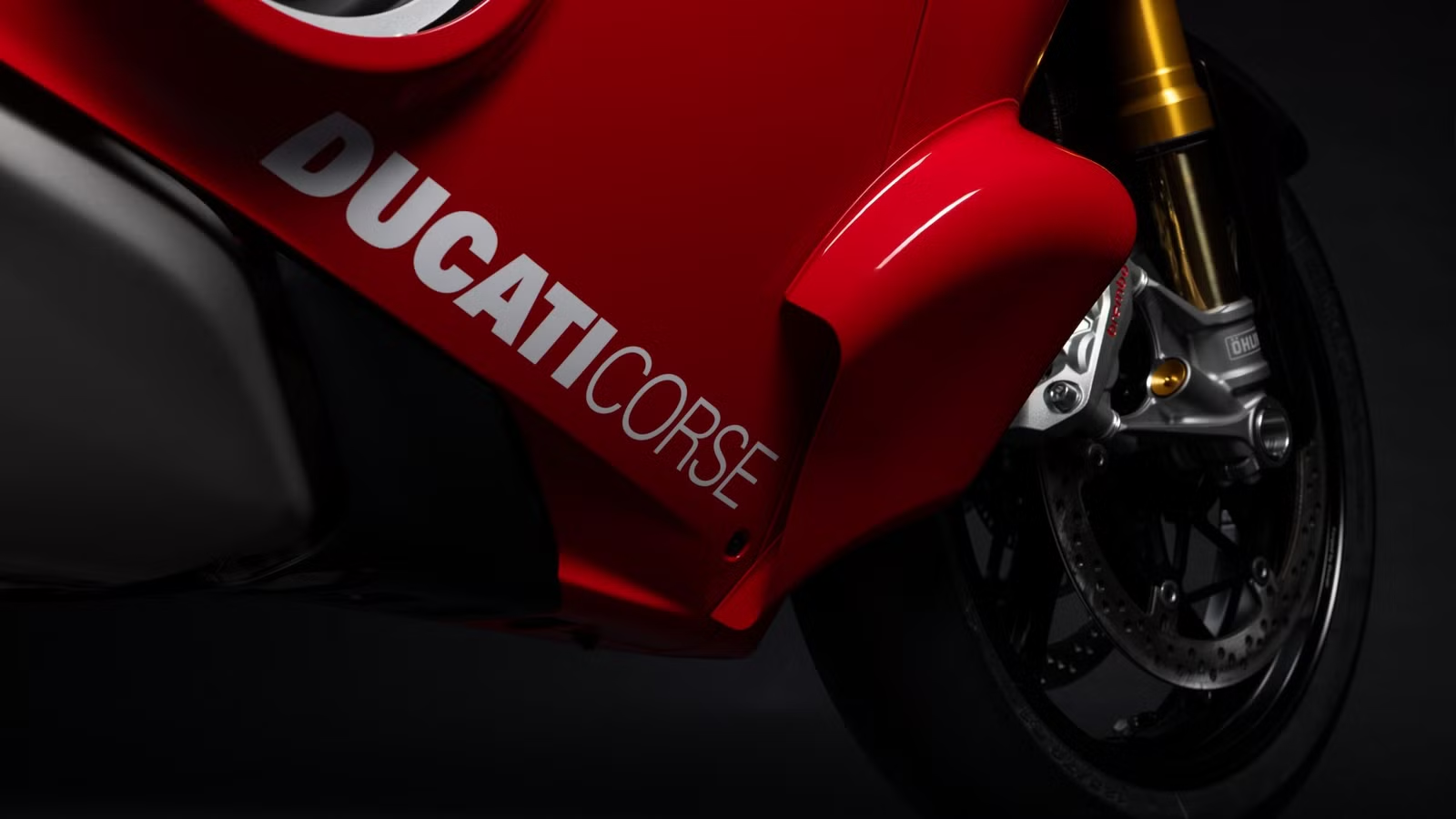
Last but not least, the underpinnings and aero package set a new standard in the class. We start with the latter, and it is all derived from Ducati’s title-winning GP25 MotoGP race bike. The wings from the 2023 model pave the way for a larger pair said to offer 25 percent more vertical load. That equates to 10 pounds at 167 miles per hour and 13 pounds at 186 miles per hour.

That might be lower than the BMW M 1000 RR’s downforce, but Ducati has another set of aero unlike the M RR. These sidepods near the belly section of the fairing exploit the ground effect while cornering. In layman’s terms, these channel air in a way that the bike can corner faster and hold a tighter line to cut down tenths. It clearly works, too, given the domination of the V4 R this year.

The underpinnings are all top-spec, too. The monocoque chassis looks the same, but it has been fine-tuned for 40 percent less lateral stiffness. This joins hands with a new double-sided swingarm to maximize grip and reduce weight. As for suspension, new Ohlins NPX25/30 forks sit up top, and an Ohlins TTX36 shock is present at the rear. Both are fully adjustable. A set of forged wheels, Brembo Hypure front calipers, and an Ohlins SD20 steering damper (a first for the superbike segment) round things off. In case you’re curious, the package weighs just 411 pounds wet without fuel, thanks to all the lightweight components.
Source: Ducati

Related posts

Latest Post


No Comments