The Three-Row Long-Range EV That Makes Road Trips Surprisingly Easy
8 minutes reading
Friday, 31 Jul 2026 14:00 0 43 autotech
Electric vehicles (EVs) continue to evolve over the years, to the point that it is no longer rare to find an EV that can offer more than 300 miles of range on a full charge. At the same time, crossovers and SUVs remain popular even in the EV segment. With so many electric crossovers and SUVs to choose from, shopping for one could be overwhelming.
That’s especially true if you’ll be using it for long drives. Sure, it’s easy to find a long-range EV these days for the family, but not all EVs offer the same level of flexibility and practicality to make long drives as easy as possible. Today, we’re exploring an EV that goes beyond offering a long range, thanks to its practicality and comfort, which makes long drives a pleasure for both the driver and its passengers.
Tesla Model Y Standard parked with hatch openTesla
When EVs were first created, their primary mission was to be a zero-emissions alternative to internal combustion engine (ICE) vehicles. Today, in 2026, EVs don’t just offer instant torque and a silent drivetrain, but also new and innovative ownership experiences that simply aren’t possible in a pure ICE car.
When properly designed, an EV offers better interior packaging. The lack of an engine means that what was meant to be the engine bay could be carved out for more interior space or a front trunk. Since the gearbox is electronically controlled, the size of the transmission is reduced or even removed completely, depending on how the electric motor is laid out in the vehicle.
But of course, there are pros and cons. For one, an EV’s battery is laid out on the vehicle’s floor. This leads to a thicker floor than what you’d normally see in a pure ICE car or even a hybrid. This presents a challenge for both designers and engineers, and it’s exactly why you have the Ferrari Luce having a tall-ish ride height, or the Volvo ES90 standing somewhat taller over an ICE sedan. The thicker floor often leads to a knees-up situation in certain vehicles, but as mentioned, these two packaging challenges of the thick battery can be addressed with clever engineering and design.
Clever Use Of Its EV Drivetrain
Vehicle-to-load function of 2024 Hyundai Ioniq 6 V2L used for charging a laptopHyundai
The biggest shift in EV development happened when Tesla opened its patents to the world. Yes, it is single-handedly why the Chinese got clever at making EVs en masse. Here in the United States, we are missing out on the clever engineering that the Chinese were able to imbue in their EVs, and so the closest we could get to such cleverness is with the Korean and German brands. For instance, by treating EVs as smartphones on wheels, these vehicles are heavily driven by software. This gave birth to the software-defined vehicle (SDV) era, in which Tesla was the company that created the first such vehicle.
The SDV era has created a vehicle that now treats the central infotainment as the main vehicle brain. Rather than having individual electronic control units (ECUs) for each vehicle feature, this can be substantially reduced to just seven ECUs, each controlling related functions. As a result, brands like Hyundai have taken advantage of an EV drivetrain in ways never possible in a pure ICE drivetrain. One of those is vehicle-to-load (V2L), which basically turns an EV into a large power bank. SDVs are also able to receive new features through over-the-air (OTA) updates. I mean, just take a look at how Teslas periodically receive new features like a smartphone. This level of computing power is only possible when you have a heavily electrified drivetrain.
Take A Look At The Hyundai Ioniq 9
2026 Hyundai Ioniq 9 exterior shot of two modelsHyundai
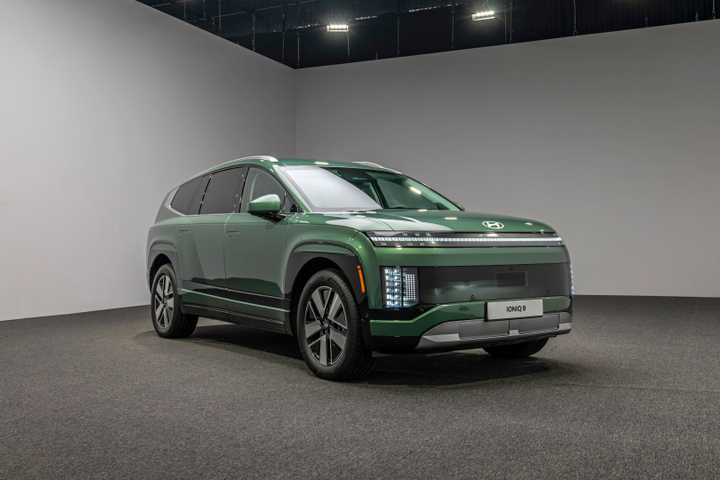
And so, with all of these aforementioned factors, the long-range EV we think that makes road trips surprisingly easy would be the 2026 Hyundai Ioniq 9. This is a well-engineered three-row electric crossover SUV that puts ingenious features and clever packaging at the forefront to deliver an EV experience that will make you wish that you weren’t at the destination yet.
A Well-Priced Sanctuary On Wheels
2026 Hyundai Ioniq 9 InteriorHyundai
If anything, it is the interior where you’ll spend most of your time, so it’d better be nice enough to keep you comfortable or entertained for hours on end. This is exactly why we recommend the Ioniq 9, because the interior design and feel are pretty much the equivalent of having a living room on wheels. Whether you go for the base S for $58,955 or the range-topping Calligraphy Design for $76,490, the interior across all variants is both distinctly styled and well-trimmed. Soft-touch surfaces in sustainable materials are the order of the day, and the dash is dominated by various silver and white textured surfaces that add a homey vibe.
In typical Hyundai fashion, two 12.3-inch screens run the connected car Navigation Cockpit (ccNC) operating system. Yet despite the sheer amount of tech features available, Hyundai still insists on having physical knobs and buttons inside the cabin. There’s a choice between seven or six seats, with the six-seater version featuring power-adjustable captain’s chairs with heating, cooling, and a footrest. Taking advantage of the EV drivetrain is the Limited and Calligraphy variants’ 16A power outlet, which you can use to charge laptops even while on the move. Though, to be fair, even in the lower trims, the seven USB-C charging ports have a whopping 100W of power—fast enough to charge laptops.
Up To 335 Miles Of Range; NACS Standard
2026 Hyundai Ioniq 9 front shot of two modelsHyundai
But what’s the point of all of these features if an EV can’t travel far, right? RWD variants of the Ioniq 9 can travel up to 335 miles, while AWD models with 303 horsepower offer 320 miles of range. For those opting for the Limited variants and up, get a powerful 422-horsepower version of the dual-motor AWD drivetrain, which reduces the range to a still impressive 311 miles. All versions have a 110.3 kWh lithium-ion battery, and thanks to the Ioniq 9’s 800-volt electrical architecture, this three-row EV accepts up to 350 kW of DC fast charging, which is good for a 10 to 80 percent charge in just 24 minutes. Oh, and the Ioniq 9 also gets an NACS charging port right out of the gate.
Finally, sealing the deal is the charging experience itself, which Hyundai is doing its best to make as seamless as possible. Now, what do I mean by that? It’s one thing for an EV to have all the necessary hardware in order to offer fast charging, but it’s another for an EV to offer a seamless charging experience. Tesla has championed the seamless plug-and-charge model with its Supercharger network, since everything is tied to the Tesla ecosystem. Hyundai aims to make this just as seamless with Hyundai Pay, wherein compatible chargers will work seamlessly with Hyundai EVs when it comes to charging. No longer do you need to manage a plethora of EV charging station apps, as Hyundai Pay aims to eliminate this headache.
What An Ioniq 9 Is Like To Drive
2026 Hyundai Ioniq 9 Front Three QuarterWilliam Clavey | TopSpeed
Sealing the deal with the Ioniq 9 is how much of a pleasure this EV is to drive. More than just its looks and practicality, the Ioniq 9 is pleasing to both the driver and its passengers, as we’ve examined from our first impressions drive.
What we tested was a range-topping Calligraphy Design trim with 422 horsepower, but you’ll be surprised that it doesn’t feel like it has that much power when you accelerate. Don’t get us wrong, it’s not that it’s lethargic (the 215-horsepower RWD model probably is), but due to the 5,000-pound weight, the 422 horsepower it offers feels athletic and brisk at most. And that’s perfectly fine, because this is a family electric SUV that’s all about comfort. Overtakes are easily executed here, since EVs are known for their instant throttle response anyway.
Coupled With Comfort For Days
2026 Hyundai Ioniq 9 Full DashboardWilliam Clavey | TopSpeed
2026 Hyundai Ioniq 9 second rowWilliam Clavey | TopSpeed
Building upon its refined nature is its excellent suspension tuning. The main concern with EVs is that, due to the heavy batteries, automakers can sometimes overcompensate for the heft with suspension that is too stiff in order to keep body roll in check. Thankfully, the Ioniq 9 delivers a striking balance, wherein the ride remains supple and comfortable, yet it’s still stiff enough for this 5,000-pound SUV to remain planted and stable in corners. There’s comfort in a vehicle that doesn’t wallow or roll too much, which often causes motion sickness in occupants.
Furthermore, as an EV, the Ioniq 9 is unsurprisingly quiet, but Hyundai even took things up a notch with measures such as optimizing the strut rings to reduce road and tire noise. There’s even the Active Noise Control through the sound system, and the standard acoustic laminated glass. If you want a Hyundai with Genesis-like levels of refinement, the Ioniq 9 delivers on that aspect.










No Comments