
Chevy SS 396 Was Actually a 402: The Badge Lie Explained
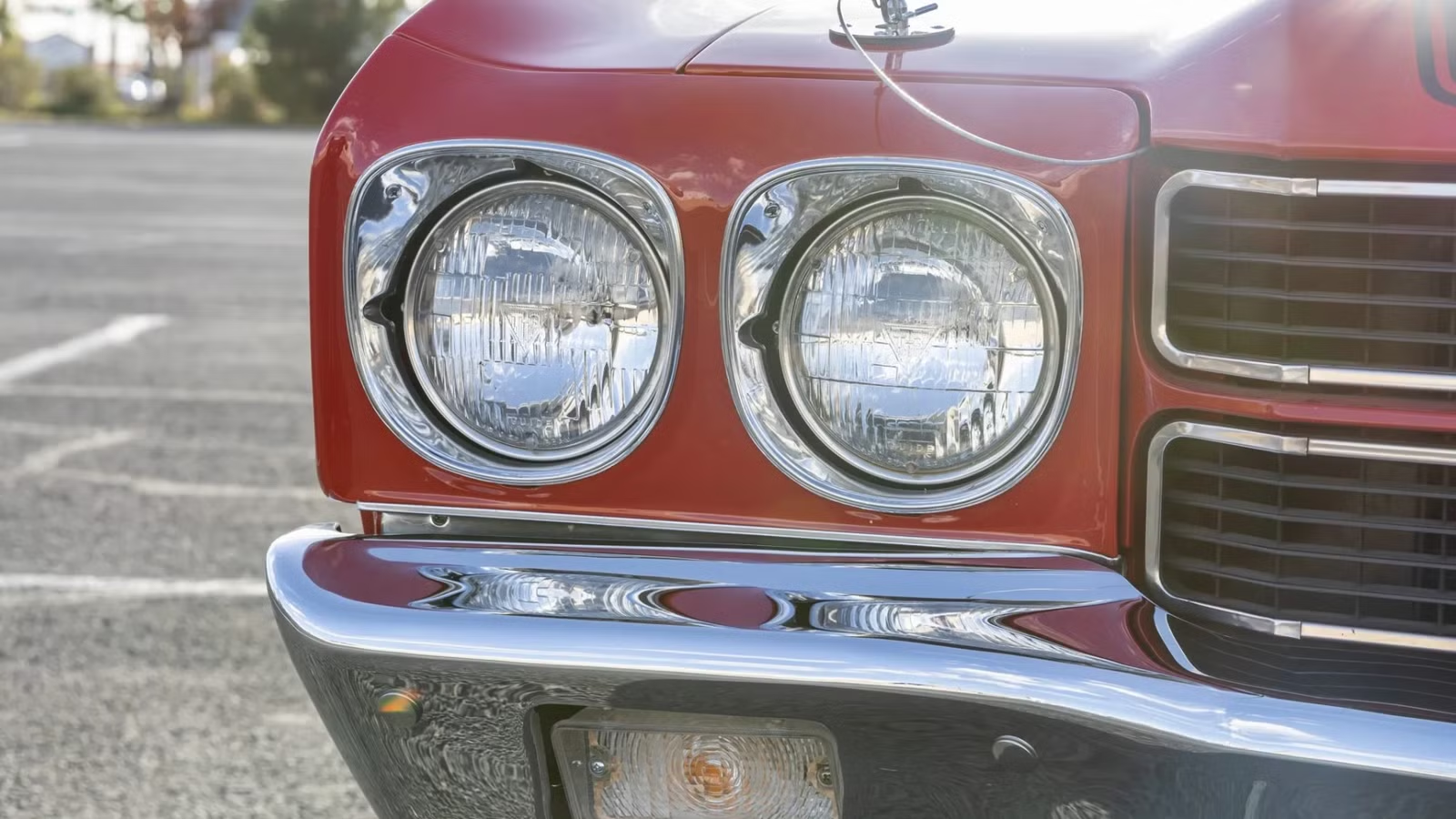
Walk through any cars-and-coffee in America and you will find one, parked proudly with its hood up. The owner will tell you it is numbers-matching, and the chrome badge on the fender will back the claim up with a figure every enthusiast knows by heart.

That number has been wrong for over half a century. The factory itself put the wrong number on the fender, deliberately, for three model years of this muscle car across three vehicle lines. The same engine wore three identities, and three stamps on the block prove it.
When Detroit Decided The Badge Mattered More Than The Truth
In the late 1960s, a displacement number was not a spec sheet detail, it was the product itself. Buyers ordered cars by the number on the fender, bragged about it at stoplights, and paid real money to move up a digit or two. Detroit understood this better than anyone, which is why the badge often told a more convenient story than the engine underneath it.

The industry gamed its numbers constantly. Automakers famously underrated horsepower to keep insurance companies calm and racing sanctioning bodies happy, so the idea of a fender badge stretching the truth was practically a Detroit tradition by 1970. Then the federal government changed the rules of the game. The new emissions standards arriving for the 1970 model year did not treat every engine equally, and for the first time, the size class an engine fell into carried regulatory consequences worth real engineering money.
That set up a collision between two departments of the same company. Marketing owned a number that sold cars, engineering needed a number that satisfied Washington, and one of them was going to have to lie.

The engine wearing the most beloved badge in Chevrolet’s muscle car catalog was not what it claimed to be. Starting at the 1970 model year, across the entire Mk IV big-block lineup, Chevrolet increased the bore of its 396 cubic inch V8 by 0.030 inches, taking it from 4.094 inches to 4.125 inches. The math is not subtle, because that new bore produces a true displacement of 402 cubic inches.
The Chevelle SS, Camaro SS, and Nova SS all kept their “396” emblems through 1972, even though the engine behind them had grown by 6 cubic inches. This was not a mid-year running change or a quiet phase-in, either, as the larger bore was in place from the start of 1970 production across the passenger car range.

The scope of it is what stings. No true 396 survived past 1969 in Chevrolet’s car lineup, with only the C/K trucks carrying the original bore into 1970, which means every “SS 396” Chevelle, Camaro, and Nova built from 1970 through 1972 is actually a 402.
Chevrolet did not even hide the evidence particularly well. The emissions tag mounted on the radiator shroud of these cars stated the displacement as 402 cubic inches, sitting a few feet away from fenders that said 396. The truth was under the hood the entire time, printed by the factory itself.
So the numbers-matching “396” at your local car show almost certainly is not one. Chevrolet knew from day one, and as we are about to see, the company told three different stories about the same engine depending on who was buying.
Same Engine, Three Showrooms, Three Completely Different Names

Picture the same engine block rolling off the same assembly line and heading to three different showrooms. At the Chevelle dealer, it arrived wearing the sacred “396” badge. In the full-size Impala brochure, the identical engine appeared as the “Turbo-Jet 400.” Only in the Chevy and GMC truck lineup did it go by its honest name, a plain and accurate “402.”
Sit with that for a moment, because the work truck got the truth while the halo muscle car got the lie. The vehicle bought for hauling gravel wore an accurate displacement figure, and the one bought for bragging rights did not.

The SS 396 name had become an institution by 1970, famous enough that Paul Revere and the Raiders had cut a promotional record about it. Chevrolet was not about to abandon a number it had spent five years and millions of dollars burning into the muscle car buyer’s brain.
The second motive was the likely regulatory prize. Federal emissions rules eased slightly for engines displacing 400 cubic inches or more, and boring the 396 just past that threshold moved the whole family into the friendlier class.

Then Chevrolet added one more layer of absurdity. The same showroom also offered a genuine 400-cubic-inch small-block marketed as the “Turbo-Fire 400,” meaning a buyer could choose between two different “400” engines, one of which was actually a 402 and neither of which shared a single part.
The charade finally ended in 1972, when Chevrolet began calling the last surviving version, the LS3, by its real displacement. The company killed the engine entirely the following year.
The L34, L78, And LS3 Prove This Was A Whole Family Of Misbadged Engines

If this had been one mislabeled engine, it might qualify as a footnote. Instead, the 402 came in three distinct versions spanning a 330 to 375 horsepower spread, which means Chevrolet misbadged an entire engine family rather than a single powerplant.
The L34 and L78 were the 1970-only carryovers. Both were identical to their 396-badged predecessors in every respect except the bore, with the L34 rated at 350 hp and the solid-lifter L78 at 375 hp. The buyers who paid extra for the hottest “396” money could buy were getting 402s they never asked for, at a time when a Chevelle SS 396 coupe started at $3,439.

The LS3 was the survivor, and its numbers tell the whole emissions-era decline in three data points. It arrived rated at 330 hp, slid to 300 hp in 1971, and finished at 240 hp to 250 hp in 1972 before Chevrolet pulled the plug.
Every one of them wore a badge that told a different story than the block underneath it.
Three Stamps On The Block Settle The Argument Forever
Here is the part that wins the argument at your next cars-and-coffee, because three marks on the block end any badge debate on the spot. No brochure, badge, or seller’s story survives contact with them.
Start with the casting number, found at the rear of the block near the bellhousing. The number 3969854 spans 1969 through 1972 and covers both 396 and 402 blocks, which is exactly why the casting number alone cannot settle anything. It narrows the field, and nothing more.

The casting date code does the real narrowing. It sits on the passenger side of the block, formatted as a letter for the month, digits for the day, and a digit for the year, and dates from late 1969 onward point to the 402 bore.
The three-letter suffix code delivers the verdict. Stamped on the machined pad ahead of the passenger-side cylinder head from 1970 onward, it identifies the exact application, horsepower rating, and transmission pairing the factory built that engine for.
If those three stamps unmask your “396” as a factory 402, do not reach for the touch-up paint. A verified 402 wearing original 396 badges is documented evidence of Detroit’s regulatory gamesmanship, and that story adds provenance to your car rather than subtracting from it.
Sources: General Motors, Hagerty

Related posts





Latest Post


No Comments