
The Most Reliable Naturally Aspirated Four-Cylinder Engine Ever Produced
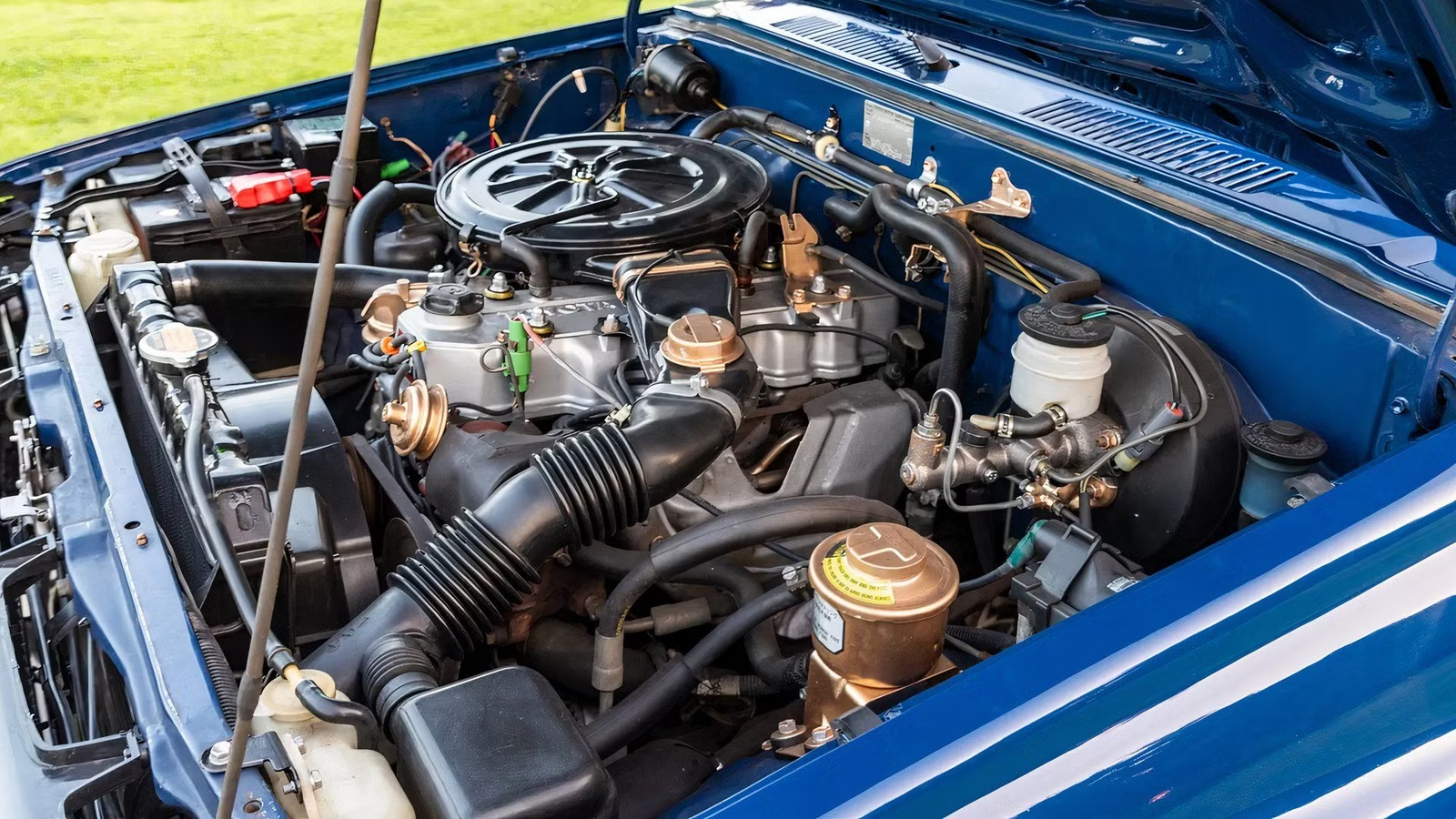
When the conversation turns to engines that simply refuse to die, naturally aspirated four-cylinders deserve a seat at the table. Forced induction may dominate today’s headlines, but the humble non-turbocharged four-pot has quietly racked up decades of real-world proof — in economy cars, trucks, and everything in between. We dug into the data, the owner forums, and the engineering history to identify the most reliable naturally aspirated four-cylinder ever built.
The Toyota 22RE Is A Stalwart Among Four-Cylinder Engines
Toyota 22RE Specs
 65 autotech Layout |
2.4-liter inline-four |
|
Power |
 55 autotech 105 hp |
|
Torque |
136 lb-ft |
(Source: Toyota)
Toyota has designed and built its fair share of reliable engines throughout its history, and remains near the top of the durability charts to this day. Its luxury arm, Lexus, led the way in the 2023 J.D. Power US Vehicle Dependability Study, with Toyota itself following not far behind in seventh.
The Japanese manufacturer has never been one to cut corners on reliability, and that philosophy was front of mind when it set out to develop a new engine with more torque back in the ’80s. Starting with the trusty 20R four-cylinder as a foundation, Toyota increased the bore of the 2.2-liter powerplant to create the 2.4-liter 22R in 1981.
The 22R was built around a cast-iron block, but featured advanced aluminum cylinder heads to reduce weight and inertia, allowing the engine to run more smoothly. It also used a single overhead cam design with a durable timing chain, which tends to be more reliable than rubber timing belts.
Toyota Borrowed The Iconic Hemi Design
Looking to extract more torque from the base 22R, Toyota borrowed an idea first perfected by Chrysler with its iconic Hemi range of engines — the hemispherical combustion chamber, which generates swirling motion within the cylinder. Those swirls distribute the fuel-air mixture more evenly, improving combustion efficiency and boosting torque compared to the standard 22R.
The engine also featured more efficient cross-flow heads and a longer 3.5-inch stroke, the refinements resulting in a unit Toyota christened the 22RE. The automaker debuted the new engine in 1985 in its heavy-duty Hilux and 4Runner models, where it went on to establish itself as one of the most reliable workhorses around.
The Toyota 22RE Can Rack Up The Mileage With Little Maintenance
Common Issues With Toyota 22RE Engine
- Front crankshaft oil seals can crack and leak frequently.
- Head gaskets are vulnerable to failure after 100,000 miles.
The Hilux pickup has carved out a reputation of being indestructible over the years, made famous by a legendary segment on Top Gear in which a 2.4-liter diesel version survived being submerged in the ocean and dropped from a tower.
While the diesel 2.4 got all the glory, the 22RE has quietly built up a commanding reputation as a bulletproof workhorse. According to RepairPal, which aggregates data from real owners, Hilux models equipped with the engine carry an average yearly repair cost of only $397. Numerous owners who left reviews on the site have also reported extraordinary mileage figures with very few issues along the way.
Owners Rave About The Reliability Of Their 22RE-Powered Toyotas
One driver who owned a rugged 22RE Toyota Pickup for 23 years, covering 240,000 miles in the process, reported that he only had to replace the timing chain and radiator during that entire time. Another had purchased a used model at 127,000 miles and driven it a further 130,000 miles without encountering a single problem with the 22RE.
Another owner bought a Hilux with the 22RE engine new in 1994 and had covered 265,000 miles by the time he submitted his review in 2012. The only engine-related item he had ever replaced was the battery.
A different owner also covered well over 200,000 miles after buying their pickup at 120,000 miles, leaving it with 345,000 miles by the time he left his review in 2011. Over that stretch he replaced the head gasket, timing chain, oil pump, and water pump.
Even a driver who left the Hilux an unfavorable review over the truck’s overall reliability acknowledged that the 22RE had proven to be a solid workhorse during the five years he’d owned it. His only engine-related expense was a timing chain replacement at a cost of $1,500 after it had become loose — the engine itself remained perfectly reliable otherwise.
According to the Toyota Nation Forums, a common problem with the 22RE is that the oil seals on the front crankshaft can wear out and begin to leak. Head gaskets also tend to be among the first components to fail, though this generally only becomes an issue past the 100,000-mile mark.
Honda’s K24 Is Another Reliable Naturally Aspirated Four-Cylinder Engine

Common Issues With Honda K24 Engine
- Premature wear on exhaust camshaft
- Leaking oil seals
While it’s difficult to beat the Toyota 22RE in terms of sheer longevity, Honda’s K-Series range of engines gives it a genuine run for its money. Honda has relied on the K-Series since its introduction in 2001, steadily refining it to serve in a wide variety of economy and performance applications.
The peppy K20A engine, which uses forced induction, formed the basis of the Civic Type R for its past three generations. Variants like the K20A3, meanwhile, were used in earlier versions of the base Civic and Acura RSX. Honda’s iconic VTEC system has featured on all variants of the K-Series to date, with the latest evolution of the K24 engine released in 2013.
Owner Reviews Of Honda K24 Engine Reliability
The K-Series has built up a strong reputation for reliability, with the K24 proving particularly dependable in everyday use. Several drivers on the Bob Is The Oil Guy forum reported that their late-2000s CR-V models equipped with earlier K24 variants had surpassed 200,000 miles with minimal trouble. Another shared the story of a 2003 Accord driven 265,000 miles on nothing more than routine maintenance.
According to Motor Reviewer, common issues for the Honda K24 engine include leaking oil seals over time and premature wear on the exhaust camshaft. The K24 W Earth Dreams version of the engine can also suffer from carbon buildup in the intake valves and valve seals, which can lead to valvetrain problems down the line if left unaddressed. The issue typically announces itself through a noticeable loss of power or higher-than-normal fuel consumption.
Toyota and Honda Lead The Pack In Reliable Four-Cylinders
All in all, both the Toyota 22RE and Honda K24 inline-four engines should deliver dependable miles for years on end, provided they receive consistent care and maintenance. Because both engines were used across so many different models by their respective manufacturers, finding an affordable example is entirely possible when searching the classifieds.
Sources: J.D. Power, Toyota Nation Forums, RepairPal, Motor Reviewer, Bob Is The Oil Guy Forum, Toyota, Mecum Auctions, Edmunds

Related posts





Latest Post


No Comments