
Hyundai’s Palisade Undercuts This Popular Toyota Rival
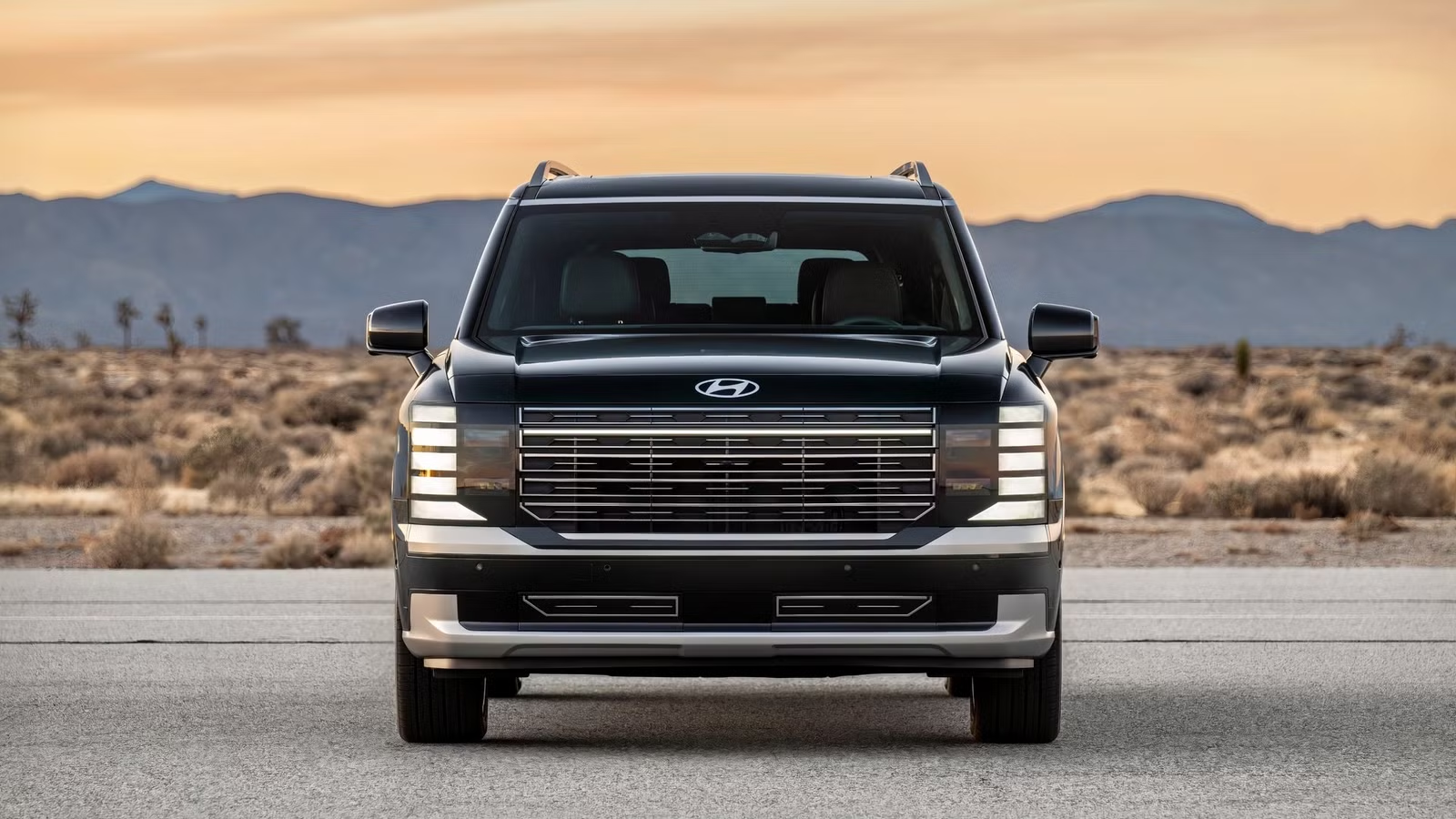
If you can believe it, which you probably can if you’ve been following the market, the midsize standard SUV wars have doubled down. The Hyundai Palisade received a complete remodel for the 2026 model year and has, as a result, pushed itself up the market to the more “premium” segment, verging on luxury. The Grand Highlander, on the other hand, was a signal to the market that they could even outdo themselves.

Hyundai knew they had stiff competition even though the Palisade is basically a money-printing machine for them. Brands like Toyota saw this and wanted a piece of the pie, and the cycle keeps going. Now, it’s not a matter of who fills a gap, but who fills a gap with the best possible product they can produce. Two top-of-the-line powerhouses: the Hyundai Palisade Calligraphy all-wheel-drive and the Toyota Grand Highlander Hybrid Max Platinum all-wheel-drive. Let’s find out how the Palisade outplays the Grand Highlander.
What “Loaded” Looks Like In A Three-Row SUV
That uber-glossy headline that everybody knows about by now, “Cars in the US have averaged a price of nearly $50,000” mainly has to do with the most bought car in the US, the family three-row SUV. Both of these segment occupiers have a decent starting point. The Grand Highlander starts at $42,260 while the Hyundai Palisade starts at $39,435. They’re both still a lot of cars, even in the base trims. However, where Toyota trips itself up is in the final cost at the top of the line, which exceeds the base price of the Lexus TX350. This raises the question: what even is luxury anymore? Features like Napa leather and HUDs used to be luxury-only but are now considered top-of-the-line features in standard vehicles.
Each Brand’s Family Flagship


Flagships also used to be sedans. For a short period of time, Hyundai’s flagship sedan was the Hyundai Equus. It is also considered one of the precursors to the now-standalone Genesis brand. On the flip side, the 10-yard Toyota badge was home to the now defunct Toyota Avalon. By the end of its lifespan, this was also a good example of blowing the lines between standard and luxury.
Now, both of these brands have midsize SUVs as their flagship models, and the pricing even denotes that. The Hyundai Palisade Calligraphy all-wheel drive is $54,560 with the hybrid Calligraphy coming in around $56,780. The Grand Highlander Hybrid Max Platinum is a cool $60,175. If you think about it, even only 10 years ago, $60,000 could easily buy you a Mercedes-Benz or BMW. Now we’re using that same money to debate Hyundai and Toyota.
Calligraphy vs. Platinum

The Calligraphy trim sits atop seven other gas trims and four other hybrid trims. The Grand Highlander comes in non-hybrid and hybrid trims as well, with actually two hybrids to speak of. In total, the Grand Highlander has 10 trims. The honest caveat is that the gas-powered Platinum Grand Highlander runs between $54,000 and $55,000, which is technically cheaper than the Calligraphy. Therefore, this comparison only applies against the Hybrid Max.
The Grand Highlander Platinum does come with a pretty decent feature list. It carries a panoramic roof, a 10-inch heads-up display, heated and ventilated second-row outboard seats, a digital rearview mirror, a 360-degree camera with traffic jam assist, and even an 11-speaker JBL audio system. However, the Hyundai has such a long list of features that it could even have its own section going over them.
Feature-Off, Where The Palisade Makes Its Case

Where these two automakers spend their money is fairly obvious when you look at the bottom line. While Hyundai does offer two different powertrains, it was relatively straightforward for them to include the last-generation V6 and a hybrid they’ve tested on their smaller vehicles. The real difference is in the cabins and features. Hyundai clearly has spent an inordinate amount of time, energy and effort on the way that it looks and feels on the inside.
While Toyota does offer some pretty premium features, where the Grand Highlander really excels is in its different powertrain offerings. The Hybrid Max powertrain is not to be overlooked, and is one of its biggest selling points from both a power perspective and an EPA ratings perspective. Not to mention, Toyota’s cabin far exceeds the Palisade’s in this regard. There is seating for eight and up to 97.5 cubic feet of cargo storage, versus the Calligraphy’s captain’s chair configuration, which seats only seven with 86.7 cubic feet of total storage.
The Lap Of Luxury

This is really where the Hyundai Palisade Calligraphy shines through. Here is a list of its features: quilted Napa leather, massaging driver’s seat with relaxation recline for the front and second row, plus heated and ventilated captain’s chairs in the second row with a heated power-folding third row. It also comes with a 14-speaker Bose Centerpoint premium sound system and a 12-inch heads-up display.
To match some luxury cars, it also comes with 21.3-inch displays, a digital rearview mirror, and, unique to Hyundai, a UV-C sanitizing compartment in the glove box area. It even comes with smart parking assist that autonomously maneuvers it backward and forward in a tight parking spot. Not to mention, there’s even a factory dual-camera dash cam setup that records at 30 frames per second and includes a parking mode. All of that, and it’s still somehow $3,000 to $5,600 cheaper than the Toyota, depending on which powertrain you choose. Some even say the Calligraphy’s Napa leather is almost too nice for carting children around.
The Warranty Queen

It is true that Toyota harbors long-term reliability; therefore, their warranties might not be as robust. The Grand Highlander Hybrid Max comes with a three-year, 36,000-mile basic warranty and a five-year 60,000-mile powertrain warranty. The Hyundai, on the other hand, has a five-year 60,000-mile basic warranty and a 10-year 100,000-mile powertrain warranty. Hyundai is known for having great initial quality, but not always the best long-term. Hyundai also comes with a three-year, 36,000-mile complementary maintenance warranty while Toyota has their patented ToyotaCare coming in at two years and 25,000 miles. We should put a hybrid asterisk on this as well, because Toyota will also cover their hybrid batteries for 10 years and 150,000 miles, whichever comes first.
Price Gaps And How They Emerge

So at this point, you’re probably wondering why the Toyota Grand Highlander, top of the line, is between $3,000 to $5,600 more expensive even without all of those features. Simply put, it’s all in the engine. Paying for Toyota’s premium gets you a turbocharged hybrid powertrain that tops out at 362 horsepower, compared to the Hyundai Palisade’s 287 horsepower. Now you could go for the more powerful Hyundai hybrid powertrain, which gives you 329 horsepower, though it still doesn’t have as much horsepower as the Toyota. What else do you get for the Hybrid Max’s premium? A longer-lasting, more reliable vehicle in the long run.
The Hybrid Max’s Counterargument

The Toyota Grand Highlander Hybrid Max comes with a turbocharged 2.4-liter inline four-cylinder hybrid with two electric motors outputting 362 horsepower and 400 pound-feet of total torque. It’s then mated to a six-speed automatic transmission and has standard all-wheel drive. In terms of EPA ratings, you’re looking at a combined 27 miles per gallon. Compare that to the Hyundai’s naturally aspirated 3.5-liter V6 outputting 287 horsepower and 260 pound-feet of torque, tethered to an eight-speed automatic transmission and an all-wheel-drive drivetrain. All the while, you only get 20 miles per gallon combined and fewer horsepower. The Hybrid Calligraphy gets a much better 29 combined.
Data To Quantify

Accoding to Fueleconomy.gov, the Hyundai PalisadeCalligraphy with the V6 will cost you around $3,000 in fuel annually — $2,050 for the hybrid engine — as opposed to Toyota’s $2,750 annually. Additionally, Kelley Blue Book projects that within five years you will have spent $68,030 on the Calligraphy and around $73,316 on the Hybrid Max Platinum. Even though there is a fuel efficiency deficit for the V6 Palisade, the Hyundai ends up being more than $5,000 cheaper to run and maintain.
The Takeaway

At this point in the argument, it really just kind of comes down to what you like. It’s not necessarily about which is better. Rather, it comes down to how much you’ll be driving in a year, how long you plan on keeping it, and how much a zero-to-60 time of 8.8 seconds really bothers you (the Hyundai Palisade). If you’re really torn, you could also go with the hybrid version of the Hyundai.
Resale Reality

As it is probably obvious, the Toyota is going to end up holding much more value down the line than the Hyundai. The Toyota Grand Highlander holds about 67 percent of its resale value over five years, compared to 54 percent for the Hyundai Palisade. That difference does matter. However, you do still get so much more from the interior of the Hyundai, and overall, for a lower entry fee and long-term costs.
The Verdict

Therefore, if you want to, you can pocket the savings and have every bell and whistle you would want from a near-luxury vehicle. Your third-row occupants will have heated seats, and you’ll be the talk of the town in the carpool line. Or, you could pay more upfront and plan on owning something that will treat you well much further down the line, as well as off the line. The Toyota Grand Highlander Hybrid Max platinum has more cargo space, more power, and even more staying power.
Sources: U.S. News, Hyundai, Toyota, KBB, FuelEconomy.gov

Related posts


Latest Post


No Comments