
The Dual-Sport Bike That Feels Right Whether You’re On Pavement Or Dirt
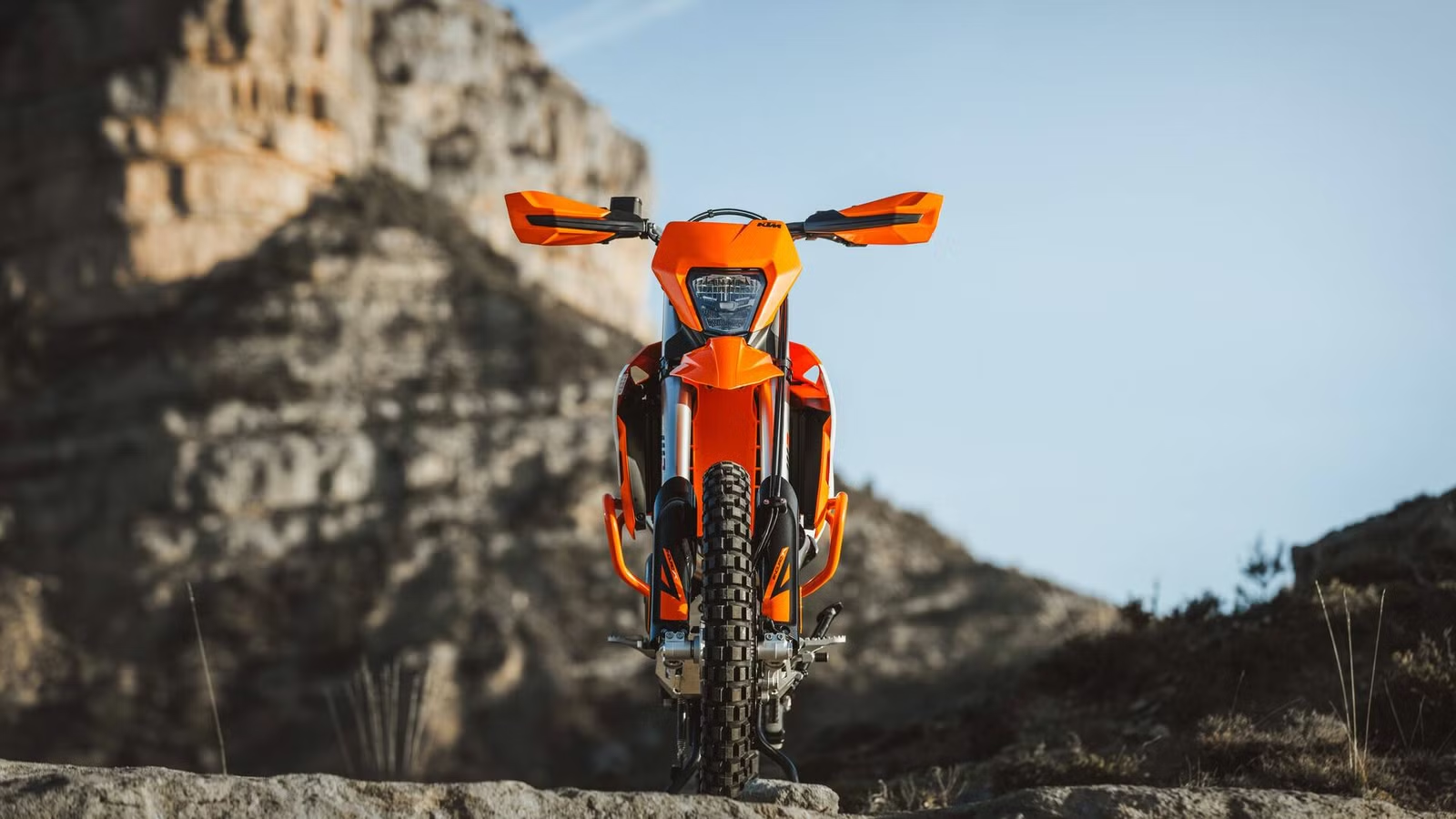
In the self-help book titled The One Thing by real estate entrepreneurs Gary W. Keller and Jay Papasan, multitasking is discouraged. The book argues that it’s mostly a myth sold to people who think doing five things badly beats doing one thing well. Real dual duty means doing two very different jobs without shortchanging either. Motorcycles run into the same wall. A machine tuned for one surface almost never doubles up with the same composure as the other, because the traits that make a bike brilliant on gravel are usually the ones that make it a chore on the interstate. There are exceptions at times, just like the KTM dual-sport we’re talking about here.
A True Dual-Purpose Bike Has To Get A Few Things Right

The dual-sport name itself is a hint that two duties need to be performed well. Instead of trying to have multiple roles, a genuine dual-purpose machine has to survive a technical trail section on Monday morning and a rain-soaked commute by Monday evening. That’s the versatility of a lighter, simplistic, reliable dual-sport machine that won’t leave you tired for anything else in the day.

These two demands, however, pull against each other when it comes to speccing it. The suspension travel has to be long enough to soak up a rutted fire road, and that usually raises the seat and the center of gravity high enough to make tackling the urban environment a two-footed affair at slow speed. So power and practicality need to be balanced in equal measures.

A dual-sport motorcycle’s practicality extends to the engine and dynamics as well. Then it needs an engine mainly tuned for low-rev tractability for traction on loose dirt, but that also means that it lacks top-end, often running out of breath on a highway. Plus, the weight needs to be kept in check, as every extra pound that helps a bike track straight at speed is a pound a rider has to muscle up a rocky switchback.


Electronics complicate the picture further. A traction control calibrated for the tarmac cuts power the instant the rear tire slides, when that exact behavior is what the rider actually wants on gravel. Similarly, ABS built around asphalt braking distances can lock a front wheel on loose surfaces unless it has a genuine off-road mode to switch into. Very few machines clear all of that at once, and fewer still manage it without a genuine compromise showing up.
The KTM 690 Enduro R Feels Right Whether You’re On Pavement Or Dirt

KTM built its reputation on the LC4 single-cylinder engine, and the new 690 Enduro R carries that history into 2026 with its biggest overhaul in years. The chromoly steel trellis frame that has equipped every big-bore KTM enduro bike since its inception is largely unchanged, but the engine bolted into it is about half as new as earlier.
The rework was directed at meeting the Euro5+ emissions rules, albeit without giving up the power that made the 690 famous in the first place. Alongside the new engine internals comes a ride-by-wire throttle replacing the old cable pull, and a six-speed gearbox now backed by a slipper clutch. At $13,399, it’s not the cheapest way into a big-bore dual-sport, but the money buys a platform built from the outset to swap surfaces without a second thought.
Employs The Most Powerful Single-Cylinder Engine On Sale

KTM’s LC4 has held the title of the most powerful production single-cylinder engine for most of its life, and the 2026 update claws it back from Ducati. The 692.7cc unit now makes 78 hp and 54 lb-ft, up from the Italian marque’s Superquadro Mono. This has been achieved with dual balancer shafts smoothing out vibrations that big singles are infamous for. KTM also stretched the service interval to 9,321 miles between oil changes, up 50 percent from before, and doubled the valve-check interval to 37,282 miles, an unusual concession from an engine built to be hammered on trails.
Ride Modes, Cornering Aids, And The New Rally Mode

The ride-by-wire throttle is what makes the rest of the electronics possible. Standard Street and Off-Road ride modes remap the throttle response, and a 6D sensor feeds the Cornering MTC and Cornering ABS so both traction control and braking adjust for lean angle. Riders who want more can step up to the optional Rally Mode, which brings Dynamic Slip Adjust, an all-new system debuting on this bike that automatically balances how much wheel slip it allows against the traction that’s actually available for the 690 Enduro R on any given surface.

These electronics now handle the on-road character of the 690 Enduro R substantially better, while there’s even more control on offer for the dirt. Offroad ABS lets the rear wheel lock for controlled slides on loose ground while keeping the front intact, and a dedicated button switches off ABS entirely for riders who want full control over their inputs, especially while negotiating technical off-road terrain. A 4.2-inch TFT ties it together with turn-by-turn navigation and USB-C charging.
Chassis And Suspension Built To Cross Between Both Worlds

But none of that electronic polish counts for much without a chassis built to match it on both surfaces. While the chromoly steel trellis frame carries over largely unchanged, the WP Xplor suspension gets updated internals at both ends. 10.43 inches of travel up front through a 48mm inverted, split-damping fork and 9.84 inches at the rear through a linkage-mounted shock with high- and low-speed compression adjustment complete a suspension setup that can be fine-tuned to the most finicky of riders.
At 357 pounds fully fueled, the 690 Enduro R sits lighter than plenty of middleweight machines riders invariably cross-shop against it. Its 10.43 inches of ground clearance is what lets it roll over obstacles that would otherwise send a lower adventure bike home with a cracked skid plate or worse, the oil sump. The 36.8-inch seat height reflects a trail-first priority, though it does mean shorter riders will be on their toes at a stop. A 59.3-inch wheelbase keeps the chassis flickable in tight technical sections without feeling nervous at highway speed, and the 3.51-gallon tank gives the 690 Enduro R good enough range for a full day of mixed riding.
The 690 Enduro R Against The Husqvarna 701 Enduro And Honda CRF450RL

If you’re out for a proper dual-sport purchase, chances are that the 2026 Husqvarna 701 Enduro will come up almost always parallel to the 690 Enduro R. It shares the same 692.7cc LC4 engine, the same outputs, as well as the same $13,399 price tag, since both bikes roll off the same Austrian line under KTM’s parent company. Different bodywork and seat shape aside, there’s nearly nothing to differentiate the running gear underneath, so picking between them comes down to your preference for a paint scheme really.

It’s the Honda CRF450RL that’s a genuine alternative. At $10,099, it undercuts the KTM by over $3,000, and at 289 pounds it’s a lighter, motocross-derived machine built for a rider who rarely leaves the dirt. Which is why there are tradeoffs. Like a 2.0-gallon tank barely good for 60 miles and a 37.2-inch seat that favors longer inseams. It’s also considerably down on power compared with the 690 Enduro R, but it is the sharper trail tool. The 690 Enduro R, however, is the one built to manage both surfaces rather than just survive one or the other, and this new iteration simply excels at both.
Source: KTM

Related posts



Latest Post


No Comments