
The “Slow” Performance Bike That Teaches You To Ride Like A Pro
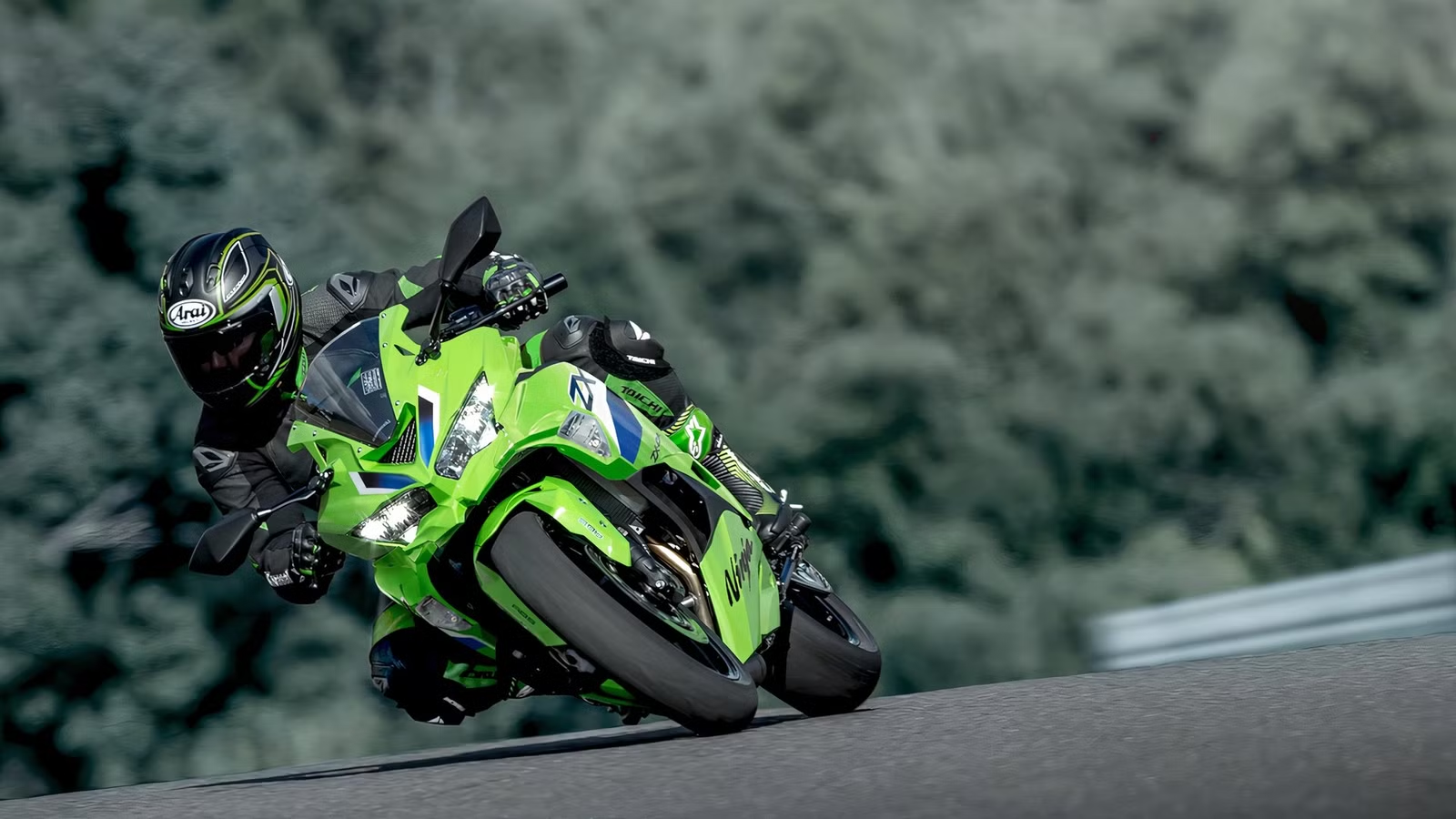
The old adage of riding a slower bike faster is true to a great extent. There’s a lot to learn in managing the nuances of engine behavior, braking, and handling of a lower-capacity sports bike, which will make you immensely skilled on larger machinery. Race and riding schools hand beginners the smallest bike for the same reason. A rookie with 200 horsepower under his/her right wrist will simply depend on it on the straights to make up time on a lap. The same rookie on a 50 horsepower bike will learn to keep the momentum up exiting onto a straight. Here’s a slow-ish bike to prove the theory right. Oh, and it has a superbike-like four-pot powerhouse.
What Riding A Bike With Less Power To Hide Behind Actually Teaches

On machines with incredible power, a rider can get away with mild throttle work in and out of a corner, letting raw grunt cover for a late apex. Take that power away and every input becomes consequential in deciding the corner exit speed. A missed braking point or a rushed downshift doesn’t get absorbed into an engine’s flexibility anymore. It just builds up a deficit in the next set of corners instead. So, corner speed has to be carried through the turn itself, since there isn’t a fistful of torque waiting at the exit to rescue a lazy line.

The gear shifts have to be just as calculated. A high-revving, small-bore engine only makes power in a narrow window near its rev ceiling, so a rider has to keep the engine spinning in the meat of the powerband and time every shift. Otherwise, the engine simply falls out of its powerband and gets slower, taking up more time and downshifts to get it back up to pace. This exact skill set and throttle control gets carried over once that same rider swings a leg over something with more cubes and horsepower. Now that you know how a slow performance bike makes you faster, here’s the one we’d recommend.
The Kawasaki Ninja ZX-4RR Is The Performance Bike That Teaches You To Ride Like A Pro


Kawasaki didn’t have to engineer a bike this demanding. There’s the Ninja 500 with its parallel-twin and low-end grunt that can be just as usable on the road too. It’s also a solid chunk cheaper than the ZX-4RR’s $9,999 price tag. Would it be exciting? Not really, and definitely wouldn’t hone your track day skills as much either. Instead, the Ninja ZX-4RR brings the visceral howl of its inline-four that progressively builds toward the redline instead of arriving in one torque wall the way a twin would. Plus, there are ways to make it faster still.

This gem of a 400cc four-banger comes wrapped in a trellis frame, with a total wet weight of 414.5 pounds. Suspended with adjustable units, the ZX-4RR boasts a 37mm Showa fork offering spring preload adjustability up front. A Showa BFRC Lite gas-charged shock does duty at the back, complete with a piggyback reservoir and adjustability for compression, rebound, and preload. Add in the bidirectional quickshifter and a more Kawi-esque paint scheme, and you’ve got hardware that actually lets a rider dial the chassis in as their skills improve. The fancy hardware doesn’t change the highlight of this little devil of a screamer that could be perceived as “slow” in the world of liter-class powerhouses, but one that’ll teach you riding lessons for life.
A High-Revving 399cc Inline-Four That Never Lets You Get Lazy

Most of what separates this engine from anything with fewer cylinders comes down to where it actually makes its power, and where it doesn’t. Peak torque comes in at 11,000 rpm, and peak horsepower a stone’s throw later at 11,500, which means anything below eight grand is just noise that the engine has to churn through before it really starts working. And it’s one that makes bigger engines feel like overkill simply because of the high revs it’s capable of.
16,000 RPMs That Rewards A Disciplined Right Hand

Kawasaki lets the tachometer swing to 16,000 rpm before the limiter steps in. This high rev ceiling isn’t for a spec sheet flex. The engine spends most of its time spinning harder than most riders are used to. It takes a deliberate effort to trust the tachometer that far around the dial, so if you back off early, the way years of riding lower-revving machines conditions most people to, and the ZX-4RR just feels ordinary. Push through to where the induction howl sharpens, and the revs keep climbing, and the same engine turns urgent in a way the 80s and 90s small-capacity inline-fours did.
Short Gearing That Punishes A Missed Shift

That same peaky nature forces a rider to actually use the gearbox thoughtfully. The six-speed unit is geared close enough that a missed shift, or holding a gear too long, or even grabbing the next one a beat late, costs real time on a lap around a track. Ride the ZX-4R the way you would a torquier bike, and the engine bogs well below its sweet spot, leaving the rider waiting out the lag instead of simply twisting the throttle harder. Match the shifts to where the engine actually wants to be revving, and every corner exit turns into a small rehearsal in timing. Done enough times and done right, the lap times keep tumbling.
Electronics That Ask The Rider To Do The Work

The ZX-4RR’s electronics package stays thin for a bike sitting in a segment full of modern rider aids. Three-mode Kawasaki Traction Control watches wheel speed alone, without a six-axis IMU feeding it lean angle or chassis pitch, à la the flagship ZX-10R. The two power modes simply cap output rather than reshaping the power delivery. There’s no cornering ABS, no wheelie control, or anything else that works as an all-encompassing safety net. Kawasaki built it this way for a rider who still needs to feel every mistake, learn, re-learn, until they get it right.
The ZX-4RR’s Real Rivals Aren’t In Its Own Class

The ZX-4RR isn’t reviving a format so much as proving it still has a job to do. Small-bore four-cylinder screamers ruled Japan’s domestic market through the ’80s and ’90s before emissions rules and insurance costs killed them off, and Kawasaki brought the layout back knowing very well that it’d make little sense as daily transport. Where it does make sense is a tight, technical circuit like Buttonwillow Raceway or Barber Motorsports Park, where the straights aren’t long enough to matter.

On paper, its closest match is whatever else sits near 400cc, bikes like the Aprilia RS 457 or Honda CBR500R. But none of them share its playground, though, since a screaming four built to be thrashed at 16,000 rpm has nothing to prove against a twin built more for commuting. The real rivals sit a class up in outright numbers but square up in price and intent, with the likes of the Aprilia’s RS 660, Triumph’s Daytona 660, and Yamaha’s YZF-R7, built with the same track day ambitions and none of them cheap enough to dismiss. However, it’s the ZX-4RR which will inevitably make you a faster rider to graduate onto riding even higher capacities like a pro.
Source: Kawasaki

Related posts

Latest Post


No Comments