
This Japanese SUV Quietly Outsmarts Luxury Brands
For decades, the definition of a “luxury SUV” has been dictated almost entirely by German manufacturers. The formula has been predictable with turbocharged four-cylinder efficiency at the entry level, silky six-cylinders at the top, and a cabin packed with digital screens and ambient lighting to justify ever-rising prices. But underneath that polished hierarchy, something interesting has been happening: Japanese engineering has quietly been rewriting the rules without making much noise about it.

Instead of chasing specification headlines or overcomplicated tech suites, Japanese brands have increasingly leaned into balance, refinement, and long-term usability. Nowhere is that philosophy more clearly expressed than in Mazda’s latest mid-size premium SUV. Sitting just below full-size luxury flagships but above mainstream family crossovers, it enters a space dominated by the BMW X3, Mercedes-Benz GLC, and Audi Q5, yet refuses to play by their exact rules.
Why Japanese Engineering Is Quietly Redefining What “Luxury SUV” Really Means
Luxury SUVs have traditionally been defined by badge prestige, horsepower wars, and increasingly complex infotainment ecosystems. But Japanese engineering has long followed a different philosophy, one rooted in harmony, durability, and mechanical integrity over flamboyance. That difference is becoming more obvious as buyers grow tired of overcomplicated user interfaces and short product cycles. Where German rivals often prioritize outright performance figures or technological showcases, Japanese manufacturers tend to refine the fundamentals first: ride quality, chassis balance, NVH suppression, and long-term reliability. The result is a quieter kind of luxury, one that doesn’t rely on constant novelty to stay relevant.


This Japanese SUV arrives at a moment when this philosophy feels especially relevant. It doesn’t attempt to overwhelm with gimmicks or radical styling cues. Instead, it refocuses attention on how a vehicle drives and feels over time. That alone is enough to make it stand out in a segment where many competitors are beginning to feel more like tech products on wheels than traditional automobiles.

The Long-Lasting Japanese Luxury SUV That Rarely Needs Repairs
The Acura MDX isn’t just another luxury SUV, it’s proof that sophistication and dependability can coexist.
How The Mazda CX-70 Brings A Driver-Focused Philosophy Into The Mid-Size Premium Space

Mazda has always positioned itself slightly apart from mainstream Japanese brands, and the CX-70 is the clearest expression of that ambition yet. Built on the brand’s large-platform architecture shared with the CX-90, it is designed with an unusually strong emphasis on driving dynamics for its class. Unlike many mid-size luxury SUVs that prioritize front-biased efficiency or purely comfort-oriented tuning, the CX-70 is engineered with a rear-biased character in mind. Even before diving into its powertrain, the chassis philosophy sets it apart with longer hood proportions, a rear-driven architecture foundation, and suspension tuning that resists the typical softness associated with family-oriented SUVs.

This is not an SUV designed purely to isolate the driver from the road. Instead, it seeks a controlled connection, something closer to a grand touring sedan than a traditional crossover. Steering response is deliberately weighted, body roll is tightly managed, and the platform itself feels designed to encourage smoother, more deliberate inputs rather than passive cruising alone. Against rivals like the BMW X3 or Mercedes GLC, which often balance sportiness with electronic intervention, the CX-70 feels more mechanically honest. It doesn’t try to mask its mass; it teaches the driver how to work with it.
The Small Mazda SUV Most Buyers Don’t Consider
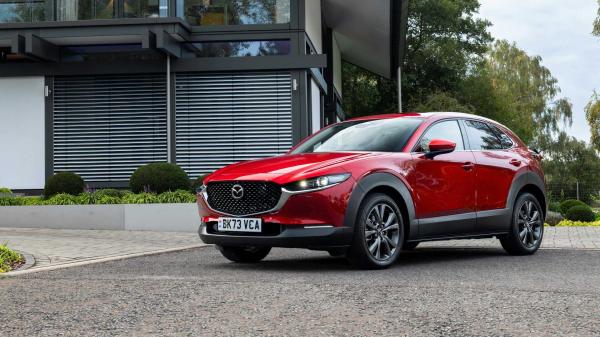
This proper subcompact SUV gets a little dash of Mazda’s sporty DNA with city-friendly proportions and a price tag that is a bit friendlier price tag.
Inline-Six Power, RWD Bias, And The Return Of Engagement In A Family SUV

The Mazda CX-70’s biggest technical statement lies under the hood. Its available 3.3-liter turbocharged inline-six engine is one of the most significant engineering decisions in the modern mid-size SUV space. While many competitors have moved toward downsized four-cylinder turbo engines with mild-hybrid assistance, Mazda has doubled down on smooth-displacement engineering. In higher-output form, this straight-six produces 280 hp and 332 lb-ft of torque delivered low in the rev range, allowing the CX-70 to move with surprising authority for its size. But raw numbers are only part of the story.

The engine is paired with Mazda’s i-Activ AWD system, which is tuned with a strong rear bias in normal driving conditions. This setup fundamentally changes how the SUV behaves under load. Instead of the nose-heavy push typical of front-biased crossovers, the CX-70 rotates more naturally through corners, with torque distribution actively managing grip in a way that feels more rear-driven than its packaging would suggest.
The inline-six itself also plays a major role in the experience. Its inherent balance delivers a level of smoothness that four-cylinder turbo units, even highly refined ones, struggle to replicate. Acceleration is linear rather than abrupt, and the sound profile is more subdued in mechanical strength than artificial aggression. In a segment increasingly dominated by electrified four-cylinder hybrids, this combination feels almost defiant. It reintroduces a sense of mechanical engagement that many buyers didn’t realize they had lost.

2025 Mazda CX-90 Turbo S Premium Plus Review: Is The World Ready For A $60,000+ Mazda?
The CX-90 succeeds the CX-9 as Mazda’s next midsize CUV chapter and moves even further upmarket. Just be ready to pay for it.
Cabin Craftsmanship And Minimalist Design That Punch Above Their Price

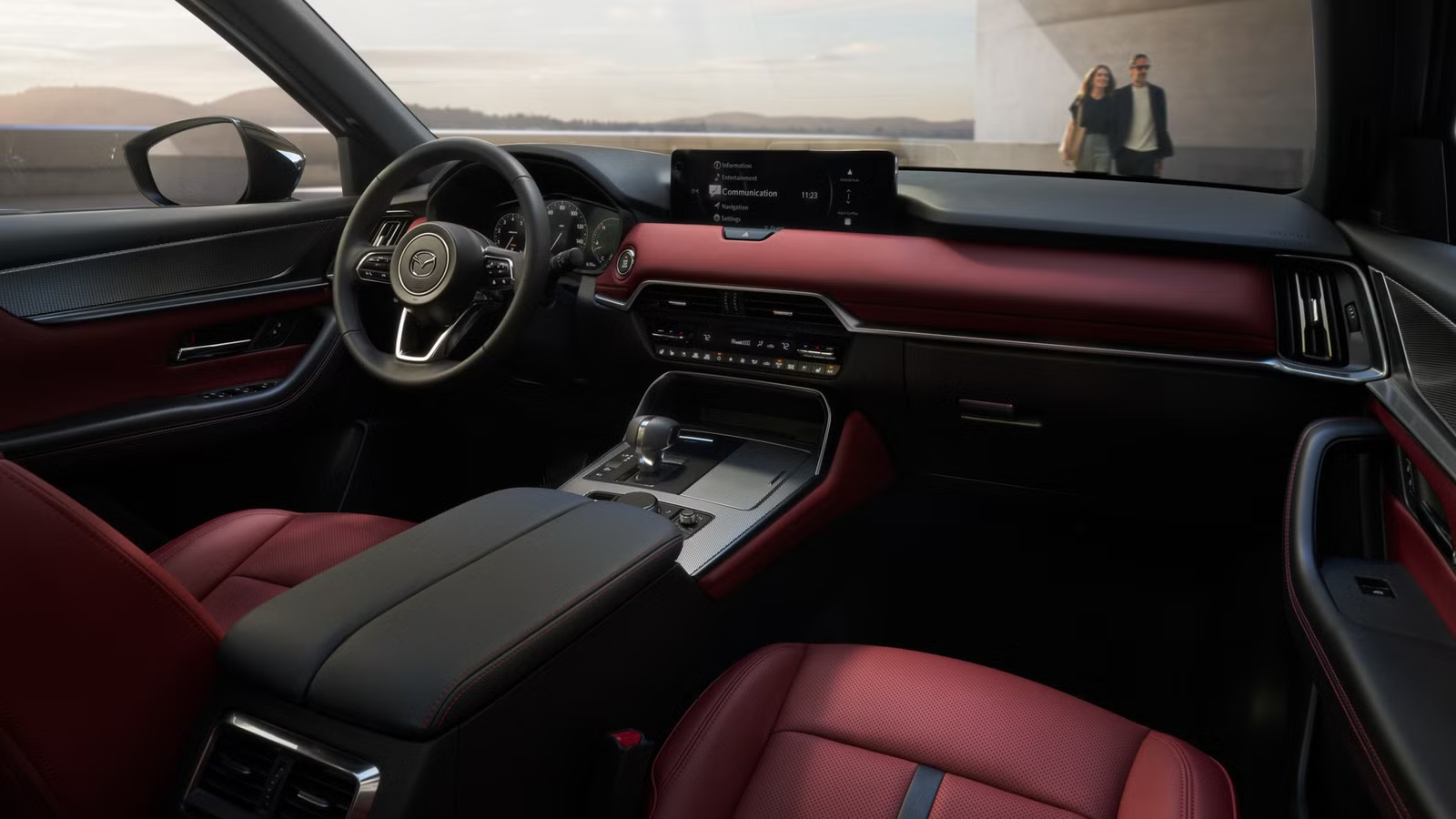
Inside the 2026 CX-70, Mazda continues its quiet challenge to conventional luxury expectations. The design language is restrained rather than flashy, but the execution is deliberate. Materials are chosen for tactility and durability rather than visual theatrics, and the layout prioritizes clarity over complexity. Soft-touch surfaces dominate high-contact areas, while stitching and trim details are used sparingly but effectively. The driving position feels more like a premium sports wagon than a tall SUV, reinforcing the vehicle’s dynamic intent.

Where the CX-70 becomes particularly interesting is in how it stacks up against German rivals in the same price bracket. A comparably equipped BMW X3 M50 or Mercedes-Benz GLC 300 4MATIC can easily push into significantly higher pricing once options are added, especially when adding driver assistance packages, upgraded interiors, and premium audio systems. The CX-70, by contrast, delivers many of these core experiences as standard or at a lower cost threshold.
Infotainment is deliberately less overwhelming than some rivals, focusing on usability rather than feature density. While it may not match the sheer digital spectacle of Mercedes’ MBUX system, it compensates with a more intuitive learning curve and fewer distractions while driving.
Why The CX-70 Challenges The Idea That Luxury Must Come With A German Badge

The strongest argument in favor of German luxury dominance has traditionally been brand equity backed by performance and resale strength. But that gap has been narrowing as consumer priorities shift toward reliability, long-term value, and ownership satisfaction.
In several recent dependability and satisfaction studies across global markets, Mazda consistently ranks near the top of mainstream brands, often outperforming several European luxury competitors in long-term reliability metrics. This matters in the premium SUV space, where high purchase prices are increasingly scrutinized against long-term ownership costs.

The CX-70 leverages that reputation directly. It doesn’t need to rely on badge prestige to justify itself because its value proposition is anchored in mechanical robustness, straightforward engineering, and lower long-term complexity. Fewer failure points, simpler powertrain architecture, and proven platform design all contribute to a different kind of premium ownership experience. This is where the challenge to German luxury becomes most visible. If luxury is defined purely by badge recognition and feature density, the Germans still lead. But if it is defined by how an SUV drives, ages, and supports its owner over time, the CX-70 makes a compelling counterargument.
Sources: Mazda U.S., MotorTrend.

Related posts





Latest Post



No Comments