
The Naturally Aspirated Masterpiece From The Analog Era
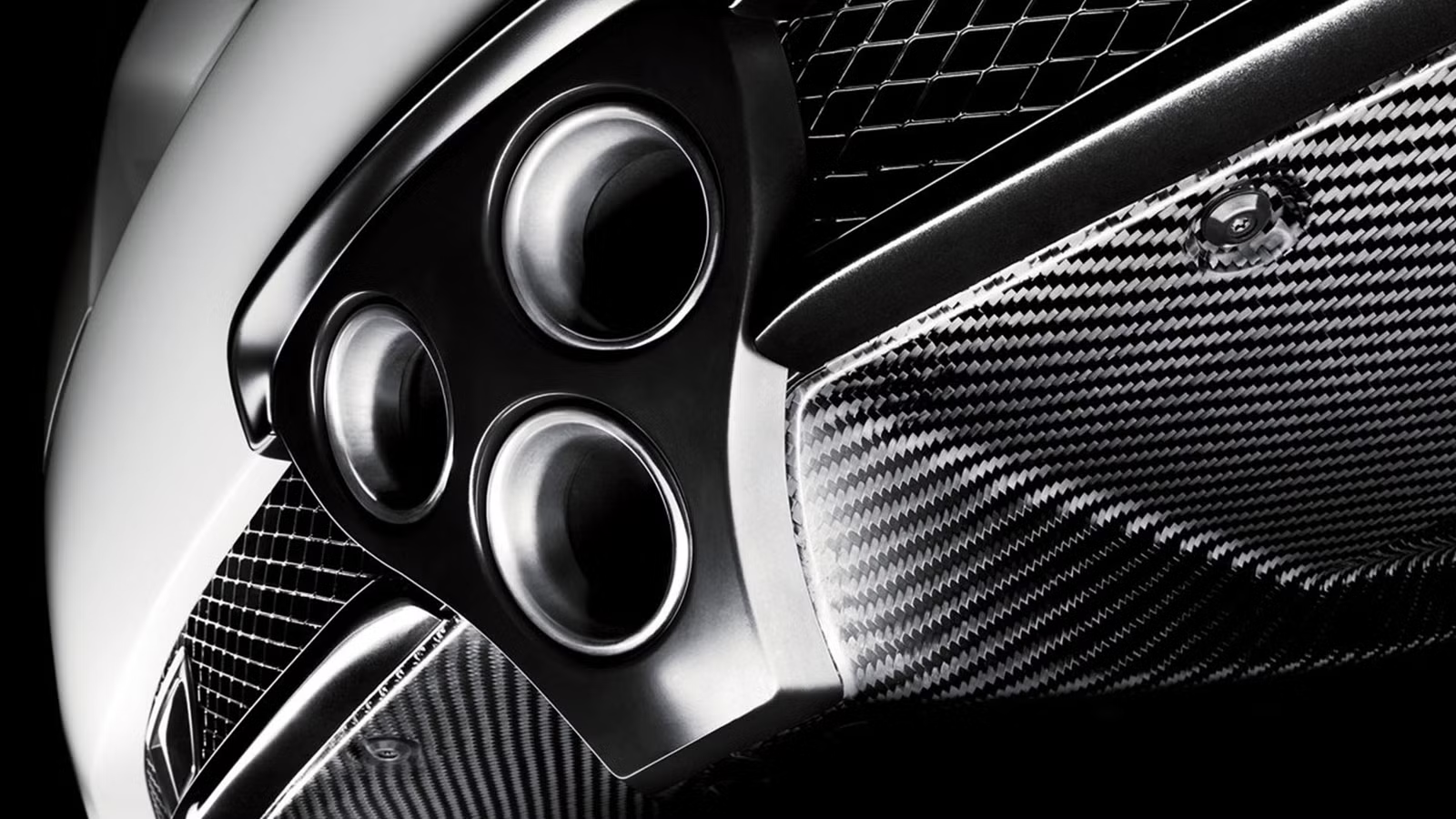
Going fast these days can be complicated. Hybrid assistance, EV drive, computers everywhere — you can feel like you need a PhD in computing just to read the owner’s manual. But there were simpler times, and one analog supercar represents one of the last, great examples of its kind. And it has a badge on its nose you would never have guessed.
The Evolution Of Cars Has Left Our Heads Spinning

It didn’t seem like yesterday that all-wheel-drive and a turbocharger were the cutting edge of performance cars. The boxy Audi Quattro of the ’80s brought this recipe to rally stages and highways across the world, changing the perception of how to build a fast car almost overnight. During the ’90s and 2000s, supercars either stuck with naturally aspirated V8s and V12s or used turbochargers. Everything seemed to stay the same for a while, until electric hybridization (a technology normally reserved for ride-shares) started being implemented in everything from fast sedans to top-end hypercars to deliver a significant boost in power.
The final piece of the puzzle is the EV super sedan and supercar, which is likely the future, whether we like it or not. So how did we go from simple ICE engines and analog machines to EVs and nearly autonomous cars covered in cameras? There is one supercar that is arguably the missing link — the last of the line of analog wonders, from a company that was always forward-thinking when it came to tech. It is, quite simply, a masterpiece.
The Lexus LFA Is One Of The Last Analog Masterpieces


Ever since Lexus arrived in the USA in 1989, it has been a cutting-edge brand. The LS 400 was a highly engineered competitor to the Mercedes S-Class, and the Lexus RX 400h of 2005 was the world’s first luxury hybrid SUV. So when the LFA was unveiled in 2009, it was cutting edge too. But looking back now, it is also amazingly analog. The car was Lexus’ take on the supercar and a “clean-sheet” design, created by a small team of engineers who wanted to push the boundaries of technologies, materials, and engineering at every stage. But while the Carbon Fiber Reinforced Plastic (CFRP) construction (Lexus used the same advanced resin technology favored by cutting-edge aerospace programs) and Carbon Ceramic Material (CCM) brakes are forward-thinking even today, the rest of the car seems like a glimpse into a simpler, glorious past.
The Heart Of The Car Is Pure Analog

At the heart of the rear-drive LFA (no fancy all-wheel-drive tech here) is a bespoke, high-revving 552-horsepower 4.8-liter naturally aspirated V10 engine. The engine is one of the greatest ICEs to ever grace an automobile, with a 72-degree angle between the cylinder heads that makes it balanced and exceptionally smooth, while Dual VVT-i technology helps give it the ability to rev to a wailing 9,000 rpm red line (while sounding like an F1 car). Electronically controlled throttle bodies for each cylinder provide superb throttle response, and a dry sump lubrication system allows the block to be positioned low in the engine bay for an optimal center of gravity.
The 354 lb-ft of torque comes at 6,800rpm, but 90% of it is available from 3,700rpm all the way to the 9,000rpm red line. The sprint to 60 mph takes just 3.7 seconds and maximum speed is 202 mph. Even though the engineering team had access to the latest dual-clutch and automatic transmission technology, they went for an automated manual six-speed gearbox to retain an authentic, analog driving experience.
The LFA Is A Unique Love Letter To The Joy Of Driving

From the compact and lightweight V10 (it is about the same size as a regular V8 engine and weighs about as much as a conventional V6) to the dedicated acoustic team that worked on the exhaust system to ensure it evoked F1 cars, the LFA is a work of art. The track-tuned suspension was developed over many hours at the Nürburgring’s Nordschleife circuit. The bespoke wishbone front/multilink rear design uses aluminum alloy extensively for high strength and low weight, utilizing the same aluminum monotube dampers as the LFA race car in the Nürburgring 24-hour race.
The LFA was hand-assembled at the Motomachi plant in Toyota City, with only 500 examples built at a maximum rate of 20 per month to make sure they had the trademark Lexus quality. The V10 engines were each assembled by a single engineer, carrying the signature of the person who constructed it. When Lexus wanted to do a supercar, they made sure they did it right.
The LFA Signaled The End For Analog Supercars

While it cannot be argued that the LFA is an analog supercar in the way a Ferrari F40 is, the attention to detail and bespoke nature are very similar. Also, the timing of its demise is eerie when you look back at it. The Lexus LFA ended production in December 2012. The so-called Holy Trinity — that is the McLaren P1, the Ferrari LaFerrari, and the Porsche 918 Spyder — were all hybrid hypercars, and all launched in 2013, just a few months after the LFA disappeared.
These groundbreaking hypercars showed the world that hybrid powerplants aren’t just for economy and can be used for dramatic power and performance. Ironically, it was Lexus and Toyota that had pioneered hybrids in more everyday cars. Soon after, many fast models followed suit, and it is hard to find any cars with naturally aspirated engines these days. The LFA was very much the last of the line for analog supercars.
The LFA Was Said To Be A Flop — But Not Anymore

Around the time the car was being built, there were rumors of slow sales and production disruption (which Toyota fairly attributed to the tsunami and earthquake that ravaged the country). Whatever the truth, you don’t have to search too much of the Interweb to find suggestions that the car was a flop, backed by claims that the car lost a lot of money for Lexus. Whether that is true or not, it could also be argued that its cult status and consistent admiration by enthusiasts recouped any lost revenue through publicity and a halo effect on the brand. Lexus also recognizes the positive impact the car has had in its own range — a new EV version of the LFA is on the way. The love of the LFA is also reflected in the prices on the used market these days.
Here’s How Much A Used LFA Will Cost You In 2026

Here is a clue: they are not cheap. The LFA has achieved legendary status, and a combination of rarity and that last-of-the-line analog V10 means collectors go crazy for these cars. Expect to pay $875,000 for a standard LFA, says Hagerty’s Valuation Tools. But if you opt for one of the 64 exclusive Nürburgring Package cars, you will need considerably more cash.
Anyone who paid the extra $70,000 on top of the standard $375,000 LFA sticker price, got themselves a bargain. These specials received carbon fiber nose winglets, a revised front splitter, and a large fixed wing at the rear. Power was up by 10 hp. But the Nürburgring Package cars now cost a whopping $1.7 million on the used market — that is a decent return on that $70,000 investment if you held onto the car. Being front-engined, one could argue that there are more exotic supercars out there than the LFA with a more traditional layout, but that only adds to the LFA’s appeal. It is a true analog original.
Sources: Hagerty, Lexus

Related posts





Latest Post


No Comments