
The Strange Engineering Trick That Made Ford’s MEL Engines So Different
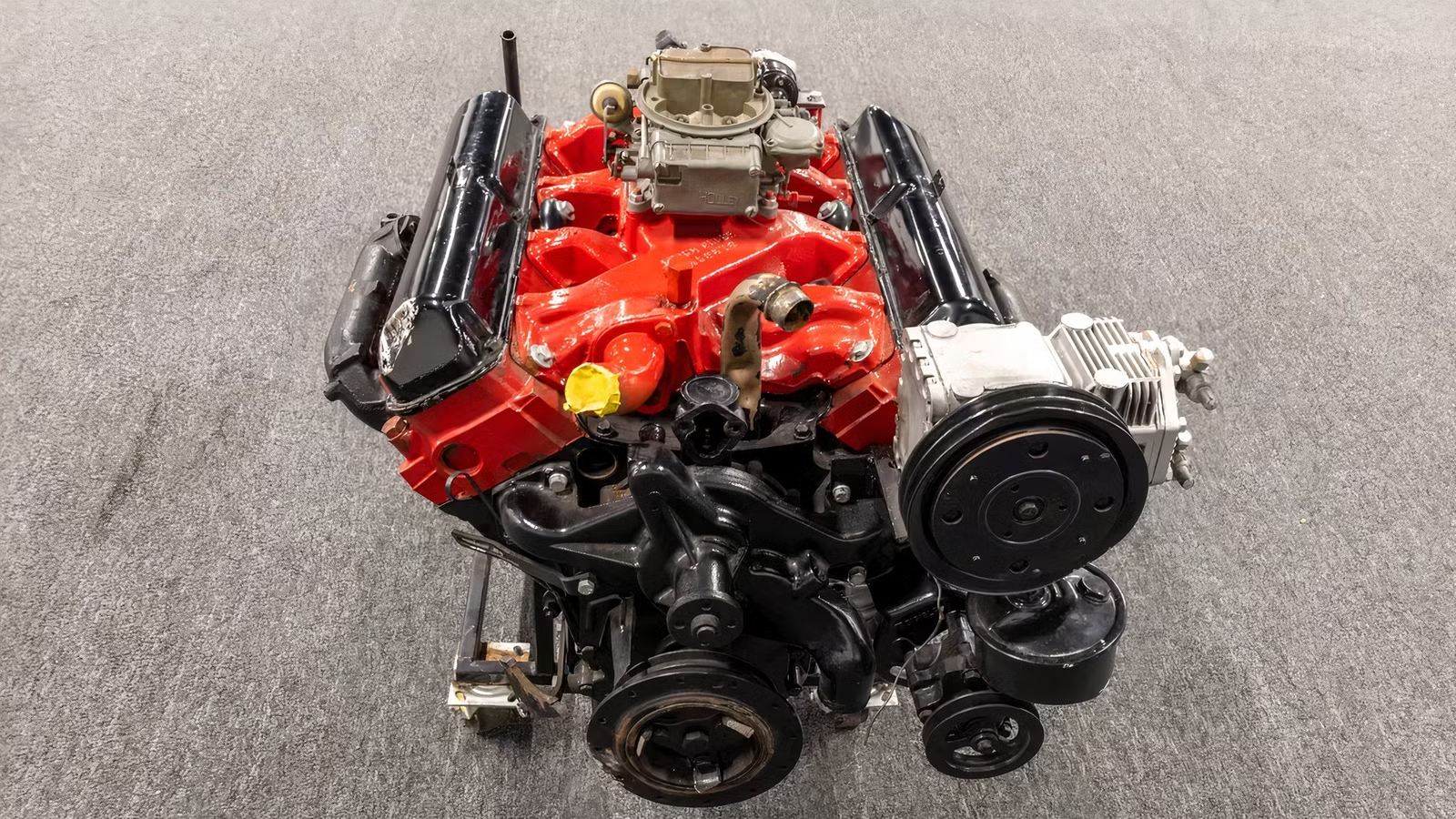
By the late ’50s, Ford’s largest cars had become heavier, more lavish, and harder to move with the effortless confidence people expected. The company needed a new V8 that could deliver serious low-speed muscle without making a Lincoln feel like it had wandered into a drag-strip staging lane.

The solution looked conventional from the outside, but its most unusual feature sat below the cylinder heads. Ford’s engineers reshaped the block itself to perform work normally handled elsewhere, creating one of the strangest combustion-chamber layouts ever fitted to a production American V8.
Ford’s Biggest Cars Had Outgrown Yesterday’s V8s
Ford’s postwar overhead-valve V8 program had already produced the Y-block, but the company’s cars weren’t standing still. Full-size models were growing heavier as the horsepower race gathered pace, and the older engine family was reaching the edge of its useful development. Lincoln, in particular, needed more displacement and stronger low-speed torque for cars designed to move with effortless authority.

Ford responded for 1958 with two new V8 families. The FE would become the famous one, earning its reputation through high-performance road cars and competition. The other engine was intended for Mercury, Edsel, and Lincoln products, with a brief detour into the Ford Thunderbird. Its job was brutally practical: make a large car feel lighter whenever the driver jammed the throttle.
More Than An FE

That mission helps explain why Ford didn’t simply stretch one architecture across every division. A luxury V8 had to feel smooth at ordinary speeds, where owners spent far more time than they did near redline. It needed deep torque and enough displacement to pull tall gearing without constant downshifts. Nobody buying a Lincoln wanted the drivetrain to act as if it had just heard the starting gun.
What resulted was a separate Ford big-block family built around generous cylinder spacing and a sturdy skirted block. It shared broad ideas with the FE, including two-bolt main journals, but it was hardly an FE in a nicer jacket. Ford had created an engine with its own dimensions, components, and engineering priorities.
The MEL Took The Long Way To Effortless Torque

MEL stood for Mercury-Edsel-Lincoln, which neatly identified the divisions it was created to serve. Production ran from 1958 through 1968, beginning with 383-, 410-, and 430 cubic-inch versions before the 462 arrived for Lincoln in 1966. Every version used the same basic architecture and a substantial 4.90-inch bore spacing, while sharing no major components with Ford’s FE or Super Duty families.
The 383 served Mercury passenger cars from 1958 through 1960. Edsel received the 410 in 1958, marketed as the E-475 because it was rated at 475 lb-ft of torque. The 430 appeared in Mercury models, the 1959 and 1960 Thunderbird, and Lincolns through 1965. Lincoln’s 462 then carried the engine family to the end of production.
In a sense, those figures tell you what Ford valued. The MEL V8’s appeal came from delivering a broad shove in large cars that weren’t interested in apologizing for their curb weight. Some versions approached 500 lb-ft, giving the engine enough low-speed strength to raise a long hood slightly while the scenery began moving backward. That isolation later hurt its popularity among hot rodders because speed parts and interchange possibilities were limited. Early 430 development also brought changes as Ford addresseddetonation and rough-idle concerns, so the MEL could be particular when builders treated it like an ordinary big-block.
Ford Moved The Combustion Chamber Into The Block
This is where the Ford MEL engine stopped following the usual script. Most overhead-valve V8s formed their combustion chambers in shaped recesses inside the cylinder heads. Ford instead used heads with nearly flat deck surfaces, then machined the block deck at a 10-degree angle to create a wedge-shaped combustion space at the top of each cylinder bore.
The cylinder itself became a major part of the combustion chamber. Bolt the flat head onto the angled block and the necessary space appeared between the head surface, cylinder wall, and piston crown. The head looked almost suspiciously plain, as though someone had forgotten to finish machining it. In reality, the block had already done the interesting work.
The Everyday Hauler

Ford wasn’t alone in exploring this approach. Chevrolet’s 348 and 409 V8s used a broadly similar chamber-in-block idea, while Ford applied related thinking to its large Super Duty truck engines. Late-1950s Detroit engineers were willing to pursue unconventional solutions if those ideas offered useful manufacturing or combustion advantages.
For the MEL, the angled deck provided manufacturing flexibility while giving the engine a distinctive wedge chamber. It also separated the engine sharply from the FE, whose later racing success would dominate Ford big-block history. One family became associated with Le Mans and Cobra Jets. The other hid its party trick under a flat cylinder head and went to work hauling Lincolns.
The Pistons Controlled More Than Compression

The MEL’s piston crown wasn’t merely a plug moving up and down the bore. Its shape helped define the combustion space, which meant piston design directly influenced how the engine compressed and burned its fuel-air mixture. Changing the crown could alter the effective static compression ratio without requiring an entirely different conventional chamber in the head.
Original step-style pistons also worked with the narrowing wedge near the top of the bore. As the piston approached top dead center, its crown squeezed the mixture toward the spark-plug area. The intended result was controlled mixture movement and more complete combustion. It was a coordinated system rather than an odd block angle dreamed up during a long lunch.
Intentional Engineering

That relationship makes rebuilding a Ford MEL V8 more complicated than refreshing a conventional big-block. A generic flat-top piston may physically fit, but it changes the chamber shape and can lower compression substantially. Correct replacements may need to be custom-made, while machine work must respect the 10-degree deck. Get that wrong and an expensive block becomes a very heavy shop ornament.
The design’s sensitivity doesn’t make the engineering flawed. It means Ford intended the piston geometry and angled block to function together beneath the cylinder head. Substituting a convenient generic piston can remove the feature that made the MEL special, leaving a running engine that performs nothing like the original design promised.
Ford’s Forgotten Big-Block Had More To Give
The MEL never built the performance legacy enjoyed by Ford’s FE or later 385-series big-blocks, but it wasn’t absent from competition. A 430-powered 1959 Thunderbird came remarkably close to winning the Daytona 500, while a Lincoln-powered dragster scored a major NHRA result that same year. Ford also offered the 1958 Mercury Super Marauder with three two-barrel Holley carburetors and a rated 480 lb-ft at 3,200 rpm. Its cast-aluminum air cleaner looked ready to inhale small birds, which seems appropriate beneath several acres of hood.
The strongest modern reminder arrived at the 2016 Engine Masters Challenge. A 420 MEL retained its stock block, crankshaft, and cylinder heads while adding 12:1 compression pistons, a roller camshaft, longer connecting rods, and an adapted intake with a Holley carburetor. The combination produced more than 550 hp, proving the old architecture could respond when someone finally brought serious development.
That comeback encapsulated the MEL V8 perfectly. Ford designed it for torque and refinement, then gave it an angled-deck combustion chamber that remains fascinating decades later. It’s strange because most engines put their cleverness in the head, but the MEL buried its best idea in the block, where history nearly buried the whole engine along with it.
Sources: Ford, ford-mel-engine.com,

Related posts





Latest Post


No Comments