
The Adventure Bike That Can Replace Almost Everything In Your Garage
If you’ve been blessed enough to have a garage full of motorcycles, then chances are that it looks something like this. A sport bike stands under a cover in the corner, ridden just twice since spring, because hitting the track requires an interstate journey, but touring isn’t its forte. A dirt bike lies behind it with flat tires and a battery tethered to a trickle charger. Parked out front is the tourer that has been doing the daily grind. Three bikes, barely enough time to maintain all of them, piling expenses, and only one of them that hits the road with some regularity. That’s a hard-to-admit reality of one person with multiple bikes.
What One Do-It-All Bike Would Actually Have To Prove

Trouble is, none of those three bikes could cover the other two. They are all specialized products for a given use case, and anything outside of that is a compromise that, at the very least, is annoying, and at best, is avoided. A genuine do-everything machine, then, has to clear a higher bar than any one of those three individually.

It needs enough chassis composure and power delivery to feel legitimately quick on a road that rewards commitment. At the same time, it has to offer enough wind protection and ergonomic range to make hours between fuel stops feel routine rather than punishing. A middleweight ADV is a great solution to replace two or more bikes, but you might crave the power deficit it has against the sport bike. While there’s also the need for enough ground clearance and suspension travel to survive loose surfaces. Very few bikes meet these criteria. Fewer still do it without feeling like a compromise stacked on a compromise.
The BMW R 1300 GS Is The Adventure Bike That Can Replace Almost Everything In Your Garage


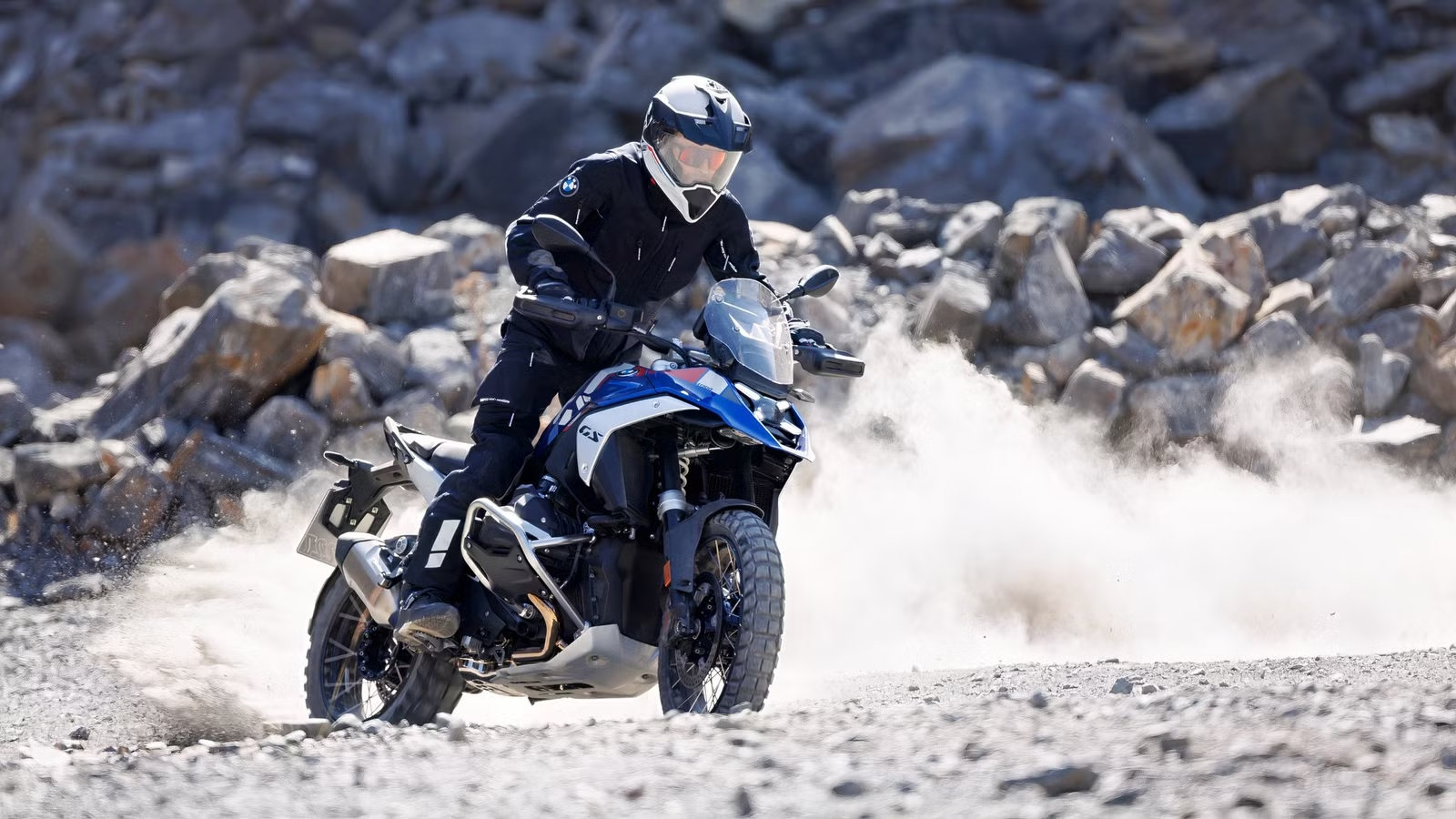
BMW built the R 80 G/S in 1980 on the idea that one motorcycle could genuinely go anywhere, and the latest R 1300 GS pushes that idea further than any generation before it. The 1,300cc boxer-twin sits low in a two-part frame that uses the engine itself as a stressed member, a layout BMW has used since the platform’s earliest days to keep weight centered. At $20,395, it costs more than a sport bike and a dirt bike combined in some cases, but it’s also the very point that it’s trying to make: that it might be the only bike a rider needs to buy for a long time to come.
The Ride Modes And Chassis Electronics That Change What Bike You’re Riding

Every R 1300 GS has four riding modes as standard in the form of Eco, Rain, Road, and Enduro, each recalibrating throttle response and traction control for a different kind of day in the saddle. The optional Dynamics package adds Shift Assistant Pro for clutchless gear changes, Dynamic Suspension Adjustment (DSA), a sportier brake setup, and a pair of Pro riding modes that push the same chassis toward opposite ends of what one motorcycle can be asked to do. One setting dials in for the canyon road. Another tackles the washed-out fire road. So true do-it-all capabilities in an ADV with optional extras that still cost less than some of its competitors.
Dynamic Mode And The Sport-Bike Case

You could decide to throw everything at the big GS, and it’ll handle it with aplomb. Switch into Dynamic or Dynamic Pro, and the throttle mapping sharpens, delivering power right off the lightest twist of the wrist instead of easing into it the way Road mode does. Shift Assistant Pro, part of the same Dynamics package, lets the rider go up and down the gearbox without ever touching the clutch lever.

So transitioning from the urban environment to a set of twisties is a fluid change from convenience to excitement. The optional DSA suspension firms up damping on the fly as lean angle and speed climb, holding the chassis flatter under hard braking into a bend than the standard setup. None of it turns a 523-pound adventure bike into a proper sport bike, but it closes the gap substantially.
Enduro Pro And The Off-Road Case

Enduro mode alone, standard on every R 1300 GS, already loosens the electronics’ grip on loose surfaces, letting the rear step out a little without traction control slamming the door shut on it. Enduro Pro, unlocked through the same Dynamics package, goes further still. Tuned around aggressive knobby rubber, it dials back electronic intervention enough that a rider can power the bike through sand or loose rock on throttle input rather than on what the electronics allow. Riders chasing serious trail use can also swap the standard cast wheels for optional forged enduro wheels, shaving weight in the unsprung mass spinning at each end of the bike. It’s truly the most durable ADV for America.
The Touring And Commuting Case

The R 1300 GS’ versatile range continues to hold up away from a canyon or a trail as well, and it’s exactly why it gets the respect that it does for catering to all kinds of riding duties. The standard seat sits at 33.4 inches, but optional low and high comfort seats swing that range from 31.5 to 35 inches, so the R 1300 GS fits a range of riders.

Heated grips and a Tire Pressure Monitor come standard, and so does a sport windscreen that adjusts by hand for better wind protection at highway speed. Radar-based guidance backs the optional Active Cruise Control that holds a set following distance in traffic or on a long interstate stretch, cutting fatigue on both kinds of ride. Add the optional Vario luggage system and the same bike can carry a week of gear for the tour.
The Boxer Twin’s Reliability Case

None of this versatility matters if the engine underneath it can’t rack up the miles to prove it. The liquid-cooled 1,300cc ShiftCam boxer-twin features double overhead cams and BMW’s variable valve timing, filling out the power curve to 145 hp and 110 lb-ft through a six-speed gearbox and a shaft final drive. While previously infamous for reliability issues, BMW has come a long way to bust those myths.

The shaft drive is the first reliability win on its own, since it skips the sprockets, chain lube, and midlife replacement a chain-driven system eventually requires. BMW also spaces oil change intervals at 6,000 miles and valve clearance checks at 12,000, a decently long interval to keep things refreshed after your continent-crossing antics are done.

The boxer’s cylinder heads sit out in open air on either side of the bike rather than buried under bodywork, so cooling and access both work in the engine’s favor over a long ownership run. It’s also one of the reasons that the big GS actually costs less to own and maintain. None of that guarantees a trouble-free bike on its own, but it’s a proven assimilation of parts and engineering that has carried generations of GS owners past six figures on the odometer, and there’s no reason to expect this one to break that streak.
R 1300 GS’ Rivals Can’t Match Up Well Enough

The R 1300 GS’ closest rivals don’t seem to win outright. The Ducati Multistrada V4 undercuts it on price, is more powerful at 170 horsepower, but riding on 19-inch cast wheels hints at its road-to-light-trails focus rather than a complete all-round build. The KTM 1390 Super Adventure R swings the other way entirely, priced higher at $21,649 with a proper 21-inch spoked front wheel, and 9.45 inches of suspension travel at each end, tipping the scales more towards off-road terrain. While the 1390 Super Adventure S is nearly as road-focused as a road and track weapon.

Neither rival is a huge compromise, as the inherent traits of an adventure-tourer remain intact and lots of versatility is built in by default. The Ducati is the sharper road bike; the KTM is an either-or situation, given the trims. But the GS is neither the fastest nor the most extreme of the three, but it’s the only one that doesn’t ever demand a rider to give up an entire category of riding. And that is the whole point of owning just the one.
Source: BMW Motorrad

Related posts
Latest Post


No Comments