
The American Bike That Makes Every Road Trip Better
There’s something uniquely American about pointing a motorcycle toward the horizon with no strict schedule and hundreds of miles ahead. It’s the image that has defined motorcycling for generations. Yet anyone who has actually spent eight or nine hours in the saddle knows fantasy often collides with reality.

Heavy cruisers can leave your back aching, sport-tourers sometimes feel more clinical than inspiring, and many adventure bikes prioritize extreme off-road capability over the kind of comfort most riders actually need on interstate highways. The best road-trip motorcycle isn’t necessarily the one that looks toughest — it’s the one that keeps every mile enjoyable.
The New Shape Of Open-Road Freedom
The classic American road trip is quietly changing shape. Heavy traditional cruisers still dominate the interstate rest stops, but some of the best destinations left in this country sit past the point where the pavement gives up — a forest service road outside Moab, a fire trail above Big Sur, a gravel spur that dead-ends at a trailhead nobody’s posted about yet. That shift leaves long-distance riders stuck with an old, tired compromise: stick to asphalt on something heavy and comfortable, or trade that comfort for a tall, dirt-capable adventure bike that turns an eight-hour highway slog into an endurance event.
The Problem With “Do-It-All” Touring Bikes


Choosing wrong here isn’t a minor inconvenience — it shows up in the body. Windscreens that buffet at 75 mph turn a six-hour ride into a neck workout. Seats built for showroom looks rather than showroom-to-sunset comfort start to ache well before the second gas stop. Suspension tuned for stunt-worthy lean angles transmits every seam in the interstate straight into a rider’s wrists. Fuel tanks sized for weekend blasts mean planning a cross-country trip around gas station locations instead of scenery.
The marketing rarely mentions any of this. Brochures sell off-road capability most owners will use twice a year, or straight-line power that matters for about four seconds off a stoplight. What actually gets tested on a real road trip is a shorter, less glamorous list: all-day ergonomics, a fuel range that outlasts the rider’s patience, real weather protection, and enough load capacity for a passenger and two weeks of gear. One motorcycle checks every box on that list without much fuss.
The Harley-Davidson Pan America 1250 Special Was Built For The Open Road
Base Price: $19,999

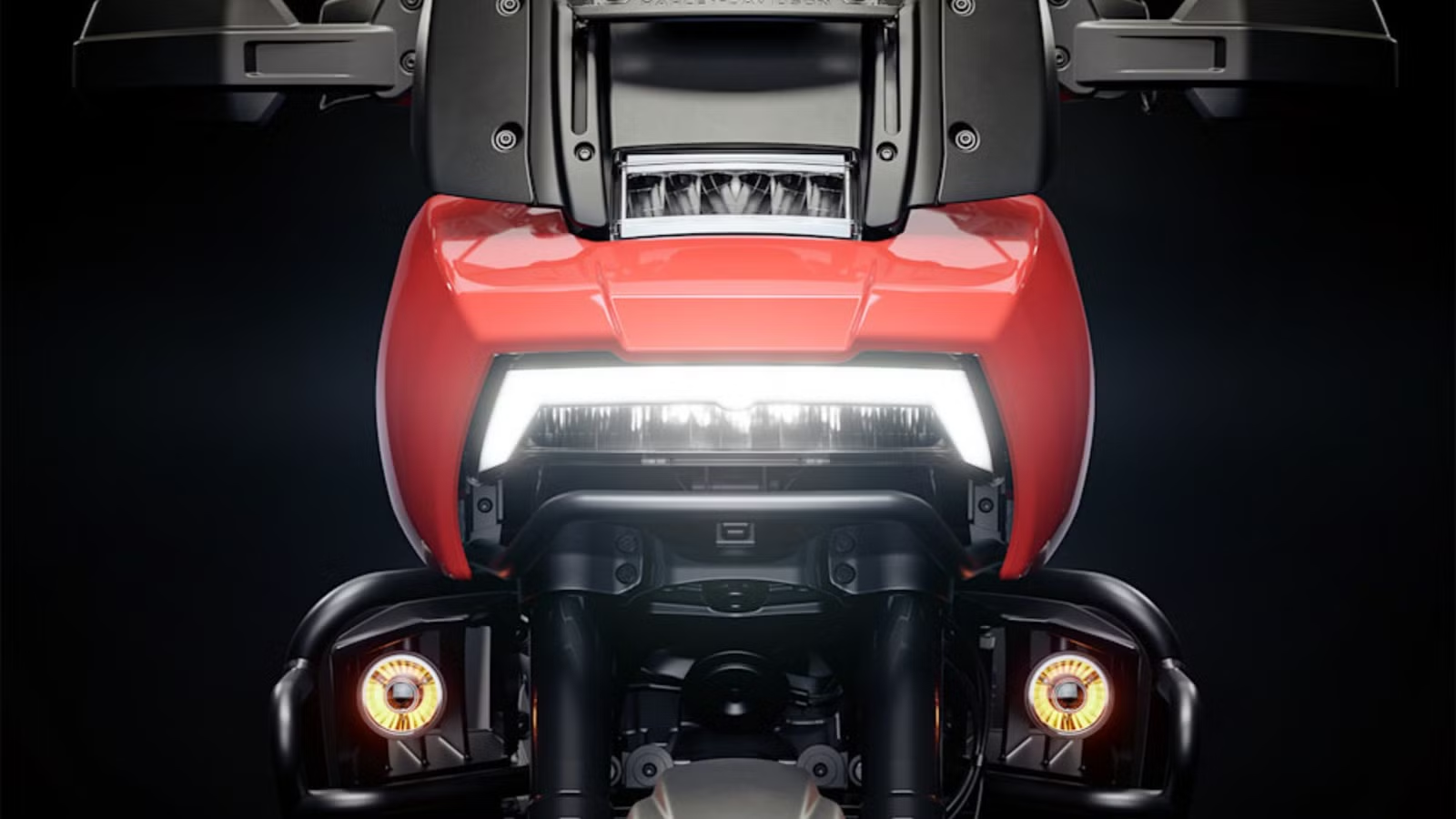
When Harley-Davidson introduced the Pan America 1250 Special, it wasn’t simply entering the adventure-bike segment — it was redefining what an American touring motorcycle could be. Instead of building another cruiser with taller suspension, Harley started with a clean sheet of paper. The result is a flagship adventure touring machine that feels equally comfortable devouring interstate miles, carving mountain switchbacks, or exploring the gravel roads leading to remote campsites. It carries unmistakable Harley-Davidson DNA, but everything beneath its rugged bodywork was engineered with versatility in mind.
Standard equipment immediately separates it from many rivals. Electronically controlled semi-active suspension continuously adapts to changing conditions, while adjustable ergonomics help riders tailor the bike to their body type. Strong luggage-carrying capability, multiple ride modes, and advanced rider aids mean the Pan America is prepared for extended travel straight from the showroom. Rather than forcing riders to choose between pavement comfort and adventure capability, Harley aimed to deliver both in a single package. That’s exactly what makes the Pan America Special such a compelling long-distance companion.
The Revolution Max 1250 Engine Delivers Effortless Highway Pace
Liquid-Cooled V-Twin Grunt Meets High-RPM Muscle

At the heart of the Pan America 1250 Special sits the Revolution Max 1250 — a clean-sheet, liquid-cooled 60-degree V-twin that Harley built without much reverence for its own back catalog. It displaces 1,252cc and makes a claimed 150 horsepower around 8,750 rpm, along with 94 pound-feet of torque peaking at 6,750 rpm. The redline sits north of 9,500 rpm, unusual territory for a brand better known for lazy, low-revving thumpers.
The key is variable valve timing (VVT) on both the intake and exhaust cams — a first for Harley-Davidson. VVT lets the engine hold onto low-rpm tractability for parking lot maneuvers and stop-and-go traffic, then open up for real breathing once the highway clears out. The result is a V-twin that doesn’t force a choice between low-end grunt and high-rpm muscle. It just delivers both, depending on what the road happens to be asking for.
Ditching Fatigue Without Losing The Soul

Power alone doesn’t define a great touring engine. What truly makes a difference after several hundred miles is refinement. Harley-Davidson integrated internal counter balancers directly into the Revolution Max engine, significantly reducing the high-frequency vibrations that often cause numb hands, tingling feet, and rider fatigue during extended highway riding. Importantly, those counter balancers don’t eliminate the engine’s V-twin personality.
That balance between character and refinement is easy to appreciate after a full day in the saddle. Riders finish the journey feeling fresher, making consecutive 500-mile days much more realistic than on motorcycles with harsher vibration levels. It’s a subtle engineering achievement, but one that transforms real-world touring comfort.
Chassis And Suspension Tuned For Pavement, Not Punishment
Adaptive Ride Height (ARH) Is A Game Changer

Harley’s Adaptive Ride Height system might be the single cleverest piece of engineering on this bike, and it solves a problem every tall adventure bike shares: staying upright at a stop. Using a network of sensors, ARH automatically lowers the seat by one inch the instant the bike comes to a stop, then quietly returns it to full height the moment the bike’s rolling again. For a rider of average height — or anyone managing a fully loaded bike two-up at a stoplight — that eliminates the flat-footed scramble that makes tall ADVs intimidating for so many riders.
Semi-Active Suspension That Reads The Road

Underneath, the Special runs Showa semi-active suspension that continuously reads rider weight, passenger load, luggage, and terrain, then adjusts damping in real time to match. It also automatically sets rear preload to maintain consistent sag no matter how the bike’s loaded, so a rider two-up with saddlebags full of camping gear gets roughly the same composed ride as a solo commuter. Riders can lean on preset ride modes or dial in custom settings, so a stretch of broken interstate and a smooth mountain pass both get handled without a wrench ever coming out. It’s suspension that quietly does its job instead of asking the rider to compensate.
Mastering The Tech Stack On Open Highways
Seamless Navigation And The 6.8-Inch Touchscreen

A road trip lives and dies by its navigation, and Harley didn’t leave that job to a phone mount vibrating loose somewhere past mile 200. The Pan America 1250 Special’s 6.8-inch TFT display is tilt-adjustable, glare-resistant, and built to register taps and swipes even through a winter glove. Paired with the Harley-Davidson App over Bluetooth, it handles moving-map navigation, music, and incoming calls right on the dash, so a rider’s eyes stay on the road instead of hunting for a buzzing phone.
Cornering Rider Safety Enhancements

None of this matters much if the bike can’t keep itself composed when conditions turn. A six-axis inertial measurement unit sits at the center of Harley’s Rider Safety Enhancements suite, tracking lean angle continuously and feeding that data to Cornering Enhanced ABS and Cornering Enhanced Traction Control in real time. Instead of treating every corner the same way it would treat a straight line, the system adjusts braking force and power delivery based on how far the bike is actually leaned over.
That matters most exactly when a rider doesn’t expect it to — gravel that’s crept onto a mountain switchback, a diesel spill outside a truck stop, a decreasing-radius turn that shows up nine hours into a riding day. The electronics aren’t there to do the riding for anyone. They’re there so one bad patch of road doesn’t end the trip early.
Source: Harley-Davidson

Related posts



Latest Post


No Comments