
Subaru’s Three-Row Electric SUV Just Got Delayed — Here’s What That Means For Buyers Who Were Counting On It
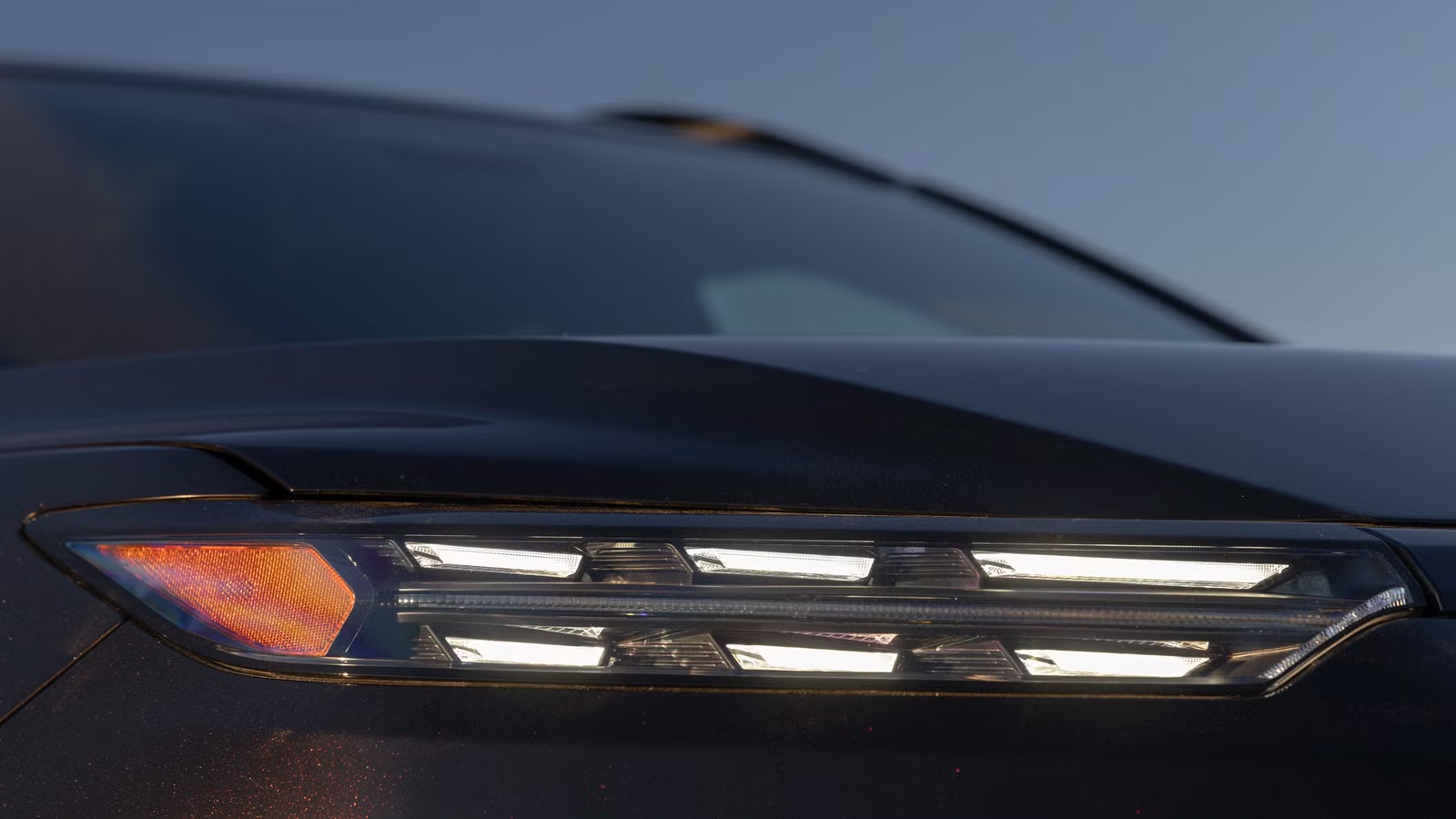
The 2027 Subaru Getaway was supposed to be one of the more compelling entries in the fast-growing three-row electric SUV segment — American-built, Subaru-priced, and slated to begin production before the end of this year. That timeline has now slipped. Subaru confirmed this week that the Getaway won’t hit its original year-end U.S. production target, pushing the launch into an unspecified later window and leaving reservation holders without a clear delivery date.

The delay is notable for a few reasons. The Getaway was positioned as Subaru’s largest EV to date, and its domestic production plan was a meaningful selling point in a market where tariff exposure and supply-chain fragility have made buyers increasingly attentive to where vehicles are built. For shoppers who had been waiting on the Getaway specifically — particularly families cross-shopping three-row EVs in the $50,000–$65,000 range — the news means recalibrating expectations and possibly reconsidering alternatives.
What Subaru Has Said About the Delay
Subaru’s official statement, reported by Inside EVs, confirms the production start is being pushed back from the originally communicated end-of-2026 target. The company has not announced a revised launch date. That kind of open-ended language — delay confirmed, new timeline not yet set — typically signals that the issue isn’t a minor calendar adjustment. A fixed slip of a few weeks usually comes with a new date attached.


Carscoops notes that Toyota flagged a similar eight-week delay for its related model, and that the Kentucky-built Subaru Getaway is now following the same path. The two vehicles share underpinnings, which points toward a platform-level or supplier-level constraint rather than something specific to Subaru’s assembly process. That shared-platform detail matters: it suggests the delay is structural, not cosmetic.
Routine Adjustment or Something Deeper?

Launch delays in the EV space are common enough that a single slip doesn’t automatically signal trouble. Battery sourcing, software validation, and factory tooling are all areas where timelines routinely compress or expand. But a few factors here warrant closer attention.
First, the Toyota parallel. When two vehicles built on the same platform in the same region both delay in the same window, the most logical explanation is a shared upstream constraint — battery cells, a specific module, or a supplier that serves both programs. Second, the broader context isn’t favorable: Hyundai recently reported a 21% profit drop tied to tariffs and supply-chain disruption, and the EV market broadly is navigating a period of demand recalibration. Subaru has notably chosen not to raise prices on its existing EV lineup for 2027, which reads as a competitive posture in a softening market — but it also means the company has less financial cushion if the Getaway launch drags.

None of this confirms a deeper crisis. But buyers should treat the current delay as potentially the first of more than one, rather than a one-time event with a clean resolution.
Where That Leaves Three-Row EV Shoppers Right Now

The three-row electric SUV segment is still relatively thin, which is exactly why the Getaway’s delay stings for buyers who had been counting on it. The vehicles currently available in this space each come with meaningful trade-offs.
The Tesla Model X seats up to seven and delivers strong range and performance, but its pricing starts well above $80,000 and its interior design remains polarizing. The Kia EV9 is the closest competitor in spirit to what the Getaway was supposed to be — three rows, family-friendly packaging, more attainable pricing — and it has received strong reviews since its U.S. launch. The Volkswagen ID. Buzz offers a distinctive design and genuine three-row capability in its long-wheelbase form, though its cargo space behind the third row is limited and availability has been constrained.

The Getaway was expected to undercut or match the EV9 on price while offering Subaru’s all-wheel-drive credibility and the appeal of U.S. production. That combination doesn’t have a direct substitute on the current market. Shoppers who were waiting specifically for that profile — affordable, three-row, domestically built — don’t have a clean alternative to pivot to right now.
What Reservation Holders Should Do Next

If you placed a reservation or deposit on the Getaway, the practical advice is straightforward: contact your Subaru dealer to confirm the status of your reservation and ask explicitly whether deposits are refundable. Subaru has not announced any changes to reservation terms, but given that no revised production date has been set, it’s reasonable to ask.

It’s also worth monitoring whether Subaru provides a more specific timeline update in the coming weeks. The Toyota parallel delay — flagged as roughly eight weeks — gives some basis for optimism that this isn’t an indefinite hold, but Subaru’s own statement doesn’t commit to that framing. Until a new date is confirmed, treat the Getaway as a 2027 vehicle in the loosest sense of that term, and keep the EV9 and ID. Buzz on your shortlist as live options.
The Getaway still looks like the right vehicle for a real slice of the family EV market — if and when it arrives. The delay doesn’t change the underlying case for the product. But buyers who needed it this year are now in a holding pattern, and that’s a meaningful setback in a segment where momentum matters.

Related posts




Latest Post



No Comments