
The American Cruiser That Gives Harley-Davidson Owners Something To Think About
Think of “American heritage cruiser” out loud in front of a group of riders and watch how many minds jump straight to the same badge. For decades, that instinct hasn’t been wrong, exactly — it’s just been incomplete. Harley-Davidson owners are a loyal bunch, the kind who trade up within the same dealership for thirty years and never once test-sit a competitor. However, loyalty isn’t the same as blind spots disappearing. Somewhere between the creeping MSRPs across the Softail lineup and a habit of locking convenience features behind pricier trims, even die-hard fans have started doing the quiet math they never used to bother with.
Harley-Davidson Still Owns The Cruiser Legacy — But Cracks Are Showing

For most of the last century, if you wanted a real American cruiser — big V-twin, low seat, chrome everywhere, the kind of bike that belongs in a black-and-white photograph — there was really only one address. Harley-Davidson didn’t just build the heavyweight cruiser category, it basically invented the emotional shorthand for it. Rivals came and went, but none of them managed to dent the idea that “Harley” and “classic American cruiser” were interchangeable terms.
That’s still mostly true in 2026. The Heritage Classic remains the segment’s north star: a Softail platform with the rear shock tucked out of sight for a hardtail look, retro-modern styling that splits the difference between a bobber and a full-dress tourer, and an MSRP that starts at $19,999 for the Solo trim. It’s a genuinely good motorcycle, and that’s exactly why it’s been able to set the terms for the entire segment for so long without much of a fight.
What Softail Buyers Keep Asking For

That said, spend any time in Harley owner forums, and a pattern starts repeating. Nobody’s torching their loyalty card, but plenty of them are grumbling about the same two things. First, the prices crept up. That $19,999 base price for the Heritage Classic climbs fast — wire-spoke wheels alone add $850, and stepping up to the Two-Up package with a passenger seat pushes the total further north of $20,000 before you’ve touched a single accessory. Second, there’s the sense that features which probably should be standard on a bike this expensive keep getting bundled into higher trims instead. That talking point now has a $21,999 answer — and it comes with a window sticker that’s harder to ignore than Harley loyalists would like.

The Indian Super Chief Forces Harley-Davidson Owners To Reconsider
Why $2,000 More Than A Heritage Classic Starts A Very Different Conversation

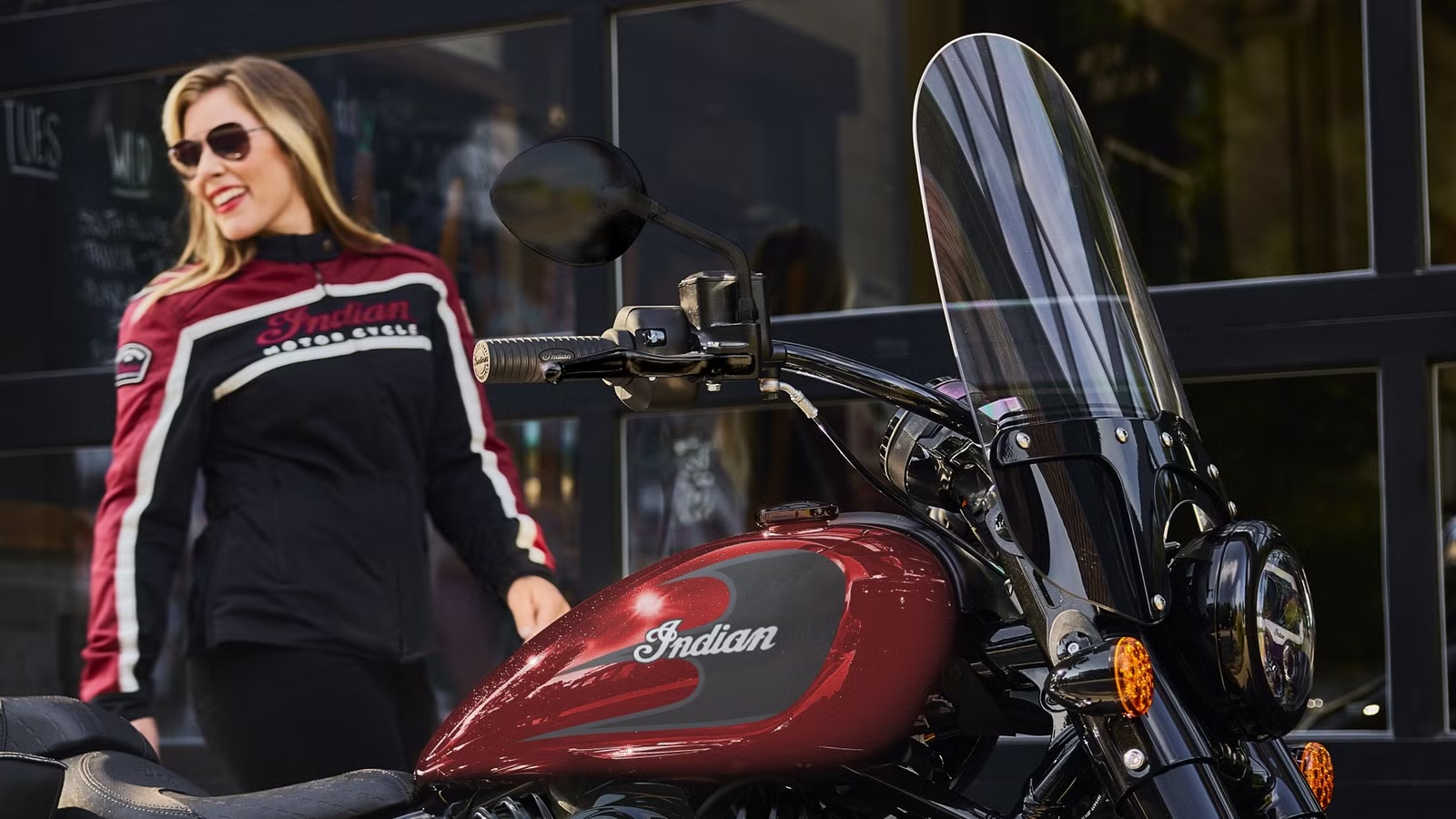
This is where Indian Motorcycle’s Super Chief enters the conversation. Springfield’s answer isn’t a scaled-down starter cruiser aimed at first-time buyers. It’s a full-size, Thunderstroke-powered Chief-family cruiser built specifically to be cross-shopped against exactly the kind of rider who’s spent their whole life assuming Harley was the only serious option.
Wire-spoke wheels, sweeping fenders that echo the shape of Indian’s 1940s originals, generous floorboards, and a dual exhaust setup that growls without needing an aftermarket pipe. The silhouette does most of the talking before you’ve even swung a leg over it. The Super Chief starts at $21,999, which puts it $2,000 above the Heritage Classic’s base price. On paper, that sounds like Indian is pricing itself out of the fight. In practice, that $2,000 gap is exactly where this comparison gets interesting — because of what comes bundled in at that number, and what doesn’t.
A Thunderstroke 116 That Matches Milwaukee-Eight Torque With Less Displacement

Under the tank sits the Thunderstroke 116 — a 1,811cc, air-cooled motor routed through a six-speed gearbox that does the job without trying to reinvent it. The cylinder heads and long pushrods are shaped to look exactly like the air-cooled V-twins that built Indian’s reputation in the first place, right down to the exposed cooling fins doing real work instead of just looking pretty.
Underneath that deliberately old-school skin, there’s closed-loop fuel injection and rear cylinder deactivation quietly handling the modern side of things. It’s a bike that wants to look like 1948 and run like 2026, and mostly pulls it off. Here’s the number that actually makes a difference, though: 120 pound-feet of torque. That’s the same peak figure Harley’s Milwaukee-Eight 117 produces — despite the Thunderstroke displacing 1,811cc against the Milwaukee-Eight’s 1,917cc.
Peak Torque At 2,900 RPM — What That Means On The Interstate

The way that torque arrives is arguably more important than the specification sheet. Peak torque comes at 2,900 rpm, which is low enough to give the Super Chief plenty of shoves without needing big revs. On an interstate, that should make passing maneuvers and relaxed roll-on acceleration feel natural. Indian itself describes the 116 as delivering passing power through all six gears, and that broad, low-rpm character is exactly what buyers expect from a machine like this.
Rear cylinder deactivation helps reduce heat around the rider when the bike is idling or moving slowly, while the V-twin’s overall character remains intentionally mechanical and substantial. That is particularly useful in urban riding, where a big air-cooled engine can otherwise become less charming as temperatures rise. Harley takes a slightly different route with the Milwaukee-Eight 117. The engine uses dual counter-balancers, which Harley says reduce vibration at idle while still allowing some character to reach the rider at speed.
The Standard-Equipment List That Would Cost Extra On A Harley
The Four-Inch Touchscreen Ride Command System

This is where the Super Chief starts making its real case. Indian built a fully functional four-inch TFT touchscreen that still appears to be a classic round analog gauge from a distance. The Ride Command feature comes standard, and it’s not a stripped-down afterthought: built-in turn-by-turn GPS navigation, Bluetooth connectivity, vehicle health diagnostics, and three selectable ride modes — Tour, Standard, and Sport — are all included at the $21,999 sticker price. Keyless ignition, cruise control, ABS, and full LED lighting round out the standard list. Want more? The upgraded Ride Command+ adds features like Bike Locator, but that’s the upsell — not the baseline you’re paying to unlock.
Retro Touring Amenities Out Of The Box

The hardware backs it up. Sixteen-inch wire-spoke wheels wrapped in Metzeler Cruisetec rubber, dual disc brakes at both ends, a 1.8-inch telescopic fork offering 5.2 inches of travel up front, and dual rear shocks good for three inches of travel out back. None of that is exotic, but none of it’s missing, either. Floorboards, proper cruiser handlebars, a quick-detach windshield, and a touring seat with a passenger pad all come standard, along with saddlebags that are actually included rather than sold separately.
Indian Super Chief Vs. Harley-Davidson Heritage Classic: Comparing The Value Proposition
Price And Standard Equipment

Line the two heavyweights side by side and the $2,000 gap starts making more sense. Both bikes ship with cruise control, ABS, and traction control with TPMS as standard — Harley isn’t skimping there. However, the real divider is what’s built into each bike’s gauge cluster. The Super Chief’s touchscreen comes with GPS navigation baked in from the factory. The Heritage Classic’s five-inch analog-digital gauge, for all its retro charm, has no built-in navigation at all.
Harley saves full touchscreen infotainment for its pricier Grand American Touring models — the Street Glides and the Road Glides of the world. A Heritage Classic owner who wants factory navigation is generally looking at a different bike entirely, not an accessory-catalog fix. If turn-by-turn navigation matters to how you actually ride, that $2,000 premium on the Indian starts looking less like a markup and more like a bundle.
Engine And Ride Character

The engines tell two different stories, and neither one is wrong. The Thunderstroke 116 is 1,811cc of air-cooled, 120 pound-feet, unapologetically old-school character—right down to the dual exhaust barking out its own unmuffled personality. The Milwaukee-Eight 117 counters with 1,917cc, 98 horsepower, and that same 120 pound-feet of torque, backed by dual counter-balancers and a 2-into-1 performance-tuned exhaust that smooth things out on longer highway stretches without losing the trademark rumble.
Harley wins on refinement, and on an exhaust note it’s spent a century perfecting. Indian wins on raw mechanical efficiency — squeezing identical torque out of a smaller engine is a genuine engineering flex, whether or not the average rider ever notices it from the saddle. What the Super Chief actually does is take the decision away from pure brand loyalty and put it back on the spec sheet. It doesn’t outperform Harley — it doesn’t try to. It just makes a genuinely competitive case for $2,000 more, and forces a question that Harley-Davidson owners haven’t had to seriously ask themselves in a long time: is the badge still worth the difference?
Source: Indian Motorcycle

Related posts
Latest Post


No Comments