
8 Vintage Honda Inline-Fours Riders Still Trust
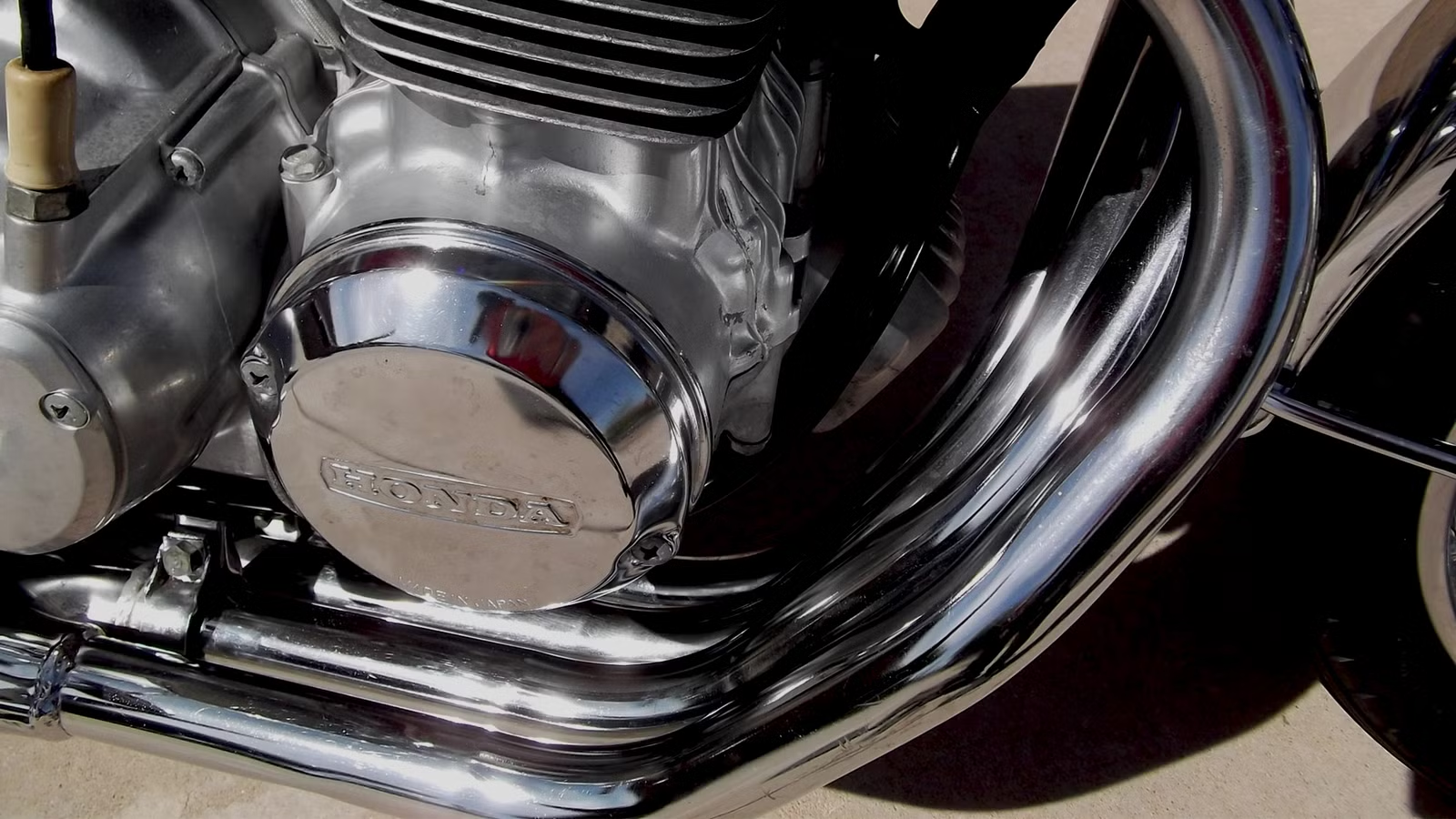
Honda did not just build great inline-fours; it perfected them. Beginning with the groundbreaking CB750 in 1969, Honda created a family of motorcycles that combined smooth power, everyday reliability, and mechanical simplicity in a way few rivals could match.

While today’s motorcycles offer more horsepower and sophisticated electronics, many experienced riders still trust these vintage Hondas to start every time, cover huge mileages, and deliver an engaging riding experience modern machines often lack. From the legendary CB750 K0 Sandcast to the rare CB1100R homologation special, these are the eight Honda inline-fours that continue to earn the respect of riders decades after leaving the showroom.
8
Honda CB400F Super Sport
408-cc, 37 bhp at 8,500 rpm
The Honda CB400F Super Sport proved that an inline-four did not need superbike displacement to deliver a memorable riding experience. Introduced in 1975, it featured a 408-cc air-cooled SOHC inline-four, a slick six-speed gearbox, and a distinctive factory four-into-one exhaust that became one of its defining features. Weighing significantly less than its larger stablemates, the CB400F rewarded riders with agile handling and an eager engine that came alive at higher revs.

Rather than relying on outright power, it delivered an engaging ride that encouraged riders to make full use of the gearbox. Its robust engine and straightforward mechanical design also earned a reputation for reliability, with many well-maintained examples still on the road five decades later. Combined with strong parts support and relatively low running costs, the CB400F continues to attract enthusiasts who value mechanical involvement over the electronic rider aids found on many modern motorcycles.
7
Honda CB550F Super Sport
544-cc, 50 bhp at 8,500 rpm

The Honda CB550F struck a balance that many riders considered the sweet spot in Honda’s four-cylinder lineup. Introduced in 1975, it retained the smoothness of the larger CB750 but packaged its 544-cc air-cooled SOHC inline-four in a lighter, more agile motorcycle. A standard four-into-one exhaust, improved front disc brake, and predictable handling made the CB550F more confidence-inspiring on twisty roads, while its manageable power delivery suited both experienced and newer riders.
Rather than chasing outright performance, Honda focused on creating a motorcycle that excelled in everyday use. That philosophy has helped the CB550F stand the test of time. Its understressed engine has earned a reputation for exceptional reliability, and its simple mechanical design makes routine maintenance straightforward. Combined with excellent aftermarket parts availability, the CB550F remains a practical vintage motorcycle that many enthusiasts would happily ride instead of a far more complicated modern machine.
6
Honda CB750 K0 Sandcast (1969)
736-cc, 67 bhp at 8,000 rpm
The 1969 Honda CB750 K0 Sandcast did more than launch a new motorcycle; it redefined what riders expected from a performance machine. Named after its early sandcast engine cases, the K0 combined a 736-cc air-cooled SOHC inline-four with an electric starter, five-speed gearbox, and the first hydraulic front disc brake fitted to a mass-produced motorcycle. Until then, high-performance bikes were often temperamental European twins, but the CB750 delivered superbike performance with everyday usability.
Its smooth power delivery and refinement helped establish the “Universal Japanese Motorcycle” formula that rivals quickly followed. More than five decades later, riders still trust the K0 because of its exceptional durability. Cycle World once profiled Kurt Winter of the CB750 Preservation Society, who regularly rode a 90,000-mile CB750, further reinforcing the model’s reputation for longevity.
5
Honda CB750F Super Sport
736-cc, 67 bhp at 8,000 rpm

Honda transformed the CB750 from an all-rounder into a sharper sport motorcycle with the second-generation CB750F. Introduced in 1975, the F Series retained the proven 736-cc air-cooled SOHC inline-four but paired it with a lower, flatter handlebar, rearset-style footpegs, improved suspension, and a redesigned fuel tank and seat for a more aggressive riding position.
The chassis revisions gave the CB750F noticeably better cornering ability and stability than the earlier K models, making it a more engaging ride on winding roads while remaining comfortable enough for everyday use. Importantly, Honda achieved these improvements without sacrificing the reliability that made the original CB750 famous. The inline-four is widely regarded as capable of exceptionally high mileages when properly maintained, while its simple air-cooled design and excellent parts availability continue to make the CB750F an attractive alternative to more complex modern motorcycles.
4
Honda CB750F2
747-cc, 73 bhp at 8,500 rpm
The Honda CB750F2 proved that Honda’s classic inline-four formula still had plenty to offer in the 1990s. Produced from 1992 to 2003, it paired a 747-cc air-cooled DOHC inline-four with modern updates such as improved suspension, stronger brakes, and a more rigid chassis. Rather than chasing outright performance, Honda focused on refinement, producing a motorcycle that was smooth, predictable, and easy to live with.
That philosophy has made the CB750F2 one of the most dependable motorcycles of its era. Its air-cooled design keeps maintenance relatively straightforward. Even today, the CB750F2 bridges two generations, offering classic Honda engineering with enough modern capability to serve as a comfortable daily rider without sacrificing the mechanical simplicity that many enthusiasts still value.
3
Honda CB900F Super Sport
901-cc, 95 bhp at 9,000 rpm

The Honda CB900F built on the success of the CB750 by adding more displacement, more torque, and a more sophisticated chassis without compromising everyday usability. Introduced in 1979, its 901-cc air-cooled DOHC inline-four produced 95 hp, while improved suspension and a stiffer frame made it noticeably more capable at speed. The model also earned an enviable competition record, with racers such as Freddie Spencer and Wayne Gardner winning aboard CB900F-based machines in production racing.
Despite its sporting credentials, the CB900F became equally respected for its durability. Its robust engine, dependable DOHC valve train, and Honda’s typically high build quality enabled many examples to accumulate impressive mileages with routine maintenance. Even today, owners praise its effortless highway cruising, mechanical simplicity, and long-term reliability.
2
Honda CB1100F
1,062-cc, 108 bhp at 8,500 rpm

The Honda CB1100F marked the final evolution of the company’s large-capacity air-cooled inline-four before liquid cooling became the norm. Introduced in 1983, it was powered by a 1,062-cc air-cooled DOHC inline-four producing 108 bhp, paired with revised suspension, a stiffer chassis, and improved aerodynamics for greater high-speed stability than its predecessors.
Unlike the limited-production CB1100R, the CB1100F was designed as a fast, comfortable road bike that could cover long distances with ease. Its combination of strong low- and mid-range torque, predictable handling, and refined performance made it one of the most accomplished Universal Japanese Motorcycles of its era. Just as importantly, the engine earned a reputation for exceptional durability. Owners on CB1100F.net have confirmed odometer readings north of 100,000 miles.
1
Honda CB1100R
1,062-cc, 115 bhp at 9,000 rpm

Built to homologate Honda’s endurance racing program, the 1981 CB1100R was far more than a dressed-up CB900F. Honda initially built around 105 pre-production motorcycles to satisfy Australian racing homologation rules before commencing full production. The 1981 CB1100RB ultimately totaled 1,050 units, with later RC and RD versions increasing overall production to 4,050 motorcycles between 1981 and 1983.
It featured a 1,062-cc air-cooled DOHC inline-four, a close-ratio five-speed gearbox, lightweight fiberglass bodywork, upgraded suspension, and stronger brakes, creating one of the most focused road-going Hondas of its era. Despite its race-bred purpose, the CB1100R never abandoned Honda’s reputation for dependability. Owners continue to praise its robust engine and solid build quality, with many examples remaining mechanically healthy decades later through routine maintenance. It proved that a homologation special could deliver genuine competition pedigree without sacrificing the reliability and usability that made Honda’s inline-fours famous.
Sources: Cycle World, CB1100F.net

Related posts




Latest Post


No Comments