
The Forgotten Datsun Straight-Six That Beat Porsche And Built Nissan’s Legend
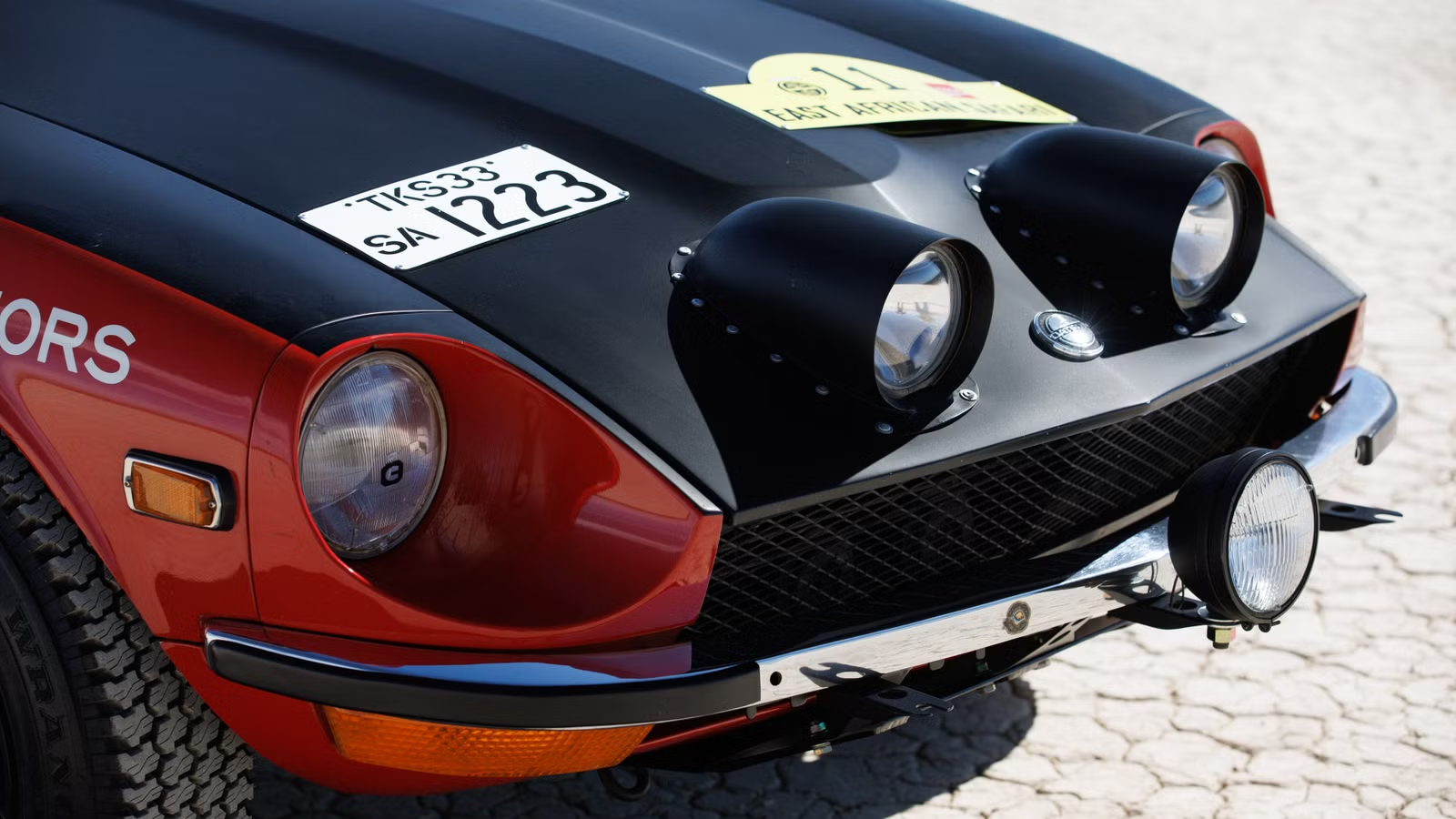
In April 1971, a dust-caked orange coupe rolled across a finish line in Nairobi, Kenya, after surviving 3,852 miles of open terrain that broke most of the field. Among the cars it outlasted were factory-backed Porsches, machines costing nearly twice as much.

Yet when enthusiasts name the engine that built Nissan’s performance legend, they almost always reach for a twin-turbo straight-six from the 1990s. In doing so, they praise the grandchild while ignoring the grandfather who built the family name. The engine that actually did the work is simpler, older, and hiding under the most famous hoods of the 1970s.
Everyone Praises The Wrong Nissan Straight-Six
Ask almost any enthusiast under 40 which engine made Nissan a performance brand, and the answer arrives before you finish the question. The RB26DETT, the twin-turbo heart of the Skyline GT-R, earned its fame through Group A domination, Gran Turismo, and auction results that now stretch well past $200,000. It is a deserving icon, but it is not the founder of the dynasty.

The RB26’s mythology rests on a foundation poured two decades earlier. In the late 1960s, Nissan was still an economy-car importer with something to prove, and no amount of clever marketing could buy credibility against Porsche, Jaguar, and BMW. That respect had to be earned on road courses, in showrooms, and in the dirt.
One engine earned it. Its resume includes back-to-back American road-racing championships, two overall wins in the world’s most brutal rally, and enough enduring demand that the factory still sells parts for it today at supercar-kit prices. It accomplished all of this with a single camshaft, two valves per cylinder, and a pair of humble carburetors borrowed from British design.
How The L-Series Turned German Lessons Into A Japanese Legend

The engine in question is the Nissan L-series, specifically the L24, L26, and L28 SOHC inline-sixes that powered the Datsun 240Z, 260Z, and 280Z through the 1970s. The same basic engine also served in a wide range of Datsun sedans and wagons, which is exactly why enthusiasts overlook it. Familiarity has a way of hiding greatness.

Its origins trace back to Germany, though not in the way the internet often claims. Prince Motor Company had been licensed to build Mercedes-Benz engine designs, and by the time Prince merged with Nissan in 1966, its engineers had refined those designs far enough that the license was no longer needed. The Mercedes resemblance survived most visibly in the valve train, while the L16 four-cylinder that set the family template was developed within Nissan’s own Small Engine Design Division.

The architecture explains the engine’s long life. A cast-iron block with seven main bearings gave it a bottom end that shrugged off abuse, while the aluminum non-crossflow SOHC 12-valve head breathed well enough to support a 7,000 rpm redline. That combination of durability below and airflow above defined a tuning ceiling far higher than its modest specifications suggested.
In the original 240Z, the 2.4-liter L24 used an 83 mm bore and 73.7 mm stroke to produce 151 hp at 5,600 rpm and 146 lb-ft at 4,400 rpm. Twin Hitachi SU-type carburetors handled fueling, with compression at 9.0:1 under the early E31 head and 8.8:1 under the later E88. The same design later stretched to 2.6 and 2.8-liters, carrying an entire decade of Z-cars on one blueprint.
151 Horsepower That Embarrassed The Porsche 911T

On paper, 151 hp does not sound like a giant-killer. In a car weighing around 2,300 pounds, however, it was enough to run 0-60 mph in 8.0 to 8.7 seconds depending on which period test you trust. The quarter-mile passed in roughly 16 seconds, and the 240Z would keep pulling to a top speed as high as 125 mph.

Those numbers put the Datsun squarely in Porsche 911T territory, which was the problem for Porsche. The 240Z launched at under $3,600, while the contemporary 911T made comparable or less power at nearly twice the price. Buyers cross-shopping an MGB GT discovered the Datsun was faster, better equipped, and no more expensive to run.
The L24 also delivered its performance without demanding sacrifice. Its strong midrange torque and unstressed SOHC design meant the same engine that raced on Sunday could sit in traffic on Monday without fouling plugs or boiling over. High-strung European rivals of the era rarely managed that trick.

Then there was the tuning headroom, which turned a good engine into a legend. Triple side-draft Weber or Mikuni-Solex carburetors, high-compression pistons, and a cam swap could unlock large, reliable gains from the stock architecture. This was not street folklore, either, because the BRE championship race engines breathed through Mikuni 44 mm carburetors. The parts that won national titles were the same parts enthusiasts bolted on in their driveways, and that connection built a tuning culture that never really died.
It Won In America And Then Conquered Kenya Twice
The racing receipts started stacking up almost immediately. John Morton drove the Brock Racing Enterprises 240Z to back-to-back SCCA C-Production National Championships at the 1970 and 1971 Runoffs at Road Atlanta, giving Datsun its first US national titles. Peter Brock’s team added consecutive Trans-Am 2.5 Challenge titles in 1971 and 1972 with the Datsun 510, powered by the four-cylinder L16 from the same modular family, completing an L-series sweep of American road racing.
The truest test came in Kenya. The East African Safari Rally covered 3,852 miles of open land and unpaved roads, and in 1971 it destroyed most of the field, with only 32 of 107 starters reaching the finish line. Edgar Herrmann and Hans Schuller brought their #11 240Z home first overall, with teammates Shekhar Mehta and Mike Doughty second, sweeping the overall, class, team, and manufacturer’s honors in the car’s first attempt.

The Porsche subplot made the result sweeter. The leading 911 developed a serious oil leak and retired, handing Herrmann a lead he never surrendered. The Datsun did not simply outrun the Porsches; it outlasted them, which is the entire point of a Safari.
Two years later, Shekhar Mehta and Lofty Drews won the 1973 event outright in the #1 240Z, proving 1971 was no fluke. The formula was simple: race on Sunday, sell 240Zs on Monday. Every ounce of credibility the Skyline GT-R later enjoyed was built on the reputation this unglamorous single-cam six earned in the dust and the dirt.
NISMO Just Spent $25,000 Per Engine Proving The Point

Half a century later, the L-series refuses to retire. Independent builders proved the architecture’s ceiling long ago, with Rebello Racing’s 3.2-liter stroker standing as the benchmark. Built on an L28 block with a longer-stroke crank, a ported N47 head, and Weber DCOE carburetors, it makes 320 hp and 295 lb-ft naturally aspirated, more than double the original output.
The race record kept growing, too. One Weber-fed 1972 240Z, running a 300 hp L-series, has collected more than 60 wins across SVRA enduros and SCCA GT2 competition. These engines did not just survive vintage racing, they kept winning it.

Then Nissan itself re-entered the conversation. NISMO’s TLX kit is a factory DOHC 24-valve conversion head that stretches the L28 from 2,753 to 2,949 cc, lifting output to 296 hp and 217 lb-ft with a 7,500 rpm redline. Production is capped at 300 units, sold only through approved L-series specialty shops, with orders opening in January 2026 at roughly $25,000 per kit.
Nissan continues to navigate one of the most financially turbulent periods in its history, yet it chose to spend engineering money resurrecting a 50-year-old engine. That is the clearest possible statement of which powerplant the company considers its heritage cornerstone. The RB26 is the poster on the wall, but the L-series is the foundation under the house.
Sources: Nissan, Hagerty, Racer.com

Related posts


Latest Post


No Comments