
The First Production Bike To Deliver Sub-3-Second 0–60 Times
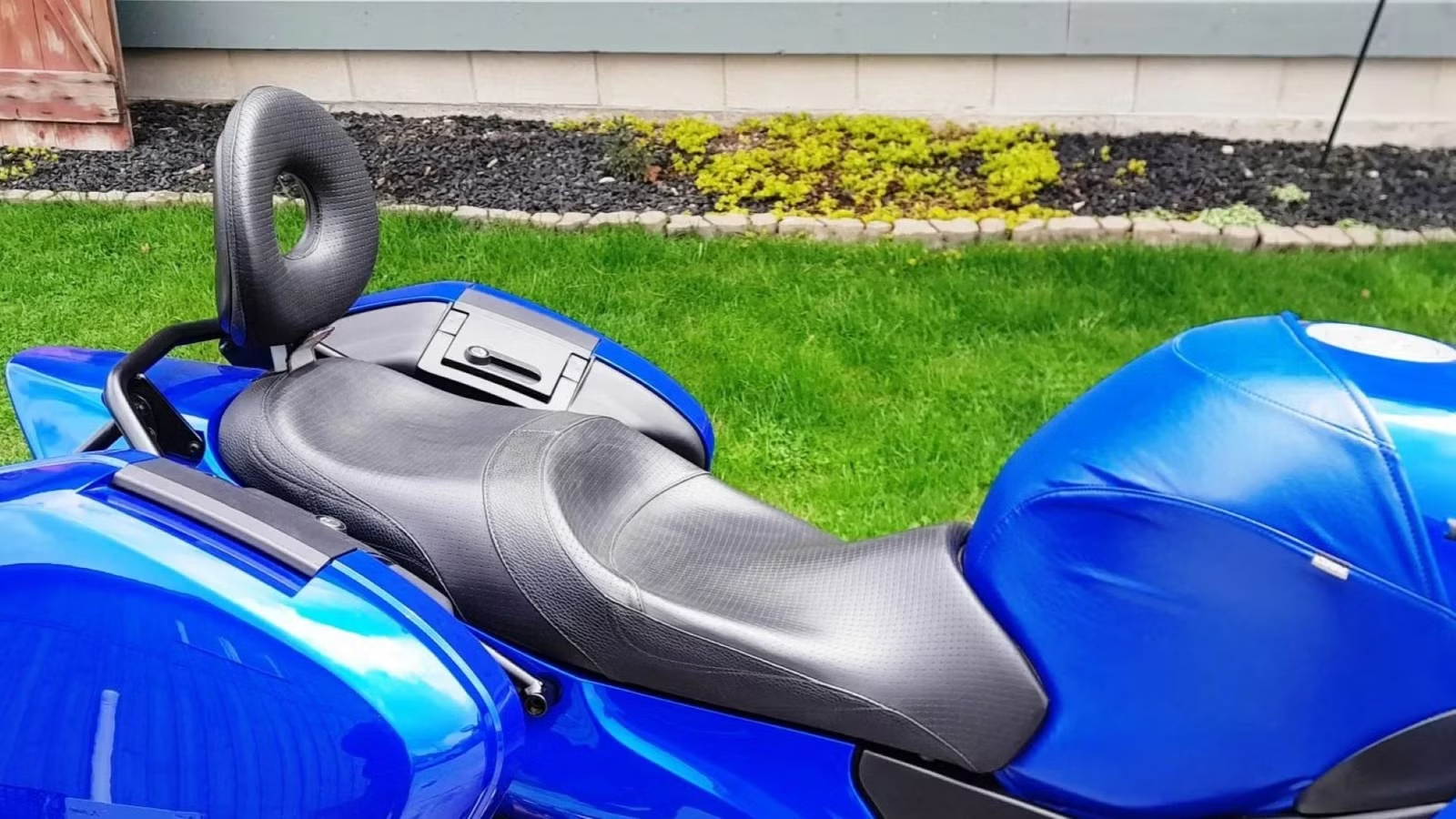
Superbikes and hyperbikes are fast, it goes without saying. An engine with two wheels attached to it was always going to be a pretty efficient way of getting down the road quickly. Since they were invented, motorcycles have been able to outperform cars for a lot less money. But when it comes to hitting 60 mph in less than three seconds, the first production bike to manage it was not as long ago as you may think. The Bugatti Veyron 16.4 arrived in 2005, and was not just the first production car to have 1,000 hp, but also the first to reach 60 mph in less than three seconds. So when did the first motorcycle do the same? It really wasn’t that long before the Veyron.
A Speed War Was Developing In The ’90s

Both cars and Motorcycles were getting faster and faster in the ’90s. At the same time that the McLaren F1 arrived in 1992, with a sprint to 60 mph in 3.2 seconds, the world of motorcycles was heating up. The 80s and 90s were arguably the golden age of motorcycle development, with Japanese brands pushing the envelope of what was possible from a bike.
Suddenly, for the price of a hatchback, you could buy an outrageously quick motorcycle that looked just like the ones on the track. The Yamaha RD500 YPVS referenced the newly launched V4 racer, the Honda NS400R was built to celebrate Freddie Spencer’s 1983 World Championship, and the Suzuki RG500 Gamma was as close to a race bike with a license plate as you could get. The Superbike World Championship was founded in 1988, bringing lightly modified road machines to the track, too.
Motorbikes Had To Stay One Step Ahead Of Supercars

It wouldn’t make much sense if a motorbike couldn’t outrun a car — that was one of the selling points. So, with the McLaren F1 honing in on the three-second mark to 60 mph, bike manufacturers realized that they needed to go one better to capture the public’s imagination. Kawasaki had stunned the world in 1990 with the 145 bhp, 175 mph ZX-11. This was a bike that ticked off a quarter mile in 10.52 seconds at 132 mph, with a theoretical top end of 188 mph. If you did some back-of-an-envelope math (or asked AI), you might come to the conclusion that the ZX-11 could hit 60 mph in less than three seconds, and you could well be right. It’s just that there don’t appear to be any documented tests where that was achieved. But when Honda answered the ZX-11 at the end of the decade, the sprint to 60 mph was logged — and it was mind-blowing.

The Honda CBR1100XX Super Blackbird Was Designed To Be The Fastest Bike The World Had Ever Seen

Launched in 1996, and named after the Lockheed SR-71 Blackbird, the world’s fastest spy plane, the CBR1100XX Super Blackbird was a statement of intent. The top speed was 178.5 mph, with recorded top speeds around a whopping 188 mph. One thing was for sure, this was the fastest production motorcycle in the world.
But what made the Super Blackbird so revolutionary was not just the speed, it was the ease at which it could do it. Sophisticated aerodynamics meant that it was just as comfortable at cruising speeds as it was at a velocity that would see your license hit the shredder. No wonder the original sales plan of 7,500 units per year was quickly ditched, with sales of the 1997 model, the first year of production, reaching approximately 18,000 units.
The Super Blackbird Had A Monster Spec

At the heart of the Blackbird, Honda fitted a water-cooled, four-stroke, 4-valve, inline four-cylinder DOHC engine mounted on a highly rigid twin-tube frame. The 1,137 cc unit was good for 164 hp and 91.5 lb-ft. The engine is famed for being smooth and willing across the range, thanks in part to twin balance shafts. For stopping power, the Blackbird features Honda’s D-CBS linked braking system, which utilizes three-piston calipers on large discs at both the front and rear. To aid top speed, the bodywork of the Blackbird was developed in a wind tunnel to reduce drag and manage airflow around the rider.
The Super Blackbird Wasn’t Just About Top End, However

Despite weighing a sturdy 492 lbs, the Blackbird would accelerate like you fired it out a cannon. When a respected motorcycle magazine tested the Blackbird against its new arch rival, the Suzuki GSX1300R Hayabusa, the acceleration times were staggering. With the test, both bikes were reported to have hit the landmark speed in 2.6 seconds. This was 1999, and the Blackbird had a new fuel-injection and ram-air system, but the output was pretty much the same. With the Blackbird being released before the Hayabusa, it seems that the Honda was the first to officially crack 60 mph in less than three seconds — less than a decade before the Bugatti Veyron, with its W16 and quad turbos, did the same.
The Super Blackbird Couldn’t Quite Match The Hayabusa In Other Areas

In 1999, the Hayabusa arrived to take the crown as the fastest bike, even inventing a new category, said Suzuki, called Ultimate Sport. The 1,298cc copper and gold bike not only looked a little out of this world, but it went like it too. The 550-pound rocket cruised past the Blackbird’s top speed and just kept on going until it maxed out at 194 mph. That is mighty fast to be clinging on to a pair of handlebars. In an instant, the Hayabusa eclipsed the Blackbird when flat out, but it couldn’t shake off the Honda in a sprint to 60 mph. No wonder the Hayabusa now lends its engine to all sorts of car projects.
The Super Blackbird Is Ridiculously Cheap In 2026

If you are used to window shopping for fast cars online (who isn’t?), you will be constantly faced with the realization that you will probably have to remortgage the house to get something exotic on your driveway. In the world of bikes, it is a different story. Big-selling, excellent sports and hyperbikes can be had for the kind of throwaway few grand that makes them a no-brainer. The Blackbird is no different. As we previously mentioned, the Blackbird sold pretty well, and these days there is a steady flow of them onto the used market. So how much can you expect to pay for the fastest bike on the road in the late ’90s? Around $5,000 should do it. A 2002 Honda CBR1100XX Super Blackbird, with 16K miles on the clock and a few tasteful mods, recently sold on Bringatrailer.com for $5,100.
A Good Blackbird Should Be Trouble-Free Biking

The Blackbird has the kind of reliability we have come to expect from a manufacturer like Honda, with excellent fit and finish. Motorcyclenews.com says the rear shock can quickly give up all its damping properties, so make sure the bike has been properly maintained. The mag adds: “Problems with the Honda CBR1100XX Super Blackbird are almost non-existent even at huge mileages.”
Of course, with any bike that will do high speeds, it is even more important to check that everything works as it should. Ultimately, if you can forgo things like a roof and four wheels, the Blackbird offers the performance of a multi-million-dollar Bugatti for less than the cost of buying a replacement turbocharger for that car.
Sources: Bring a Trailer, Honda, Cycle World

Related posts

Latest Post


No Comments