
The Forgotten Buick That Scared Corvette Owners
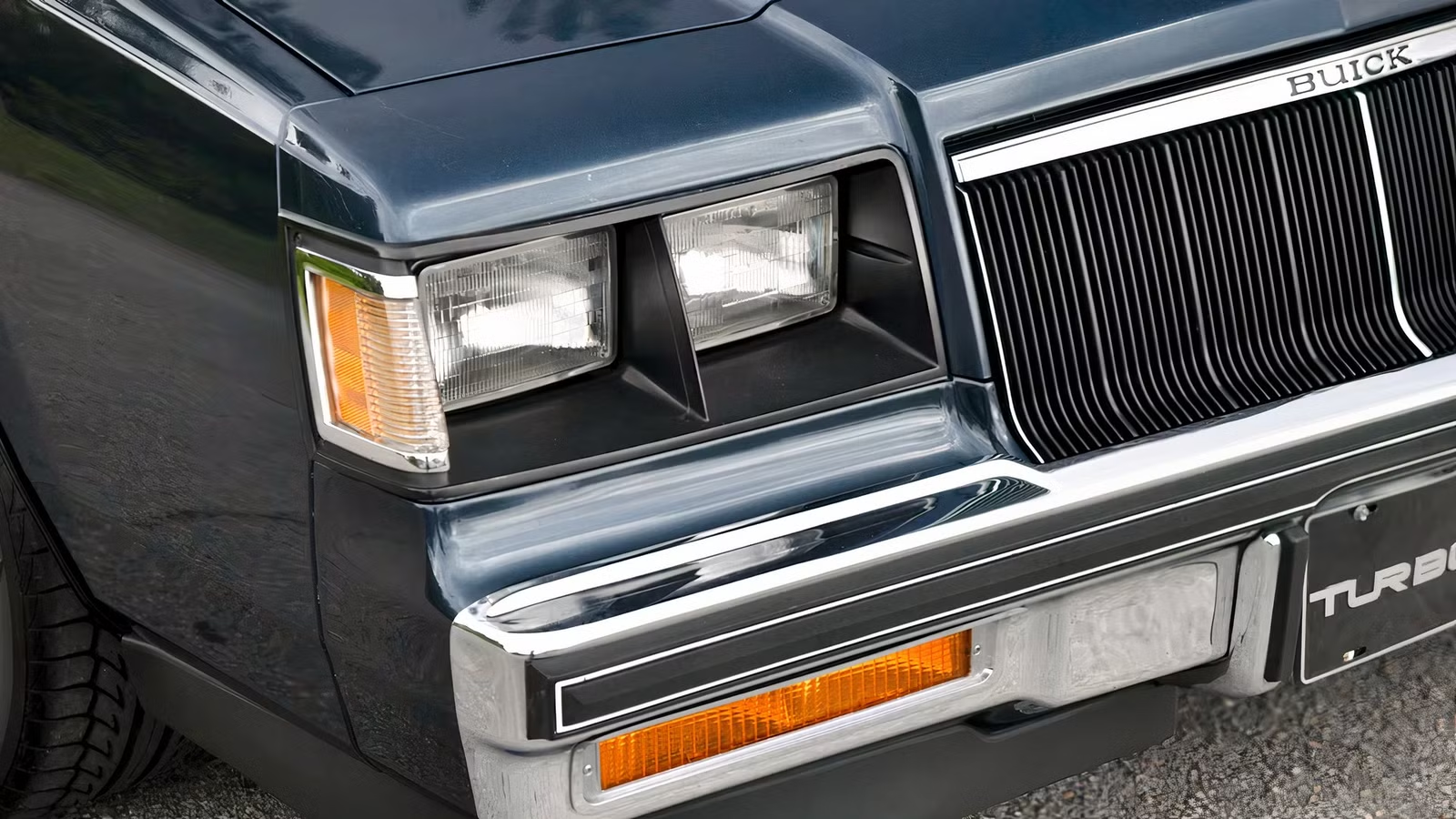
The Chevrolet Corvette’s shape announced its intentions before the engine ever fired. By 1986, the Ford Mustang GT and Camaro IROC-Z had joined Chevy’s sports car in rebuilding Detroit’s performance hierarchy, and people generally knew where the serious speed lived.

Then something with upright glass and a Buick badge began ruining that tidy arrangement. It looked ready for a country-club parking lot, yet one road test placed it ahead of America’s most recognizable Performance Cars. The joke landed hardest on Corvette owners because the punchline looked dressed for dinner.
The Corvette Was Supposed To Own America’s Fast Lane
The Corvette was the obvious target because it served as America’s performance reference point. The Mustang GT and 350-powered Camaro IROC-Z broadened the field, but Chevy’s two-seater still carried the image that made other drivers glance across at a stoplight. A traditional Buick coupe wasn’t expected to enter that conversation, much less end it.
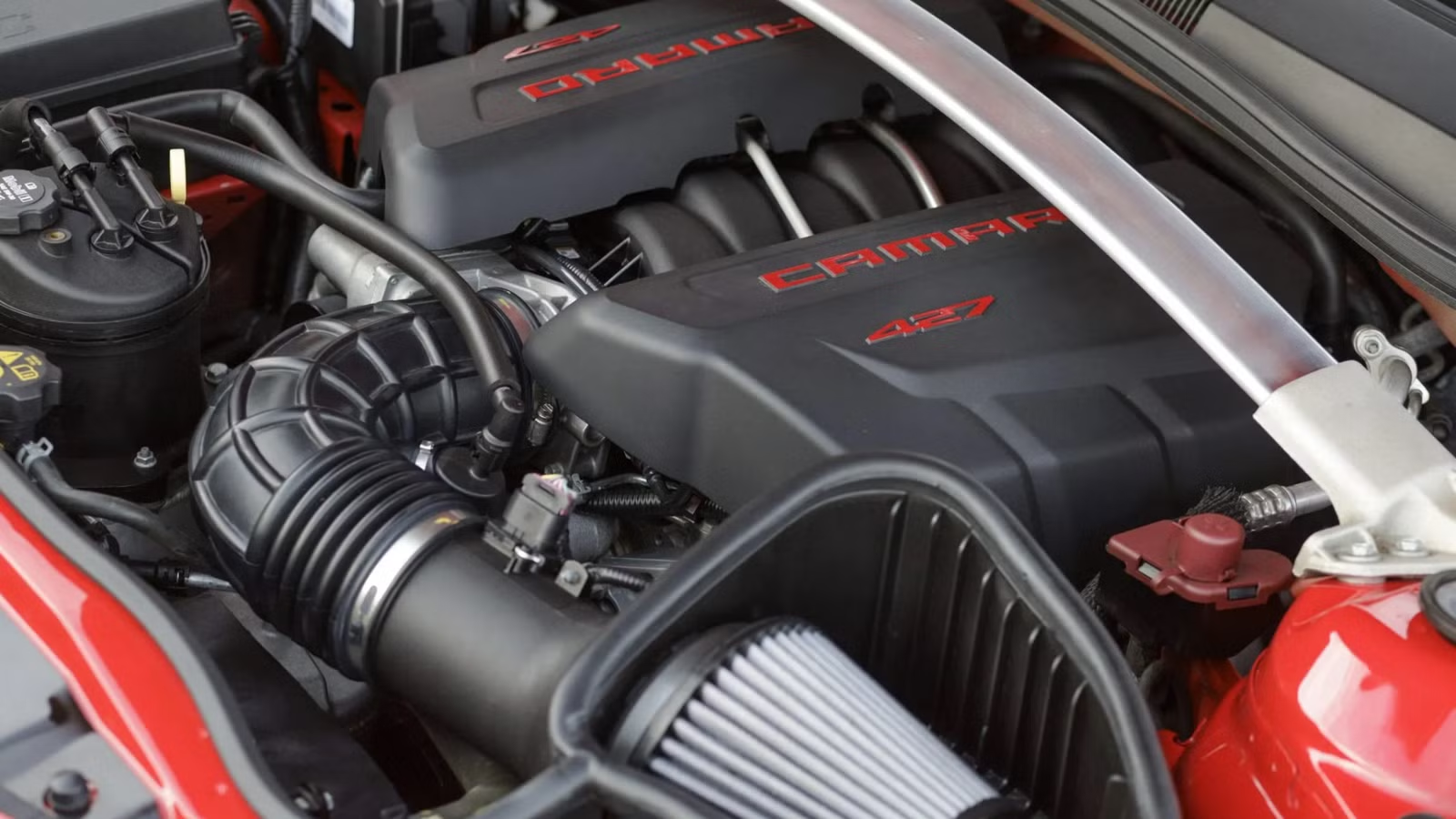
Buick’s regular engine menu made the idea sound even sillier. The standard Regal used a carbed 231ci V6 with 110 hp, while the optional Oldsmobile-built 307ci V8 produced 140 hp. Those figures suited a comfortable luxury coupe, but they weren’t going to make a Corvette driver spill his coffee.
A 1986 road test called the turbocharged version the quickest and fastest American production car, placing it above the Corvette and Mustang GT, with the IROC-Z also trailing. Buick had taken the broad-shouldered Regal shape and turned it into a genuine threat without making it look like a rolling declaration of war. That mismatch between appearance and ability was, with hindsight, quite a trick.
Buick Hid Its Best Work Behind A Formal Roofline

Buick’s turbo V6 had taken years to mature. Earlier versions had earned criticism for weak gains, detonation, and heavy fuel use, but fuel injection and electronic management steadily transformed the 3.8-liter engine. For 1985, the turbocharged Regal produced 200 hp and 300 lb-ft of torque. That was already healthy, but Buick had another 35 hp waiting for ’86.
The major addition was an air-to-air intercooler capable of flowing 350 cubic feet per minute. It used airflow from a front-mounted scoop, plus a small crankshaft-driven fan at lower engine speeds, to pull heat from the compressed intake charge. Charge temperature could fall by as much as 125 degrees, allowing denser air and more aggressive boost without inviting destructive detonation.
Tech Heavy

The rest of the system mattered just as much. A redesigned two-piece intake manifold flowed 10 percent more air, while sequential fuel injection delivered fuel to each port through Bosch injectors. A mass airflow sensor helped the engine computer calculate the correct mixture, and a distributorless ignition system managed spark through crankshaft and camshaft position data.
All that tech lived inside a body that still looked like traditional Buick thinking rendered with a ruler. The formal roof and generous glass gave almost nothing away.
The 1986 Buick Regal T-Type Was America’s Unlikely Speed King

The car upsetting that established order was the 1986 Buick Regal T-Type. Its intercooled, turbocharged 3.8-liter V6 produced 235 horsepower at 4,400 rpm and 330 lb-ft of torque at 2,800 rpm. Those numbers more than doubled the output of the base Regal V6 and comfortably eclipsed the optional V8.
A road test at the time recorded 0-60 mph in 5.85 seconds, followed by a 14.3-second quarter-mile at 98.4 mph. It launched with little tire drama, gathered speed through its automatic transmission, and reached the far end of the strip just shy of 100 mph.
That performance was enough for the T-Type to be declared quicker and faster than every American production rival named in the comparison, including the Corvette. The Buick delivered the measured acceleration needed to make the claim stick, which must have made for some very long silences inside passing Corvettes.
The best part was how little it needed to shout for the result. There was no manual gearbox to master and no cramped sports-car cabin to tolerate. The T-Type did its work while surrounding the driver with Buick comfort, air conditioning, and enough space to carry the excuses of whoever had just lost.
The Intercooler Was Only Part Of The Trick

Every T-Type sent its power through a Turbo Hydramatic 200-4R four-speed automatic with overdrive and a lock-up torque converter. A standard 3.42:1 final-drive ratio and limited-slip diff helped turn the V6’s low-rpm torque into useful acceleration. Buick didn’t ask buyers to dig through an options catalog to uncover the correct gearing.
Meanwhile, on the chassis side, its Gran Touring suspension added higher-rate springs and shocks, a larger front stabilizer bar, and a rear stabilizer. The car used 15 x 7-inch cast-aluminum wheels wrapped in P215/65R15 Goodyear Eagle GT tires. The same test produced 0.80 g on the skidpad and a 141-foot stop from 60 mph.
Playful And Fun

Those figures didn’t turn the Regal into a Corvette through a corner, and pretending otherwise would miss the car’s appeal. The T-Type offered credible grip and strong braking without giving up its smooth ride, while keeping its strongest advantage in reserve for the next open straight. It was a balanced road car with a wonderfully unfair powertrain.
The visual changes were restrained but purposeful. Blacked-out trim appeared around the grille, windows, wipers, and headlamps, while body-color sport mirrors and revised taillamp moldings sharpened the shape. Inside, people got a leather-wrapped steering wheel, a turbo boost display, and an LED tach. The colored bar-graph boost gauge looked more arcade cabinet than cockpit, but at least the game was fast.
The Grand National Took The Fame And Left This Buick Behind

Buick built 7,896 turbocharged performance Regals for 1986, but only 2,384 were T-Types. The remaining 5,512 wore Grand National trim, and that split says plenty about what people wanted, doesn’t it? The Grand National’s all-black body, front air dam, rear spoiler, and minimal brightwork gave the performance a recognizable uniform. It looked dangerous while standing still.
The T-Type delivered essentially the same core mechanical package with less spectacle and a broader choice of exterior colors. That made it the subtler car, but subtlety sadly doesn’t always win the poster contest. The Grand National became the name everyone remembered, while the Buick Regal T-Type was reduced to an explanatory sentence at car shows.
Embarassing The Established Lot

Collectors are paying more attention now. Over the most recent one-year snapshot, eight sales averaged $28,581, with the market benchmark sitting at $28,136. The highest recorded sale reached $49,000, proof that a sharp T-Type no longer hides at used car money even if it remains less famous than its blacked-out sibling.
That delayed recognition feels appropriate. The ’86 Regal T-Type showed that Detroit’s next performance leap didn’t require more cylinders or an obvious sportscar body. Buick paired boost with an intercooler and careful engine management to embarrass the established order, then strangely let another version take most of the applause.
Sources: HotRod, Over-Drive Magazine, Hagerty, Mecum, Classic.com.

Related posts


Latest Post


No Comments