
The Honda V6 So Reliable It Survived 27 Years Without A Turbo
For years, the automotive industry has insisted that smaller turbocharged engines represent the future. More power, better fuel economy, and cutting-edge technology have become the standard sales pitch as manufacturers race to squeeze every last horsepower from fewer cylinders. Yet as recalls mount and increasingly complex powertrains reveal expensive weak spots, many buyers are beginning to wonder whether newer automatically means better. Sometimes, the smartest engineering decision isn’t chasing the next big thing; it’s perfecting what already works.

One automaker quietly ignored the industry’s rush toward turbocharging and spent nearly three decades refining the same basic formula instead. The result isn’t the most powerful V6 on the market or the one with the flashiest specifications, but it has earned something many newer designs are still trying to prove: the confidence of owners who expect to drive well beyond 200,000 miles. In an era when reliability has become a competitive advantage, that long-term philosophy may be paying off more than ever.
Why Some Engines Earn A Reputation That Outlasts Automotive Trends
Reliability Often Matters More Than Chasing The Latest Technology
Horsepower, sprint speed, and lap times are fun to discuss when it comes to high-performance engines and vehicles made to go extremely fast. While these are exciting topics, they don’t have anything to do with what drivers really want or need out of the vehicles they drive every day.

The SUVs, vans, trucks, and sedans we drive daily need to perform in traffic and provide the peace of mind that makes it easier for drivers to go where they need to without concern. This is where reliability, durability, and long-term proven performance come in. As the industry shifts toward turbocharged engines to reduce emissions by using fewer cylinders, naturally aspirated engines are standing out, showing many owners why they often make the most sense, especially when it’s an engine like the Honda V6 that has been dependable for nearly three decades.
Honda’s Long-Term Engine Philosophy Has Rarely Followed Industry Trends

Honda has a long history of developing engines that simply do their job well. Dating back to Honda’s arrival in America with the N600, many naturally aspirated, small Honda engines have delivered daily driving confidence, making it easy for owners to go where they need to go every day. The engine that has quietly lasted 27 years of production and development without the need for major improvements isn’t a small four-cylinder, but a V6 used in several Honda vehicles, including the modern-day Passport, Pilot, Ridgeline, and Odyssey. This engine is also used in the Acura MDX, making it one of the most widely used engines on the market.
The J35 Has Been Quietly Evolving Since 1998
The 2026 Honda Pilot Uses The Most Advanced Version Yet

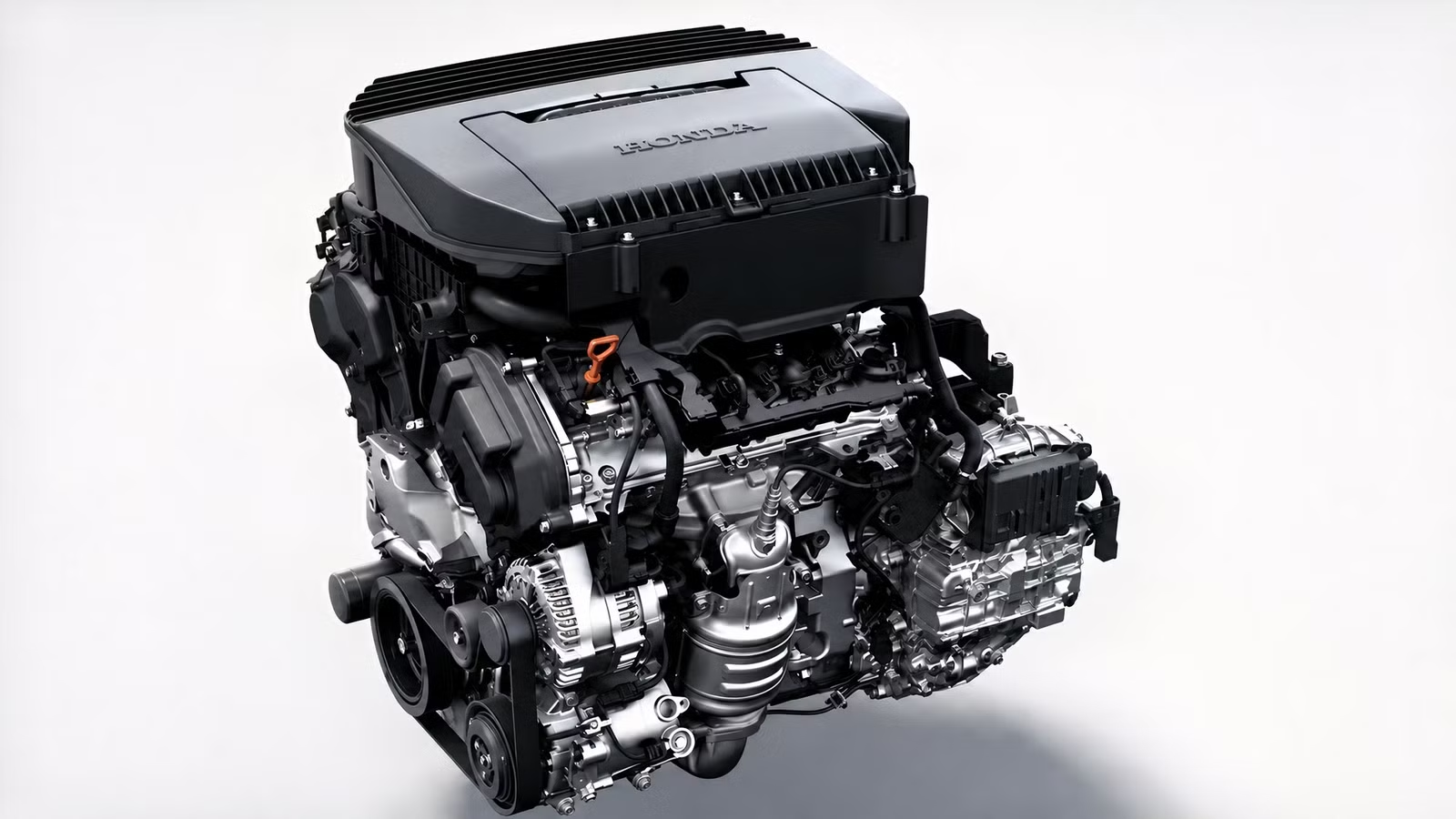
The J35Y8 engine found in the 2026 Honda Pilot is a 3.5-liter V6 model that produces 285 horsepower and 262 pound-feet of torque. To ensure the J35 engine continues to comply with emissions standards, it was updated from a SOHC/VTEC to a DOHC setup. This allows Honda to maintain the naturally aspirated build while meeting necessary SULEV30 industry standards. This deliberate decision to avoid turbocharged engines in its largest vehicles shows Honda’s commitment to the durability of its J35 engine series.
In the Pilot, the J35 engine mates with a 10-speed automatic transmission, and the SUV is available in FWD or AWD. In FWD models, the fuel mileage reaches 19 city/27 highway mpg while AWD versions achieve 19 city/25 highway mpg.
Twenty-Seven Years Of Refinement Matter More Than Reinvention

Over the past 27 years, the Honda J35 engine has evolved rather than been reinvented. This has led to at least four variations during that time, including the J35A, J35Y, and J35Z, with only the J35Y still in use for five vehicles from the Honda family. Instead of embracing turbocharged four-cylinder engines for its largest vehicles, Honda understands the benefits of the J35 engine, especially in the latest models.
This engine has been continually refined for improved combustion efficiency, durability, improved electronics, and emissions. Incremental improvements reduce unexpected failure points that many automakers are encountering with new technologies and smaller turbocharged and hybrid powertrains. The historically impressive J35 engine contributes greatly to owner confidence in Honda vehicles with this naturally aspirated V6 under the hood.
Simplicity Is Still One Of Honda’s Greatest Reliability Advantages
Why A Naturally Aspirated V6 Avoids Many Turbocharged Failure Points

Simplicity matters. One of the biggest selling points for electric vehicles is the same as that for naturally aspirated engines. These engines lack turbochargers, intercoolers, additional plumbing, and higher combustion pressure. This means naturally aspirated engines have fewer moving parts than turbocharged engines, resulting in far fewer failure points.
Turbocharged engines require high-pressure combustion, which increases thermal stress on the engine and turbochargers. While a naturally aspirated engine runs cooler, has lower-pressure combustion, and experiences lower thermal stress, smaller turbocharged engines are forced to face these challenges. This causes long-term stress on turbocharged engines, which simply doesn’t exist in the Honda J35 engine. To be perfectly clear, a naturally aspirated engine doesn’t automatically mean it’s better than a turbocharged engine, but the J35 engine has proven itself over many years and variations.
The J35 Still Requires Maintenance To Deliver Its Reputation

Just because the J35Y has fewer moving parts and failure points doesn’t mean you can simply ignore it and expect it to perform. Like every engine and its surrounding components, your Honda vehicle requires maintenance and care if you expect the J35 to live up to its reputation for longevity.
Some early J35 variants faced oil consumption issues in the Variable Cylinder Management (VCM) system. Additionally, the timing belt must be replaced at the recommended interval to ensure the engine continues to perform as expected. Some owners have even experienced carbon buildup when the engine wasn’t serviced at its proper intervals. These issues highlight the importance of necessary maintenance, ensuring the J35 can perform as desired. This transparency is a strength, not a weakness, ensuring owners can enjoy years of worry-free driving when they adhere to regularly scheduled maintenance intervals.
Toyota’s Recall Shows The Risk Of Modern Engine Complexity
The Twin-Turbo V35A Recall Became One Of Toyota’s Biggest Recent Engine Stories

Toyota made a bold move, especially for the brand, by moving away from naturally aspirated V8 engines in favor of the 3.4-liter twin-turbocharged V35A V6 engine. This engine is used for the modern Toyota Tundra and Sequoia as well as the Lexus LX and GX models. While this engine isn’t a direct competitor to Honda’s J35, recent issues with it, which have resulted in Toyota recalling roughly 270,000 vehicles, highlight the distinct difference from the reliable naturally aspirated V8 engine Toyota used in previous generations.
The recall issued for Toyota’s twin-turbo V6 is due to main bearing failures from machining debris. To be completely fair, any automaker that makes such a bold change is likely to face recalls and issues, and Toyota produces more vehicles than any other automotive brand in the world. Still, ditching the 5.7-liter V8, which had been a proven performer, will likely cost Toyota points in reliability scores.
Honda’s Conservative Engineering Suddenly Looks Like A Smart Long-Term Bet

Honda has not adopted turbocharging in its largest vehicles, which seems like an intentional choice rather than simply sticking to an outdated engine design. Honda has turbocharged engines in many of its smaller vehicles, which means it is intentionally sticking with the J35 engine family, betting on conservative, proven engineering rather than embracing new, unproven philosophies.
Why The Honda J35 Remains One Of The Best Engines For Long-Term Ownership
Mechanics Continue To Trust The J35 Beyond 200,000 Miles

The Honda V6 engine is well-known as one of the most reliable engines, and it’s capable of easily reaching more than 200,000 miles, as long as the timing belt is replaced every 100,000 miles, as directed by the maintenance schedule. Many independent mechanics continue to recommend the J35 engine for its simplicity, proven longevity, and ease of service.
The Honda Pilot has an average annual maintenance and repair cost of $542, which is lower than the midsize SUV class average of $573 and the all-vehicle average of $652. Extensive parts availability, coupled with predictable maintenance, contributes to lower maintenance costs, which in turn leads to lower ownership stress. No wonder Honda sticks with the J35 engine.
The 2026 Pilot Proves Reliability Can Still Be A Competitive Advantage
The Honda J35 engine embodies a “refinement over revolution” philosophy and shows that a naturally aspirated engine with a proven track record of longevity still has a place in the modern automotive market. Although it might not be the most efficient engine on the market, it offers years of worry-free driving with predictable needs that make it easy for owners to understand how to keep it running well past the end of their automotive loan. This makes the 2026 Honda Pilot a good option for drivers who plan to keep their vehicle for 10–15 years. The Pilot has a 31.5 percent chance of reaching at least 200,000 miles, according to iSeeCars, which is much higher than most vehicles.
Twenty-seven years is an eternity in the automotive world, yet this Honda V6 has survived every major industry trend without surrendering to turbocharging. Instead of chasing bigger numbers or flashier technology, Honda chose to refine a proven formula, creating an engine that continues to earn the trust of owners who measure success in decades and hundreds of thousands of miles rather than quarter-mile times. It isn’t perfect, and it still demands timely maintenance, but its longevity proves that reliability doesn’t always come from reinventing the wheel. Sometimes, the engine that survives 27 years without a turbo is the one that was engineered to outlast the trends themselves.
Sources: Honda, CarPro, Edmunds, RepairPal, iSeeCars

Related posts


Latest Post


No Comments