
The First Production Pickup To Break 1,000 LB-FT Of Factory Torque
There was a time when 900 lb-ft of factory torque sounded almost excessive for a consumer pickup. Then, almost overnight, four digits became the new target. What looked like another headline-grabbing specification turned into the defining moment of the modern heavy-duty truck market, forcing every major diesel manufacturer to rethink the limits of engines, transmissions, and chassis design.

The milestone wasn’t the finish line. It was the starting gun. Within a few product cycles, competitors had pushed well beyond 1,000 lb-ft, transforming what had once seemed unimaginable into the segment’s new normal.
Before Four Digits Became The Benchmark
By the late 2010s, the heavy-duty pickup segment had become Detroit’s most competitive engineering battleground. Ford’s Power Stroke, GM’s Duramax and the Cummins-powered Ram HD were no longer fighting over styling or trim levels alone. Every product update brought higher tow ratings, stronger drivetrains and another jump in diesel torque.

The numbers reflected that escalation. For 2018, the strongest Ram Heavy Duty produced 930 lb-ft of torque and 385 horsepower, while maximum fifth-wheel towing reached 31,210 pounds. Ford and General Motors remained close enough that leadership frequently changed with each new model year, leaving no manufacturer comfortably ahead for long.
Yet engineers inside all three companies understood that one number carried more weight than the rest. Breaking into four-digit torque wasn’t simply another incremental increase—it represented a psychological threshold comparable to the first 200-mph production car or the first 300-mph supercar. Whoever reached it first would redefine expectations for the entire segment.
Breaking Four Digits Required More Than Engine Tuning

Adding another 70 lb-ft wasn’t as simple as recalibrating fuel delivery or increasing turbocharger boost. Every additional pound-foot had to travel through the crankshaft, transmission, driveshaft, axle shafts and frame before it reached the rear tires. Weakening any link in that chain risked compromising durability under heavy towing.
Engineers therefore approached the challenge as a complete vehicle program rather than an engine upgrade. A stronger block could survive higher cylinder pressures, but the transmission needed greater torque capacity. The axle had to withstand larger loads. Even the frame required higher torsional rigidity to support increased towing capability without introducing unwanted flex.
When Ram unveiled the finished truck, then-brand head Jim Morrison summed up the achievement with a line that immediately entered diesel-truck folklore: “It’s the sound barrier, and we just broke it.” The quote wasn’t about owning the torque crown forever. It acknowledged that once one manufacturer crossed four digits, every competitor would be forced to follow.
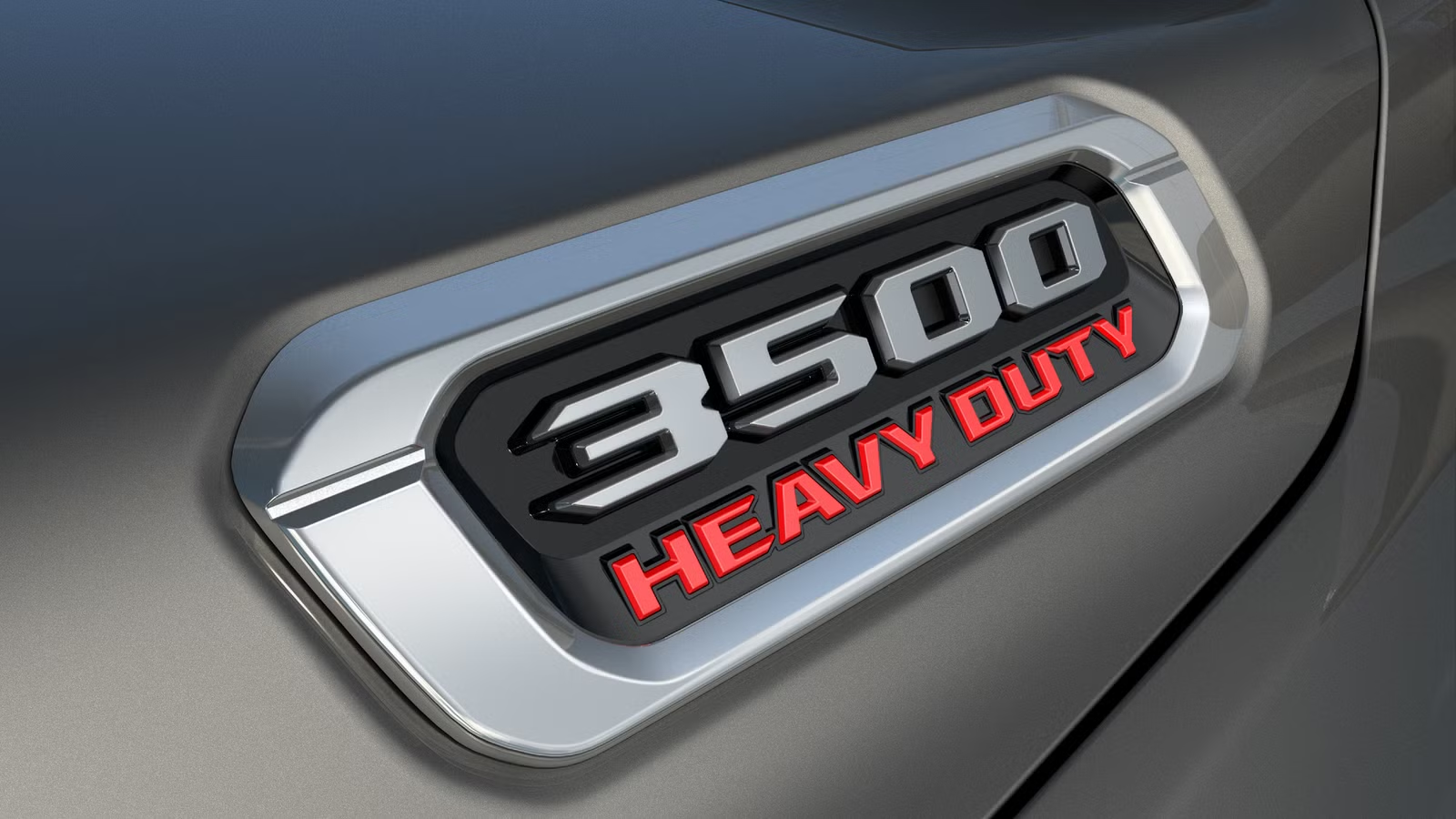
The Ram 3500 Heavy Duty Was The First Production Pickup To Break 1,000 LB-FT

The truck that crossed the threshold was the 2019 Ram 3500 Heavy Duty, equipped with the High-Output 6.7-liter Cummins turbo-diesel. Factory output climbed to 400 hp and 1,000 lb-ft of torque, making it the first production pickup to achieve a four-digit factory torque rating. Properly equipped, it also delivered a 35,100-pound maximum fifth-wheel towing capacity, demonstrating that the additional torque translated into measurable working capability rather than a headline number.
Reaching that milestone required far more than revising the engine calibration. Ram introduced a compacted graphite iron (CGI) engine block, a material more commonly associated with commercial-duty diesel applications because of its superior strength compared with conventional gray cast iron. The redesign also reduced engine weight by roughly 60 pounds, improving strength without adding mass.
The supporting hardware changed just as dramatically. Torque flowed through an Aisin AS69RC six-speed automatic transmission before reaching a larger 12-inch American Axle Manufacturing rear axle. Beneath everything sat an all-new frame constructed from 98.5% high-strength steel, providing the rigidity required for higher gross combined weight ratings and increased towing performance.
Engineering The First Four-Digit Pickup

The CGI block became the headline engineering change, but it worked because every surrounding system evolved alongside it. Higher combustion pressures demanded stronger internal components and revised cooling strategies, while the transmission’s calibration had to balance durability with drivability during repeated heavy-load operation.
The new frame wasn’t simply stronger; it was designed to reduce twist under extreme trailer loads. Greater torsional rigidity helped the suspension work more consistently while allowing Ram to raise towing ratings without relying on excessive structural weight. Viewed as a complete package, the 2019 Heavy Duty demonstrated that four-digit torque couldn’t be achieved by upgrading a single component. The milestone depended on treating the engine, driveline and chassis as one integrated system.
The Torque War Started Overnight
The 1,000 lb-ft headline lasted only briefly before competitors responded. Ford answered by raising the 6.7-liter Power Stroke in the Super Duty trucks to 1,050 lb-ft, reclaiming the torque crown. Ram countered for the 2021 model year with 1,075 lb-ft and 420 hp, increasing maximum fifth-wheel towing to 37,100 pounds.
The race hasn’t slowed since. Ford’s latest High-Output Power Stroke now leads the segment with 500 hp and 1,200 lb-ft of torque, while GM’s latest Duramax produces 975 lb-ft. In hindsight, the significance of the 2019 Ram wasn’t that it reached the highest number. It permanently shifted the benchmark every manufacturer had to chase.
When Tires Became The Weak Link

Crossing 1,000 lb-ft exposed a different engineering challenge. Producing enormous torque had become easier than using it. An unloaded heavy-duty pickup can overwhelm its rear tires long before the engine reaches its full potential. Modern diesel trucks therefore rely heavily on electronic torque management, traction control and transmission programming to meter power during low-grip conditions. The engine may be capable of producing four-digit torque, but the truck rarely delivers all of it instantaneously on an empty road.
Attach a multi-ton fifth-wheel trailer, however, and the equation changes. Additional tongue and pin weight increases rear-axle loading, giving the tires enough grip to convert engine output into forward motion. That’s why the benefits of 1,000-plus lb-ft are most obvious while climbing grades, accelerating with heavy loads, or reducing transmission downshifts—not during stoplight sprints.
The next chapter of the torque war may therefore have less to do with squeezing another 50 lb-ft from a diesel engine than with improving how pickups manage, transmit and apply that torque. Engines have advanced rapidly. Whether tire technology and traction management can keep pace remains one of the industry’s more interesting engineering questions.
The Truck That Changed Heavy-Duty Engineering

The 2019 Ram 3500 Heavy Duty no longer holds the torque record, and that isn’t what secured its place in pickup history. Its achievement was proving that a factory-backed, warranty-covered consumer truck could reliably deliver four-digit torque while increasing towing capability at the same time.
Every major heavy-duty diesel introduced since has been measured against the standard it established. Ford answered. Ram answered again. The competition continues. Jim Morrison called it breaking the sound barrier. History suggests he chose the right analogy—not because Ram stayed ahead, but because once the barrier was broken, there was no going back.
Source: Ram, Ford, General Motors, Cummins

Related posts





Latest Post


No Comments