Walk through any three-row SUV showroom and the pitch is always the same. More turbo boost. More screens. More torque printed in bold. The whole segment is selling excitement to people who mostly need to get four kids and a Costco run home in one piece. Here is the part nobody puts on the window sticker: the SUV most likely to still be running at 200,000 miles is the one that skips almost all of that.
Think about the last three-row SUV ad you saw. It probably had a turbocharged four making big numbers, a clever multi-speed gearbox, and a screen the size of a cutting board. All of it looks great in a launch video. None of it is free.
Every one of those features is a part that can fail. A turbo adds heat, boost pressure, and another set of seals and plumbing between you and a bill. A complex transmission adds clutches and control logic. A giant infotainment stack adds software that ages faster than the metal around it. Simply put, complexity is a tax. You pay it in reliability, and you pay it later, usually right after the warranty ends. The flashy three-row wins the test drive. Then it spends the next decade quietly costing you money.
What Low-Drama Actually Buys You
Front 3/4 action shot of 2026 Toyota Grand Highlander Hybrid driving on roadToyota
Now flip it. Picture a three-row that runs an engine design old enough to have every weakness engineered out of it. No turbo. A conventional automatic. Proven parts everywhere. It will not win a stoplight drag race or a spec-sheet argument. What it will do is start every morning, ask for almost nothing, and keep going long after the exciting rivals are parked with a check-engine light. Low-drama is not a compliment the marketing team wants. It is exactly what you want at 150,000 miles.
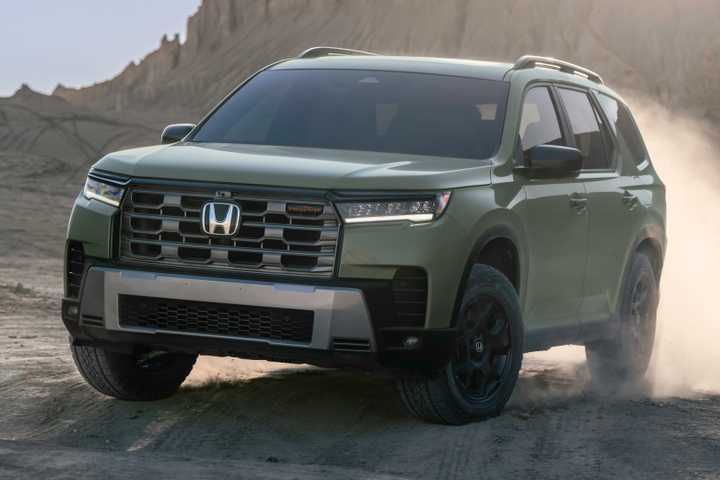
2026 Honda Pilot front 3/4 shot parkedTopSpeed | Michael Frank
The 2026 Honda Pilot is the least exciting way to buy a three-row, and that is the whole point. Honda has spent more than two decades turning the Pilot into a default answer for American families, and the 2026 car does not reinvent that formula. It refines it. If you want the full ownership picture, including the quirks worth knowing before you sign, start with “What No One Tells You Before Buying A Honda Pilot.” For the longevity case, though, two things carry the argument: the engine and the data.
The V6 Is The Whole Argument
Profile shot of 2026 Honda Pilot parked in front of houseNicole Wakelin/TopSpeed
Every 2026 Pilot runs the same engine: a 3.5-liter naturally aspirated V6, the J35 family, making 285 horsepower at 6,100 rpm and 262 pound-feet at 5,000 rpm through a 10-speed automatic. That rating has stood since 2023 and carries into 2026 unchanged. Read that again, because the boring part is the important part. Naturally aspirated means no turbo, no boost, no extra heat cycling a set of seals toward failure. It is an engine Honda has built, refined, and shared across the Pilot, Ridgeline, and Odyssey for years, which means the failure points are known and mostly designed out. The V6 is not fast. It is durable, and durable is what a 200,000-mile promise is made of.
Worth being straight about one thing here. Honda has confirmed a hybrid is coming to its big North American models, the Pilot included, but that powertrain is not due until around 2029 and rides on an all-new V6-based system. For 2026, there is no Pilot hybrid to buy. Every Pilot on the lot is the naturally aspirated V6, which is convenient, because that is exactly the engine the longevity argument rests on.
The Longevity Numbers Hold Up
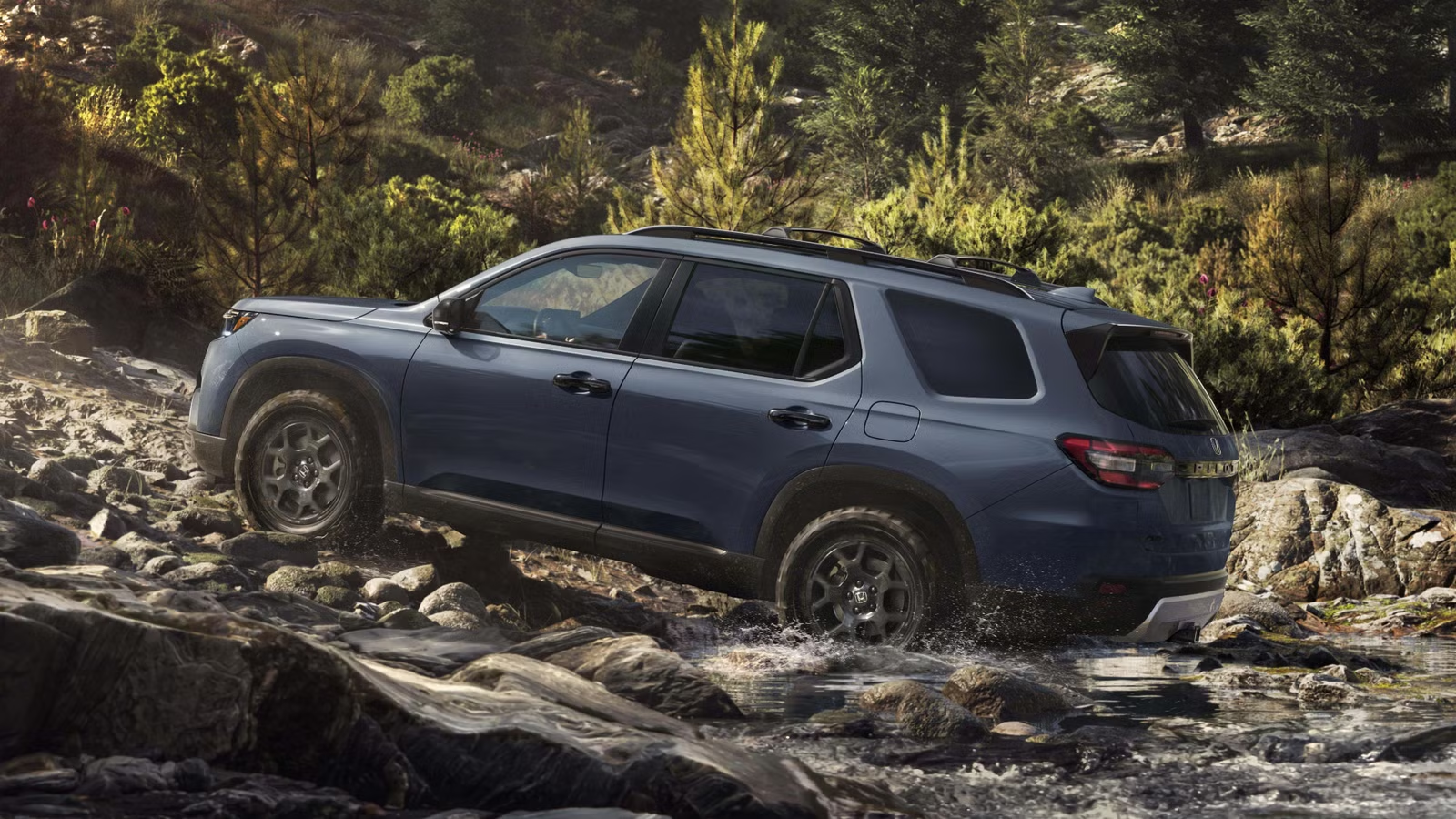
Front 3/4 action shot of 2026 Honda Pilot driving off-roadHonda
Assertion is cheap, so here is the data. iSeeCars, which builds its estimates from hundreds of millions of vehicles, puts the Pilot’s average lifespan at 170,159 miles, or about 11.4 years, with a 31.1 percent chance of reaching at least 200,000 miles. To put that in context, most vehicles sit far lower on that last figure. Nearly one in three Pilots crossing 200,000 miles is not a fluke. It is the naturally aspirated V6 and a simple drivetrain doing exactly what they were built to do, over and over, for a decade or more.
It Costs Almost Nothing To Keep Alive
Front 3/4 action shot of 2026 Honda Pilot driving on roadHonda
Reaching 200,000 miles only matters if getting there does not bankrupt you along the way. This is where the Pilot’s boring engineering pays a second dividend. RepairPal pegs the Pilot’s average annual repair and maintenance cost at about $542. That lands below the $573 average for midsize SUVs and well under the $652 average across all vehicles.
Its reliability rating sits at 3.5 out of 5, ranking it 13th of 26 midsize SUVs. Here is the honest read on that: the Pilot visits the shop slightly more often than the segment average, but the visits are cheap and rarely serious. No exotic turbo plumbing to rebuild. No dual-clutch to replace at 90,000 miles. Just routine, predictable, forgettable maintenance, which is the only kind you want on a car you plan to keep.
Parts And Dealers Are Everywhere
2026 Honda Pilot wheelHonda
There is a second cost nobody thinks about until they own something rare: availability. The Pilot shares its bones and its V6 with some of the most common vehicles Honda sells, and Honda moves these by the hundreds of thousands. What this really means is that parts are cheap, plentiful, and stocked almost everywhere, and any competent shop in the country can work on one without special training or a three-week wait for a component shipped from overseas. A car that is easy to fix is a car that stays fixed. That is half the battle at high mileage.
What You Give Up For The 200,000 Miles
None of this comes free, and pretending otherwise would insult you. The Pilot earns its longevity by giving things up. Here is the honest ledger: The naturally aspirated V6 is smooth and willing, but it is not quick, and it never pretends to be. Zero to 60 mph takes around 7.8 seconds, which is fine and forgettable. The 10-speed automatic hunts through gears around town more than it needs to. There is no drive mode that transforms the thing, no turbo swell, no soundtrack worth rolling the window down for. Rivals with boosted engines will pull away from it at every on-ramp. If you want your daily drive to feel like an event, the Pilot will disappoint you on purpose. That flatness is the same quality that keeps it alive at 180,000 miles.
The Honest Trade
Shot of 2026 Honda Pilot interior dashboard and cabinNicole Wakelin/TopSpeed
Profile shot of 2026 Honda Pilot interior second row of seatsNicole Wakelin/TopSpeed
The trade is simple, and you should make it with your eyes open. You give up straight-line speed, a cutting-edge powertrain, and any real sense of occasion. You get an engine with almost nothing to break, repair bills that stay boring, parts on every shelf, and a genuine shot at 200,000 miles. For a family SUV that has to earn its keep for a decade, that is not a compromise. That is the smart side of the bet. The rivals sell you the first three years. The Pilot is built for the next 10.
TopSpeed’s Take
2026 Honda Pilot side shot parkedTopSpeed | Michael Frank
The 2026 Honda Pilot is not the three-row you brag about. It is the one you still own when the bragging is over. It refuses to chase turbo numbers or spec-sheet drama, and that refusal is precisely why it outlasts the SUVs that do. The data backs it: a 170,159-mile average lifespan, a 31.1 percent shot at 200,000 miles, and repair costs that sit below the segment. If you want excitement, buy something else and budget for the repairs. If you want an SUV that quietly goes the distance and asks for almost nothing in return, this is the one worth putting your money on. Low drama is not the consolation prize here. It is the whole reason to buy.










No Comments