
Toyota’s Once-Pricey Off-Roader Has Finally Become A Smart Used Buy
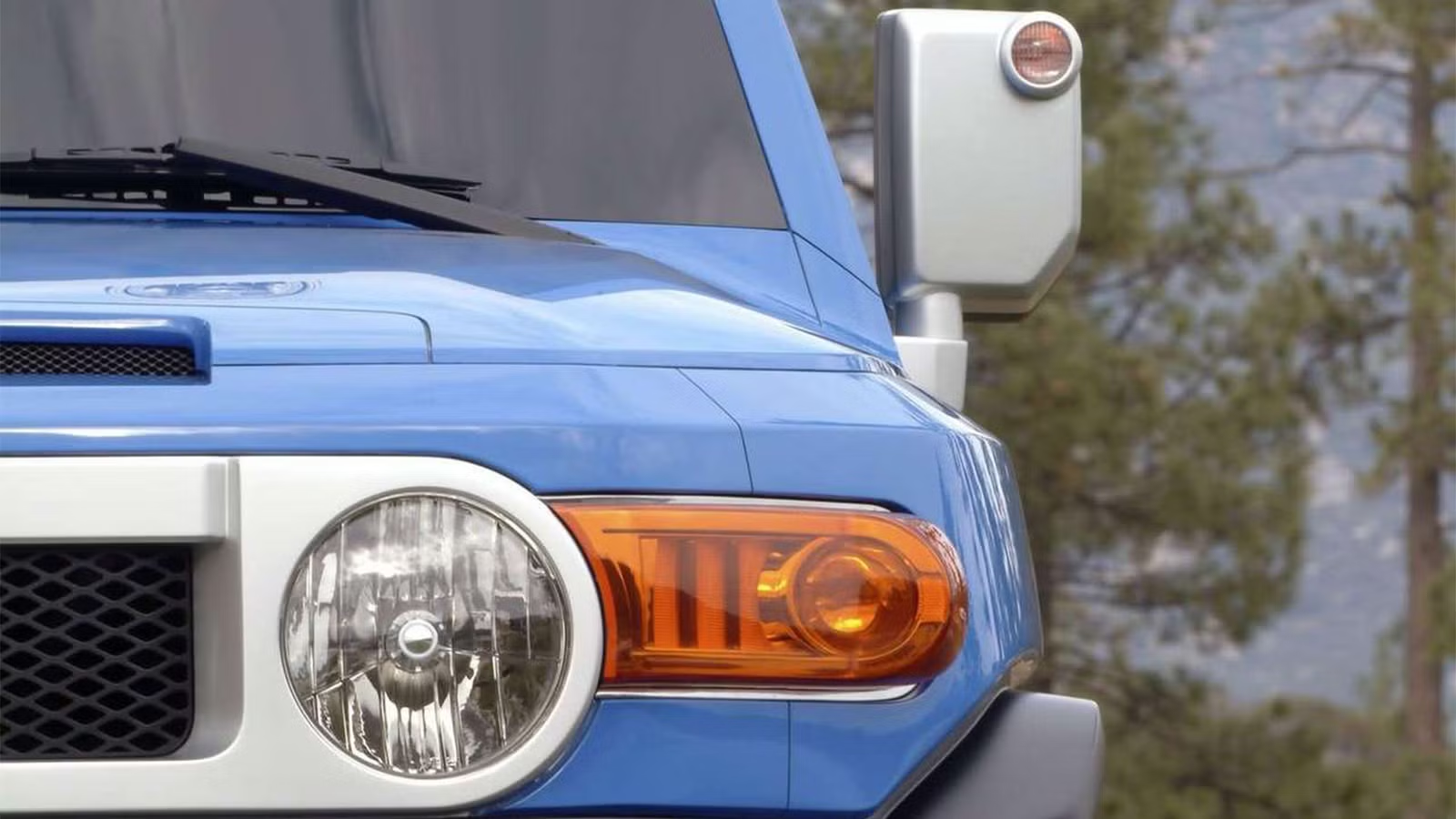
Toyota’s once-pricey off-roader has finally become a smart used buy. Toyotas have never had a reputation for being pricey. But in the digital world, things are a bit different. The way it works on social media is driven entirely by popularity: the more people like something, the more they pursue it. That is exactly what happened to this Japanese off-roader. The following may be an uncomfortable truth, but the numbers make it unavoidable. Social media has convinced buyers to pay well over what this Toyota off-roader is actually worth.
Why This SUV Refused To Get Cheap

At the time of its launch, the starting price for this Toyota SUV ranged from $21,710 to $23,300. Today, this off-roader is one of the better deals you can find in the modern auction market, and that alone tells you where used prices have gone. Looking at the aggregated numbers from classic tracking sites, the data spans across hundreds of sales with an average price hovering around $31,988.
While the lowest recorded sale dropped to $6,700, the most recent tracked sale came in at $67,500. A 2008 model with 259,000 miles sold for $10,250, while a different 2008 model with just 4,000 miles was listed for $listed for $ 59,995. That the same model year and trim tier can carry a sixfold price gap proves how much condition dictates value. A 30,000-mile 2014 model was recently listed for $74,900, nearly two and a half times its original window sticker price.
Breaking It Down By Trim

When you break down the benchmarks by specific trim levels, the divergence gets even clearer. The base model sits around $26,903, a one-year-only special edition from 2007 lands at $23,723, a multi-year off-road special edition jumps up to $35,888, and the ultimate run-out edition from 2014 commands a massive $49,155.

There are even wild, record-breaking outliers, like a 2012 special edition variant with only 212 miles and a six-speed manual transmission that fetched an astonishing $112,012 at auction, roughly five times what it cost when new. It also won the Kelley Blue Book Best Resale Value award twice, once for the midsize utility category in 2012 and again for the midsize SUV category in 2014, which was highly unusual for a vehicle still in active production at the time.

Shortly after launch, sales took a dive. Now here is where the social media and the online communities come into play. Owner forums maintain that values are only climbing, regardless of what the odometer reads. Dedicated owner forums and marque-specific community sites sustain highly active valuation and classified threads more than a decade after the model was discontinued in the US market.
These owner community threads explicitly frame the values as inherently appreciating regardless of mileage or condition. One long-running forum thread is literally dedicated to asking whether this vehicle officially counts as a future classic. Because it only had a single generation in the United States from 2007 to 2014 with no direct successor, a built-in narrative of scarcity has been reinforced within these online communities.
The Recognition That Keeps Getting Recirculated

This entire chronology of early recognition is continuously recirculated as proof of the vehicle’s special status within owner culture. Period press and media added momentum early, too, with a regional SUV award in 2006, a design award in 2007, back-to-back satisfaction awards in 2007 and 2008, a top safety rating in 2009, and a best overall value recognition that same year.
The community also fixates heavily on production details, like how the 2009 model year added three new monochromatic colors including solid Iceberg White, reinforcing the sense among enthusiasts that certain production years and paint colors are the exact ones to want. The six-figure auction outcomes cluster around exactly the profile that forum culture signals as desirable: low mileage, completely unmodified, a documented service history, and a manual transmission.
The Toyota FJ Cruiser Was Never Worth What You Paid

This legendary off-roader is none other than the Toyota FJ Cruiser, a vehicle that debuted as a concept car at the 2003 Detroit Auto Show. Because the public response was so overwhelmingly strong, Toyota approved it for production, and it officially went on sale as a 2007 model in the spring of 2006. Beneath the rugged retro styling, the engineering package was capable but far from unique. At launch, it featured a 4.0-liter DOHC 24-valve V6 known as the 1GR-FE, making 239 horsepower at 5,200 rpm and 278 lb-ft of torque at 3,700 rpm, which required 91 octane fuel.
This output eventually rose to 260 hp and 271 lb-ft of torque from 2011 onward on regular 87 octane, once Dual VVT-i and roller rocker arms arrived with the 2010 update. Toyota’s own spec sheets put curb weight at 4,050 pounds for the two wheel drive version, 4,290 for the four wheel drive manual, and 4,295 for the four wheel drive automatic, with gross vehicle weight rating between 5,335 and 5,567 pounds.
Built For The Trail

For off-road duties, the two-wheel-drive model offered approach and departure angles of 32 and 30 degrees, while the four-wheel-drive stepped up to 34 and 31 degrees, and the vehicle was factory rated to ford 27.5 inches of water. Buyers could choose from five launch colors, Black Cherry Pearl, Black Diamond, Voodoo Blue, Sun Fusion, and Titanium Metallic, all under a standard white roof cap. Inside, the seats used a water repellent fabric with a breathable resin backing and sealed stitching, built to be hosed down after a muddy day on the trails.
Rear-hinged half doors, an externally mounted spare tire, rubberized floor mats, and an optional gauge pod on the dash showing compass heading, incline, and outside temperature all pointed the same direction: this was built to be used. Toyota even included its Star Safety System as standard from launch, comprising stability control, traction control, and anti-lock brakes with brake assist, which was unusually generous for the class at that time. It also wasn’t a standalone engineering effort. It shared its platform and major drivetrain with the 4Runner, the Tacoma, and the Land Cruiser Prado.
The Cracks The Forums Won’t Admit To

Despite the flawless reputation broadcast online, there are real structural and mechanical issues that enthusiast forums tend to gloss over. A major class-action lawsuit filed in April 2022 alleged that the frames used from 2007 to 2014 lacked a continuous zinc phosphate coating, leaving sections of the frame unprotected and prone to premature rust. This lawsuit was filed on behalf of owners in salt-heavy regions including Illinois, Maryland, Michigan, New York, New Jersey, Pennsylvania, Virginia, and Utah.
The case was dismissed at the motion-to-dismiss stage in November 2022, though plaintiffs were given leave to amend certain claims, and owner forum threads as recent as April 2025 continue to discuss refiling. These frame rust complaints concentrate heavily in northern markets where road salt is common, and experienced owners frequently describe wire brushing and chemically treating the frame as an annual spring ritual rather than a one-time fix.
Engine Wear And Everyday Gripes

Under the hood, the 1GR-FE engine uses a three-chain timing system with original equipment tensioners that some mechanics and owners describe as underbuilt. When these parts fail, chain elongation shows up as retarded camshaft timing codes like P0016 and P0340, concentrated on a subset of higher mileage, Japan built early 2007 units. The recurring theme across mechanic and owner accounts points to poor maintenance rather than faulty engineering, as sludge from extended oil change intervals starves the tensioner and accelerates chain wear.
Beyond the mechanics, daily usability is compromised by limited rear visibility caused by thick rear pillars, a small rear window, and a high beltline, a consistently noted complaint across ownership and safety discussions alike. Modern buyers should also note that newer options like the Ford Bronco and Jeep Wrangler have given buyers real off-road alternatives that simply did not exist when this vehicle was new, easing some of that captive demand.
What This Toyota Is Actually Worth Now
When sifting through the hype and looking at actual recent auction sales, it becomes clear exactly where the market is settling across the entire condition spread. A 2010 model with 99,000 miles sold for $28,500, while a pristine 2012 special edition with only 212 miles brought in that staggering $112,012 figure. A high-mileage 2008 model with 259,000 miles traded hands for $10,250, a low-mileage 2007 model with 25,000 miles went for $18,700, and a 2014 model with 57,000 miles sold for $32,250.
It is important to look at completed sales rather than active listings, as one 2007 model with 46,000 miles recently failed to sell at a high bid of $23,500, a stark reminder that asking prices and actual sold prices are two very different numbers. The publicized $31,988 market average is heavily pulled upward by collector grade sales, and is not representative of what a typical buyer should expect to pay for a daily driver.
The vast majority of actual everyday transactions take place in a more reasonable band between $18,000 and $29,000, usually high mileage examples that still have plenty of life left in them. This is the real smart buy: targeting the mainstream trims below the premium tier and skipping the six-figure headline sales that get all the attention on social media.
Sources: Toyota, Classic.com, Bring A Trailer

Related posts


Latest Post


No Comments