
10 Used Japanese Sport Bikes That Still Set The Benchmark
Back in the 80s, sport bikes of all shapes and sizes had captured the imagination. These motorcycles were capable of speeds previously not thought possible on two wheels. Of all the leading motorcycle manufacturers, it was the big four Japanese brands that really understood the marketability of pure, unadulterated speed.

All the way through the 80s and 90s, we got one incredible superbike after another. It was only when common sense prevailed by the early 00s, and the top speed of all new motorcycles was limited to 186 MPH (something the Japanese brands still adhere to) that their attention shifted to track performance. As a result, we ended up getting more sensational sport bikes that all also offered dynamic handling.
Buying a used motorcycle always has an element of risk attached, so please do your research, and proceed with caution. The motorcycles on this list go from oldest to newest.
1992 Honda NR750
Price Range: $90,000 – $100,000

Out of all the Japanese brands, Honda has historically been the most adventurous when it comes to engine configurations. The NR750 had one of those more unusual engines, with an oval-piston V4 that rather effectively worked like a scaled-down V8. Naturally, this kind of thing was fantastically expensive to produce, and was only ever produced in small numbers to satisfy homologation requirements. On top of this incredible engine, the bike also looks suspiciously similar to the famed Ducati 916, because this was the bike that served as inspiration for Massimo Tamburini when he penned that masterpiece.
2005 Suzuki GSX-R1000 (K5)
Price Range: $5,000 – $7,000

After the introduction of the Yamaha R1, the liter-class superbike quickly became the industry standard for performance. Suzuki initially struggled to put together a competitive motorcycle, but by 2005 it is fair to say that the Japanese brand struck gold. In the right hands (and condition), these old superbikes are still competitive on track, and more than capable of showing modern sport bikes a clean pair of heels.
2006 Yamaha YZF-R6
Price Range: $4,000 – $6,000

Just like most of the sport bikes of the era, the R6 stood in the shadow of the R1, right up until the 2006 model was launched. Not only did it rev to the moon, it was also the very first mass-produced motorcycle to make use of ride-by-wire technology. At the time, it was one of the most advanced sport bikes money could buy, and quickly proved to be one of the most effective track bikes, too.
2008 Suzuki Hayabusa (Second Generation)
Price Range: $7,000 – $9,000

Although the second generation Hayabusa was equipped with a limiter and had a lower top speed, it is a significantly better motorcycle than the first gen. With 194 horsepower, it was a fair bit more powerful than the original speed queen, and the revised design certainly makes the bike a little easier to look at. Few modern motorcycles, including the third generation Hayabusa, will be able to keep up with this monster.
2008 Kawasaki Ninja ZX-10R
Price Range: $5,000 – $7,000

Four years after the truly bonkers original Ninja ZX-10R came out, we got this ode to analog high-performance motorcycles. With ram-air installed (it was a factory option), it was capable of producing 200 horsepower. For a bike that only weighed 459 pounds and had no modern electronic rider aids, that is ludicrous. In the wrong hands, this is a dangerous motorcycle, and even in the right hands, it is still a little terrifying. In a good way.
2011 Suzuki GSX-R750
Price Range: $6,000 – $8,000

In 1985, the original GSX-R750 got the sport bike ball rolling, forcing answers out of all the leading brands. Sadly, by 2011 it got its final update. It is easy to be critical of Suzuki not updating the platform, but with its razor-sharp lightweight chassis, and potent inline-four, there was no express need to improve upon perfection. For those that want the security of a warranty, you can still go out and buy a new one, but for half the price, you can have one of the very best sport bikes ever made.
2012 Kawasaki Ninja ZX-14R
Price Range: $6,000 – $8,000

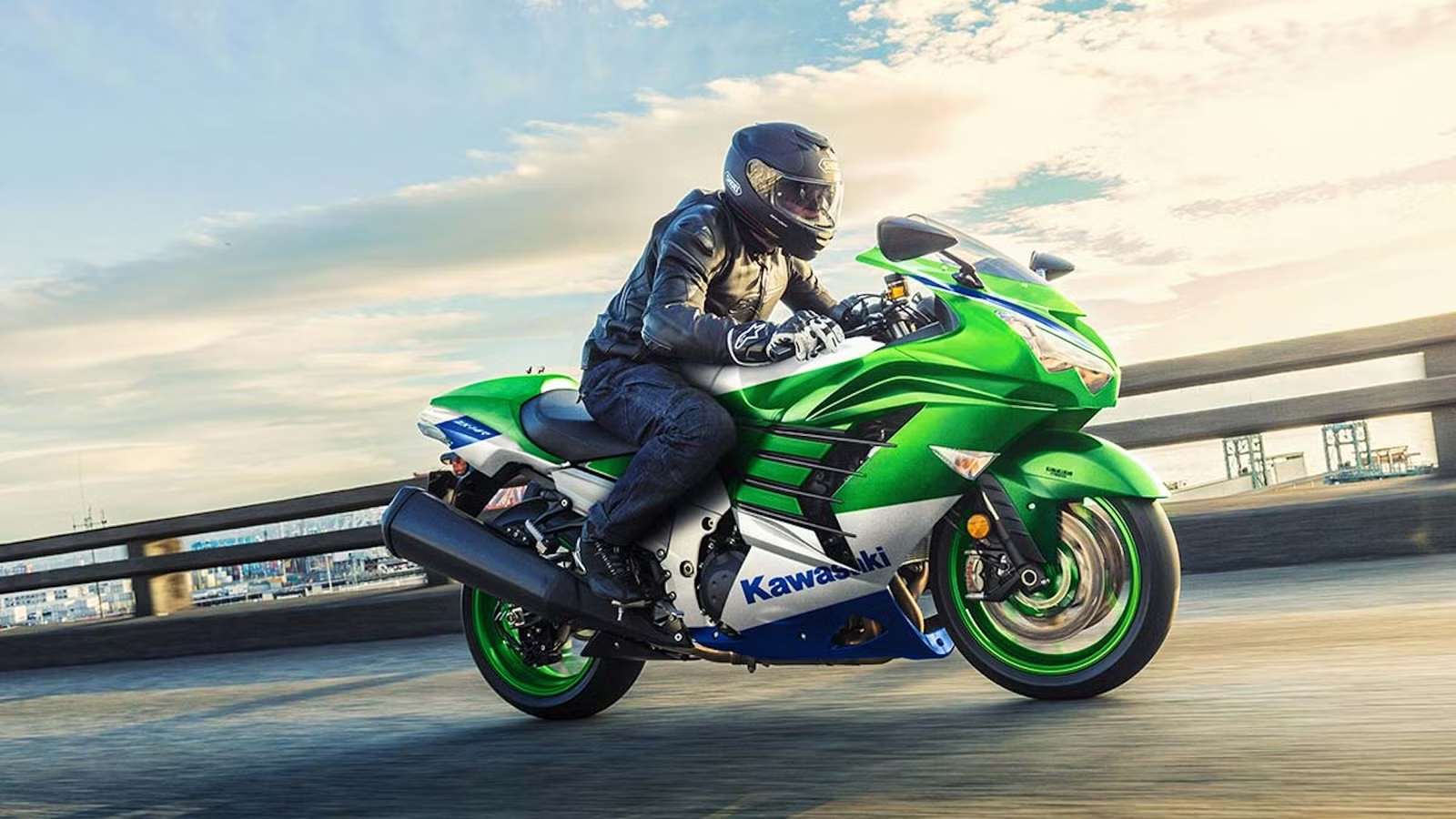
In 2012, Kawasaki gave the Ninja ZX-14R its last update, and with that update the bike made over 200 horsepower (once again, with the optional ram-air fitted). With a quarter mile time of around 9.5 seconds, it certainly lives up to its billing as “the quarter mile king.” There are precious few modern superbikes that will be able to keep up with this in a straight line.
2015 Yamaha YZF-R1
Price Range: $12,000 – $14,000

While the original R1 can be credited with establishing the liter-class sport bike, it is the modern version that really sets the benchmark for reliable performance. Since its introduction all the way back in 2015, this platform has been given modern electronics, but the CP4 engine is more or less unchanged. It is what gives the bike its unique soundtrack and enviable reliability record.
2017 Honda CBR1000RR Fireblade
Price Range: $9,000 – $11,000

The old Fireblade actually isn’t really showing its age much at all. Compared to most of the other superbikes on the market today (including the new Fireblade), this is a far more usable machine, offering ergos that won’t break your back after an hour in the saddle. Its 189 horsepower is not necessarily all that impressive by modern standards, but it is more than enough when you realize the bike only tips the scales at 432 pounds. It is actually lighter than some new middleweight sport bikes.
Kawasaki Ninja H2R
MSRP: $62,100

It is fair to say that the H2R moved the goalposts so far that nobody else is even bothered to try and develop a faster bike. With a top speed of 249 MPH, this is by some margin the world’s fastest motorcycle. Unfortunately, it is not street legal, and can only be ridden on track. Which is a little frustrating, because it is not much of a track bike. This 300 horsepower supercharged monster is, to say the least, a niche offering.
Sources: Various manufacturer websites

Related posts
Latest Post


No Comments