
The Hyundai SUV That’s Worth More Than Its Price Tag
The three-row SUV segment has never been more competitive, or more confusing. Buyers are being asked to weigh horsepower against fuel economy, captain’s chairs against bench seats, and infotainment screens against warranty terms, all while watching sticker prices creep closer to luxury territory. In that environment, a vehicle that actually delivers more than its price tag suggests stands out immediately.

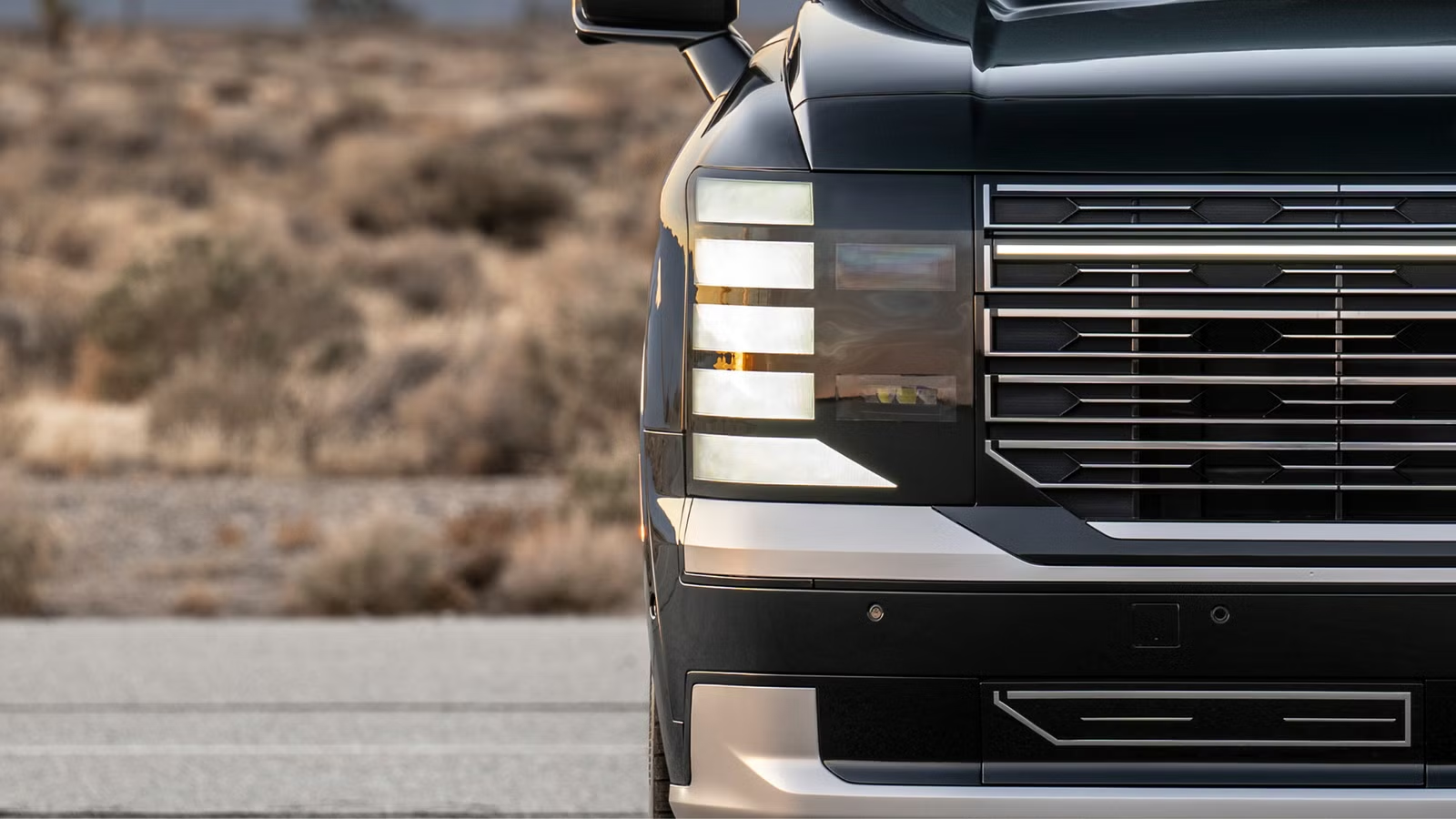
This Hyundai SUV has spent the better part of a decade doing exactly that. It arrived in 2020 as an underdog against the Toyota Highlander and Honda Pilot, and it has since become the benchmark that rivals like the Kia Telluride are measured against. The redesigned 2026 model pushes that advantage further, adding a hybrid powertrain, a richer cabin, and even more standard safety technology, all while staying meaningfully cheaper than several of its closest competitors.
What Makes An SUV Feel More Expensive Than It Actually Is
Perceived value in an SUV rarely comes down to a single number on a window sticker. It’s the sum of small decisions: whether the door closes with a reassuring thud, whether the cabin stays quiet at highway speed, whether the tech feels intuitive rather than gimmicky, and whether the safety suite is standard rather than locked behind a $5,000 options package.


Buyers notice materials first. Soft-touch surfaces, real stitching, and tight panel gaps read as expensive even when the badge doesn’t carry a luxury price point. Ride quality matters just as much. An SUV that isolates road noise and absorbs harsh impacts feels like a more expensive machine, regardless of what’s under the hood. Then there’s technology and safety. When a mainstream SUV includes driver-assistance features and screen sizes usually reserved for premium trims, the value equation shifts dramatically in the buyer’s favor.
The Hyundai Palisade Delivers Premium Comfort And Features Without The Luxury Price Tag

The redesigned 2026 Hyundai Palisade starts at $39,435 for the SE trim, with the lineup stretching up to around $56,780 for a fully loaded hybrid Calligraphy. That base price undercuts the 2026 Honda Pilot, which now starts at $42,395, and comes in below the Toyota Highlander’s $46,270 starting point. Even the value-oriented Kia Telluride, long considered the Palisade’s closest sibling under the Hyundai Motor Group umbrella, starts only marginally lower, and the two share enough hardware that choosing between them often comes down to styling preference rather than substance.
What separates the Palisade from budget-minded competitors is how much content Hyundai packs into the lower and mid-tier trims. Ventilated second-row seats, a surround-view camera system, and dual-zone climate control appear on trims well below the range-topping models, features that rivals frequently reserve for their most expensive configurations. The mid-tier SEL Premium trim in particular has become a favorite among reviewers for bundling near-luxury equipment at a price point that still feels accessible to a mainstream family buyer.

Step into the Calligraphy trim and the value argument becomes even more pointed. Nappa leather, a massaging driver’s seat with thigh extension, a synthetic suede headliner, and a UV-C sterilization compartment for the center console are the kinds of details usually found in vehicles wearing a Genesis, Acura, or Lincoln badge, not a mainstream Hyundai.
Refined Road Manners, Family-Friendly Practicality, And A Cabin Built For Long Journeys

Where the Hyundai Palisade quietly outclasses its price bracket is on the road. Independent testing has consistently praised its composed, absorbent ride, the kind of cushioned, luxury-adjacent character that smooths out broken pavement and long highway stretches without transmitting harshness to the cabin. It’s not a vehicle that rewards aggressive driving, but that’s not the assignment. Families cross-shopping this segment care far more about a serene commute and a stress-free road trip than they do about cornering grip.
Cabin space reinforces that mission. The Palisade offers seating for up to eight with the standard second-row bench, or seven when configured with second-row captain’s chairs. Third-row access is genuinely usable for adults on shorter trips, not the token afterthought found in some competitors, and cargo capacity behind the third row remains competitive with those of the Telluride and Pilot.
Visibility Is Another Quiet Strength

Large windows and a low beltline give the Palisade an airy, easy-to-place feel in parking lots and tight suburban streets, while the available 360-degree camera system renders in sharp, lag-free resolution, something not every rival in this price range can claim. Combined with a genuinely quiet cabin at speed, the Palisade delivers the kind of long-journey comfort that buyers typically associate with three-row SUVs costing considerably more.
Power, Technology, And Safety Features That Rival SUVs Costing Thousands More

Under the hood, the standard 2026 Hyundai Palisade uses a 3.5-liter V6 producing 287 horsepower and 260 pound-feet of torque, paired with an eight-speed automatic transmission and the choice of front- or all-wheel drive. New for this generation is a 2.5-liter turbocharged hybrid powertrain that combines a turbo four-cylinder with dual electric motors to produce up to 329 horsepower and 339 pound-feet of torque, targeting an estimated 34 mpg combined and a driving range approaching 600 miles. That hybrid option undercuts the starting price of most hybridized three-row rivals while offering more horsepower than the standard Telluride’s turbocharged four-cylinder, which makes do with 274 horsepower and 311 pound-feet.
Safety Is Where The Palisade’s Value Argument Becomes Hardest To Ignore

Hyundai’s SmartSense suite comes standard across the lineup and includes forward collision-avoidance assist, lane-keeping and lane-following assist, blind-spot collision-avoidance assist, rear cross-traffic braking, and highway driving assist with lane-change assist—a level of standard active safety equipment that many competitors still gate behind mid-tier or top trims. Higher trims add rear-occupant alerts via radar sensing, a remote smart parking feature, blind-spot intervention, and front and rear dash cams built directly into the vehicle, a feature few rivals offer at any price.
Inside, Hyundai has also kept pace on technology, with widescreen digital displays for both the instrument cluster and infotainment system, wireless smartphone charging, and Bluelink connected services that include remote start and climate preconditioning. None of this is exotic by 2026 standards, but the fact that it arrives on a mainstream three-row SUV starting under $40,000 is precisely the point.
Why The Hyundai Palisade Continues To Be One Of The Best Value Three-Row SUVs On The Market

Add it all together and the Palisade’s appeal becomes obvious: a starting price thousands below the Honda Pilot and Toyota Highlander, standard safety technology that rivals often charge extra for, a genuinely upscale cabin experience even in mid-tier trims, and a new hybrid powertrain that outmuscles some competitors’ base engines while sipping less fuel.

None of this means the Palisade is flawless. It’s not the quickest vehicle in its class, and the standard V6 can feel unhurried when merging onto a fast-moving highway. But speed was never the assignment for this segment. Comfort, safety, practicality, and perceived quality are what most three-row buyers are actually shopping for, and on every one of those fronts, the Palisade delivers more than its window sticker would suggest.
That’s the essence of a vehicle worth more than its price tag: not the cheapest option in the segment, but the one that makes rivals costing thousands more look like they’re the ones playing catch-up. For 2026, the Hyundai Palisade remains one of the clearest examples of that idea on sale today.
Sources: Hyundai, The EPA

Related posts


Latest Post


No Comments