
The Adventure Bike That Makes You Want To Skip The Highway
Highways are usually the boring tax riders pay before the good part of a trip begins. They’re useful, sure, in the same way plain oatmeal and waiting rooms are useful. But adventure bikes are supposed to make the long way home look better than the short way home. Lately, though, a lot of them have become so big, fast, expensive, and polished that the “adventure” bit starts to sound more like a brochure promise than a dare.
Big Adventure Bikes Have Become Too Good At The Wrong Thing

Modern adventure bikes have gotten extremely good at acting like tall sport-tourers with crash bars. They can cruise at highway speeds all day, carry luggage, protect you from weather, and come loaded with enough ride modes to make a laptop jealous. That’s great when the route is mostly pavement, but it also means many of them are built around the ride riders have to do, not always the ride they secretly want to do.
The funny thing is that capability isn’t always the limiting factor. A heavy, expensive adventure bike may have the suspension, traction control, and tires to tackle the rough stuff, but the rider still has to be willing to point it down there. A rocky two-track looks a lot less charming when your brain starts calculating repair bills, recovery effort, and the horrible sound of plastic meeting gravity.
Weight Changes The Way Riders Make Choices

Weight has a way of changing the entire mood of a ride. On paper, a few extra pounds can look meaningless, especially when an engine has enough torque to bully its way out of mistakes. In the real world, weight shows up when the trail gets loose, when the front tire starts wandering, when you need to paddle through a bad section, or when the bike takes a nap and expects you to apologize by picking it back up.

That’s why a lighter adventure bike can feel more adventurous before it even leaves the driveway. It makes bad roads seem less like a commitment and more like an option. You’re less worried about getting stuck, less worried about scratching something expensive, and less worried about turning a small mistake into a full-body workout. Confidence doesn’t always come from more power. Sometimes it comes from knowing the bike won’t punish you for being curious.
Power Matters, But Usability Matters More

There’s still a place for power, of course. Nobody wants an adventure bike that runs out of breath the moment traffic gets serious or the road starts climbing. But there’s a big difference between useful performance and spec-sheet flexing. For a lot of riders, the sweet spot is enough engine to handle real roads, enough chassis to survive bad ones, and enough approachability to make the rider actually use the bike as intended. That’s where the small-displacement ADV formula starts to make sense. A good one doesn’t need to cosplay as a globe-circling flagship. It just needs to be quick enough, tough enough, comfortable enough, and simple enough to make every detour look like a decent idea. The best version of this formula doesn’t make the highway impossible. It just makes the highway look like the least interesting choice on the map.
The KTM 390 Adventure R Will Make You Want To Take The Long Way Home
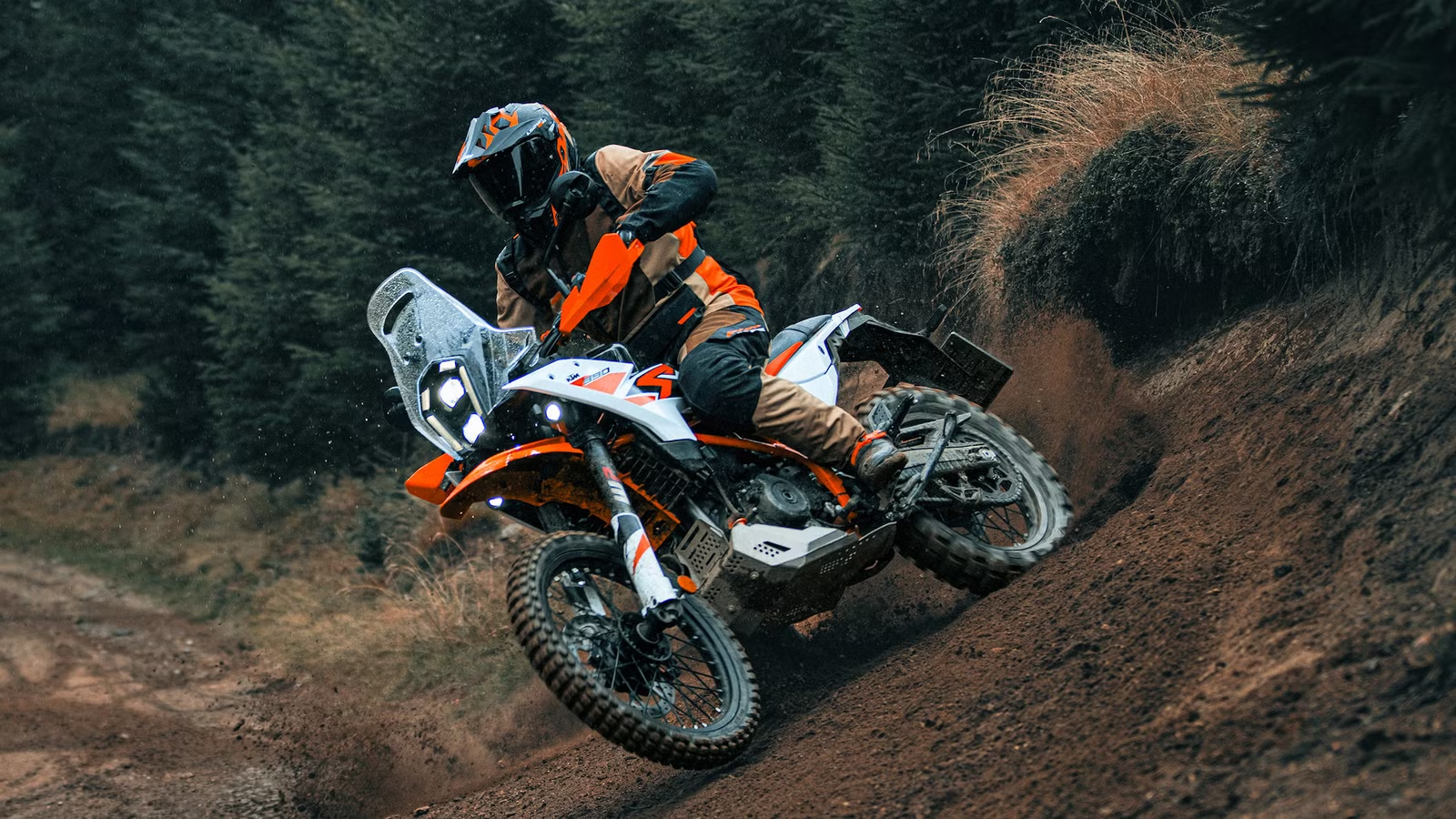
That’s where the KTM 390 Adventure R comes in, and yes, this thing looks like it was built specifically for riders who treat “road closed” signs as a soft suggestion. KTM’s latest small ADV lands with a $6,999 MSRP, which immediately puts it in a more serious space than a basic beginner bike. But the equipment list also makes it clear this isn’t just a street bike wearing hiking boots.
At the center is a liquid-cooled 398.7cc single-cylinder, four-stroke engine making 45 PS, or about 44.4 horsepower, and 28.8 pound-feet of torque. It runs through a six-speed transmission with Bosch engine management and ride-by-wire throttle, and KTM says the latest LC4c engine brings more power, smoother acceleration, an improved gearbox, and an optimized cylinder head. In other words, it’s not trying to win a dyno argument. It’s trying to be useful everywhere.
|
Engine |
398.7cc liquid-cooled, single-cylinder, four-stroke |
|
Output |
44.4 horsepower, 28.8 pound-feet |
|
Transmission |
6-speed, 520 X-Ring chain |
|
0 to 60 mph |
Around 5.5 to 6.0 seconds |
The Hardware Actually Matches The Attitude

The rest of the bike backs that up in a way that matters. The frame is a powder-coated steel trellis design with a bolt-on steel trellis subframe, while the chassis uses a 62.9-degree steering head angle, 110mm of trail, and a 58.3-inch wheelbase. Braking comes from a 320mm front disc with a two-piston Bybre axial floating caliper and a 240mm rear disc with a single-piston Bybre floating caliper, tied together with a 520 X-Ring chain final drive.
More importantly, the dirt stuff isn’t decorative. The off-road focused 390 Adventure R gets heavy-duty spoked wheels measuring 21 inches up front and 18 inches at the rear, wrapped in Mitas Enduro Trail E07+ tires. Suspension is handled by a 43mm WP APEX open-cartridge fork with 230mm of travel and 30 clicks of compression and rebound adjustment, plus a WP APEX split-piston shock with matching travel, rebound adjustment, and tool-adjustable preload.

That gives it the kind of stance and hardware riders actually want when the route gets ugly. It has 10.7 inches of ground clearance, a 34.3-inch seat height, a 3.69-gallon fuel tank, and a fully fueled weight of 388 pounds. That seat height will not be everyone’s favorite number, especially if your inseam is more “urban scooter” than “rally raid,” but the tradeoff is real clearance and travel rather than pretend ADV posture.
This Isn’t Just A Cheap Ticket Into The ADV Club

The electronics are also more serious than the displacement might suggest. KTM fits Cornering MTC, Cornering ABS, Offroad ABS, and an Off-Road Mode that allows more rear-wheel slip and keeps its settings even if the engine stalls or the bike is switched off. There’s also a five-inch full-color TFT display, a USB-C port, LED lighting with position light, KTM Connect smartphone pairing, and optional turn-by-turn navigation through the app.
That mix is why the price needs a little context. At $6,999, this is not exactly the bargain-bin route into adventure riding. It costs enough that riders are allowed to squint at the number and ask hard questions. But it also gives you real off-road-focused hardware, modern rider aids, long-travel adjustable suspension, proper wheel sizing, and a chassis that seems built for riders who would rather explore than preserve resale value like a museum curator.
The Best Adventure Bike Might Be The One You’re Not Afraid To Get Lost With

The 390 Adventure R by no means makes big adventure bikes irrelevant, and it doesn’t need to. If you want to cross states in maximum comfort with a passenger, hard luggage, and enough horsepower to bend geography, the big machines still make sense. What this bike does instead is attack the hesitation that often comes with them. It makes the dumb road look less dumb. It makes the scenic route look more like the obvious one.
That might be the real point of an adventure bike. It’s not just supposed to get you somewhere far away. It’s supposed to interrupt your route with better ideas. The right one doesn’t make you stare at the highway entrance and think about efficiency. It makes you look past it, spot a dusty road curling toward nowhere in particular, and decide that getting a little lost might be the whole reason you left home in the first place.
Source: KTM

Related posts


Latest Post


No Comments