
GM Is Tearing Down The Building Where Pontiac Built Its Legend
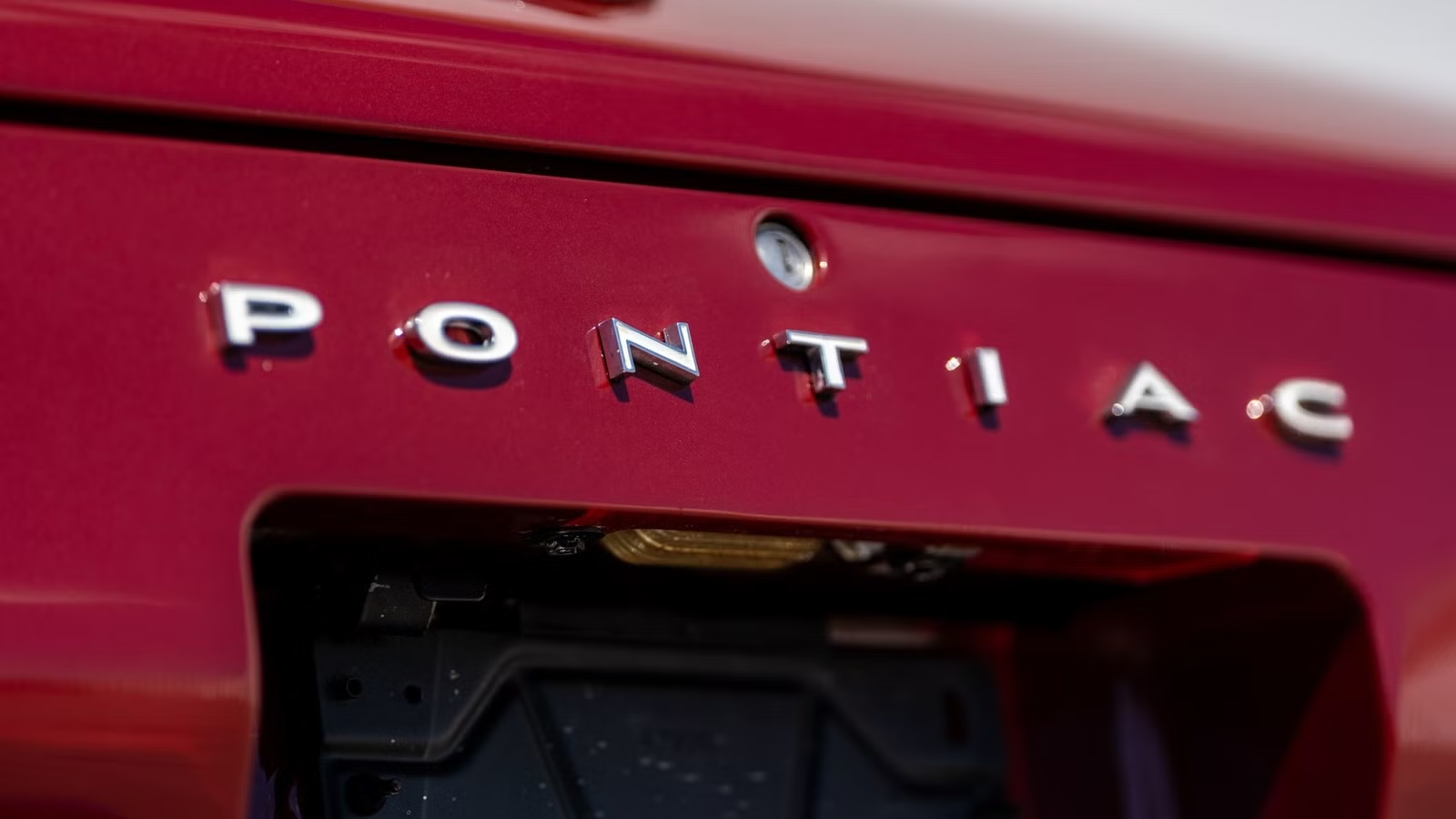
The wrecking ball has arrived in Michigan, and it’s taking down more than concrete and steel. General Motors has begun demolishing the former Pontiac headquarters building — the place where engineers and designers conceived the GTO, the Firebird, and the Trans Am, three nameplates that defined American performance for a generation. Demolition started this week, closing a chapter that technically ended when GM killed the Pontiac brand in 2010 but never felt quite this final.

For the Pontiac faithful, this isn’t a routine property clearance. It’s the physical erasure of a place where some of the most important performance cars ever built in America were dreamed up — not assembled on a line, but conceived in offices and engineering bays that are now being reduced to rubble.
The Building Behind The Legends
The former Pontiac headquarters sat in Michigan as a tangible monument to what the division once was. This was the nerve center where John DeLorean and his team pushed through the 1964 GTO — a car widely credited as the original muscle car, a factory-built street fighter that stuffed a 389 cubic-inch V8 into the intermediate Tempest body and rewrote what American buyers expected from a performance machine. The GTO didn’t just sell; it created a template every other Detroit division spent the next decade chasing.

The Pontiac Firebird followed in 1967, Pontiac’s answer to the Mustang and a platform that would carry the brand’s performance identity for over three decades. Then came the Trans Am in 1969 — a road-racing homologation package that grew into a cultural icon, its screaming chicken hood decal and 455 HO engine becoming shorthand for American muscle at its most theatrical. These weren’t cars that happened to be built in Michigan. They were cars that were *born* in the building now coming down.
What Replaces A Shrine

Details on what will occupy the site after demolition are limited at this stage. GM has not publicly announced a specific redevelopment plan tied to this particular structure, and the timeline for full clearance of the site has not been confirmed. What is clear is that the demolition is active — not pending, not planned, but underway right now.
The building had sat largely dormant since Pontiac’s discontinuation, a casualty of GM’s 2009 bankruptcy restructuring that wiped out both Pontiac and Saturn in a single sweep. For sixteen years the structure stood as an artifact — visited by fans, photographed by historians, quietly deteriorating. Now it’s coming down for good.
The Finality Enthusiasts Felt Coming

Gearheads have watched Pontiac’s legacy get chipped away in stages. The brand died. The dealerships closed. The nameplates got shelved. But the building was still there, still standing in Michigan, still a place you could point to on a map and say: that’s where it happened. That’s where they built the car that started the muscle car era.
That’s gone now. What remains is the cars themselves — the GTOs in garages and at shows, the Trans Ams that keep climbing in value, the Firebirds that refuse to rust into irrelevance. Hagerty recently tracked a 2006 GTO — the last-generation model, built on an Australian platform — selling for $73,500 with just four miles on the clock, proof that the market hasn’t forgotten what the name means. The building may be rubble, but the legacy these cars carry doesn’t need a structure to survive. It lives in the machines.
It’s a hard thing to watch, even for people who never set foot inside. The Pontiac headquarters wasn’t a museum — it was a working place, a place of arguments and drafting tables and decisions that shaped American car culture. Now it’s a demolition site. Let’s hope the cars it gave us get the preservation they deserve.
Source: DetroitNews, Carscoops

Related posts






Latest Post



No Comments