
The Harley-Davidson That Gets Better Every Year
There’s a specific kind of frustration that only performance-minded cruiser riders understand. You love the stance, the exhaust note, the way a big V-twin makes its presence known at a stoplight. However, you also want the bike to actually work when the road stops going in a straight line — to turn in without drama, to stop hard without a second thought, to hold its line through a corner instead of wallowing through it.

For years, getting both halves of that equation meant buying the cruiser, then spending another few thousand dollars at the dealership fixing what the factory left unfinished. Most cruiser motorcycles don’t ask you to think about any of this twice. A model gets its look nailed down, sells on that look for the better part of a decade, and changes only when nostalgia needs a fresh coat of paint. That said, a handful of nameplates have quietly broken that pattern, evolving under the sheet metal year after year even while the silhouette stays familiar.
How The American Cruisers Overcame Challenges That Plagued This Segment
Performance cruisers weren’t always known for their performance. For much of the 1980s, ’90s, and early 2000s, cruiser buyers expected straight-line acceleration and relaxed highway comfort. Handling ranked somewhere much lower on the priority list. Manufacturers concentrated on styling, chrome, engine character, and customization, while chassis development often lagged behind. That philosophy created motorcycles with plenty of personality but obvious limitations once the pavement became interesting.

Long wheelbases reduced agility. Twin rear shocks offered limited suspension travel. Flexible frames allowed noticeable movement during aggressive riding, while narrow forks and conservative brake setups struggled to inspire confidence. Riders learned to adapt their pace rather than expecting the motorcycle to rise to the occasion. A new generation of riders wanted cruisers that looked traditional while behaving more like modern sports standards when roads became technical. They wanted stronger braking, better suspension control, more lean angle, and predictable handling without sacrificing the unmistakable character of a big American V-twin.
The Harley-Davidson Low Rider S Gets Better With Every Year
Base Price: $18,999

The Low Rider S exists because Harley-Davidson finally addressed the performance-cruiser dilemma head-on instead of leaving it to the aftermarket. Rather than selling a stripped-down cruiser and letting customizers bolt on the suspension, brakes, and chassis bracing needed to make it genuinely capable, Harley built all of that in from the factory. Look closely at the specification sheet, and you’ll notice many upgrades enthusiasts used to install themselves.
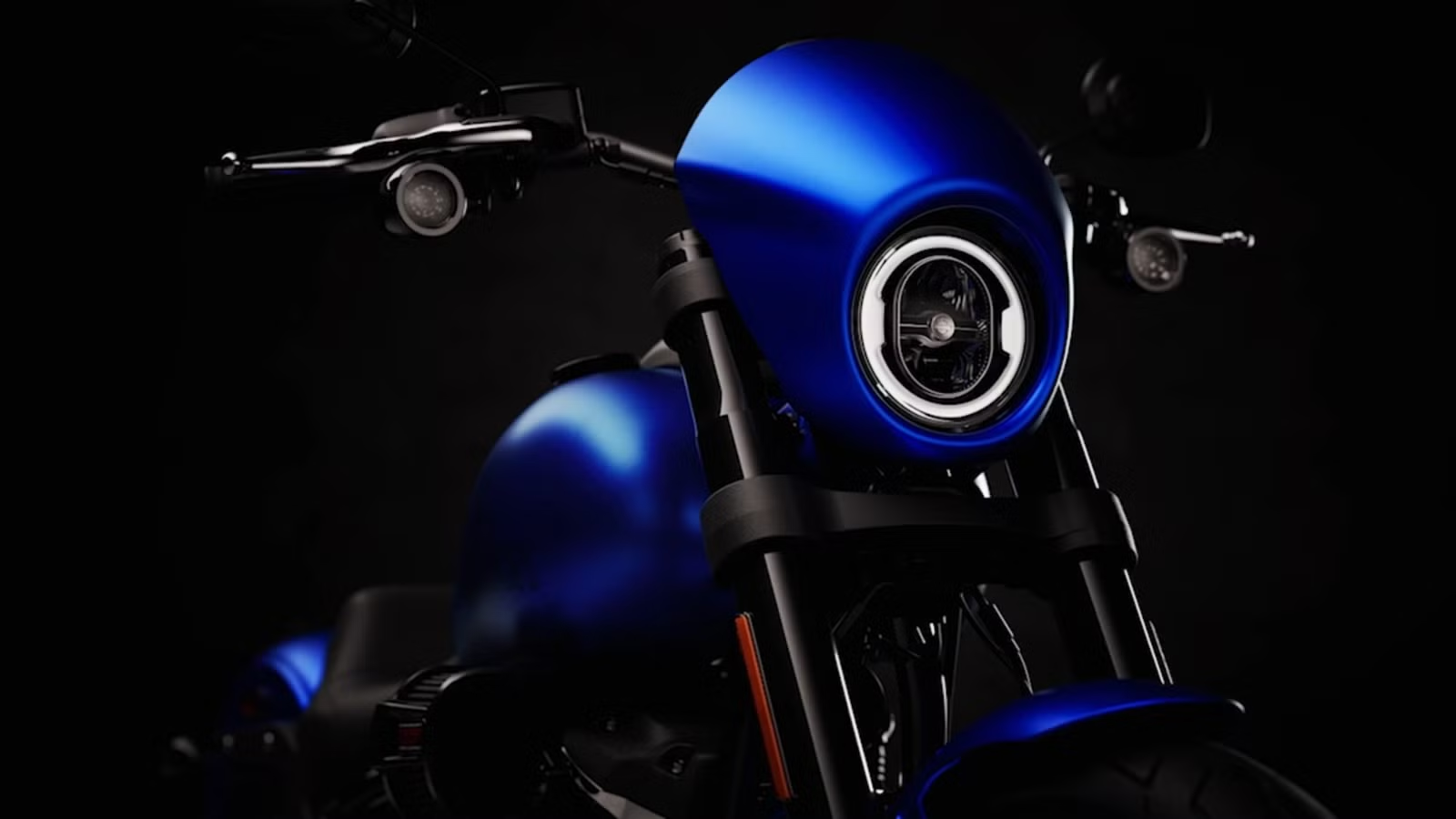
The motorcycle comes equipped with an inverted 43 mm front fork, dual front disc brakes, aggressive riding ergonomics, mid-mounted controls, a performance-focused Heavy Breather intake, a factory 2-into-1 exhaust, and premium suspension components. Those aren’t accessories — they’re standard equipment. That’s a significant shift from the old Harley ownership experience. Its styling also reflects its purpose. Blacked-out finishes dominate the motorcycle, from the powertrain to the exhaust system. The compact headlight cowl recalls West Coast performance customs without becoming excessive, while the solo seat locks the rider in place during hard acceleration.
The Structural Evolution From Dyna To Softail
The Flex-Prone Foundations Of The Past

The Low Rider name goes back to Harley’s Dyna lineup, which used a rubber-mounted Twin Cam engine bolted into a comparatively flexible tubular steel frame. That rubber-mounted setup was there to isolate the rider from engine vibration, and it worked well enough for that job. But it came at the cost of chassis rigidity — push a Dyna hard into a corner, and you’d feel the frame and swingarm give a little, right when you wanted them to hold firm. It’s part of the reason why the old Dyna Low Rider had a cult following for its looks and its motor, but never quite earned a reputation as a corner-carver.
The Rigid Mono-Shock Revolution

Harley retired the Dyna platform in 2018 and folded the Low Rider name into the Softail family, and the Low Rider S arrived on that architecture in 2020. The change was bigger than a name swap. The Softail chassis hides its rear shock under the seat rather than running visible twin shocks, and — critically for the S model — the Milwaukee-Eight engine is rigid-mounted directly into the frame instead of floating on rubber isolators, which stiffens the whole structure considerably. The real-world payoff shows up exactly where you’d want it: less rear-end wallow at speed, sharper turn-in, and a chassis that stays composed under hard braking, all while the bike actually weighs less than the Dyna-based version it replaced.
The Milwaukee-Eight Has Been Refined Over The Years
Squeezing Out Pure Muscle With The 117ci Motor

The Low Rider S launched in 2020 with the 114-cubic-inch Milwaukee-Eight, a strong engine but not Harley’s biggest. That changed for the 2022 model year, when the S adopted the 117-cubic-inch version of the same architecture — a bump up that added roughly five percent more torque over its predecessor. The current spec sheet lists 128 pound-feet of torque, accompanied by 114 horsepower, which is the kind of number that matters on a highway on-ramp: the roll-on power is there the instant you ask for it, no downshift required.
Heavy Breathers And Aggressive Cams

Getting there wasn’t just about adding displacement. Harley fitted the Low Rider S with a forward-facing “Heavy Breather” intake, a factory-optimized setup that looks like a bolt-on performance part but comes stock, feeding the engine more air with less restriction than the standard Softail intake. Paired with higher-lift camshaft profiles, the result is a powerband that pulls harder across a wider stretch of the rev range instead of just making a bigger peak number — which is the difference between an engine that impresses on a spec sheet and one that’s actually more fun to ride every day.
Features And Hardware Kept Improving For Every New Iteration
Electronics And Safety Tech That Arrived In Stages

Harley didn’t dump every piece of modern rider aid onto the Low Rider S in one redesign — it phased them in. The bike launched with standard ABS and traction control, reasonably basic equipment for 2020. Cornering ABS and cornering traction control, which factor in lean angle rather than just wheel speed, arrived as the electronics suite matured through the 2025 model year. By 2026, the Low Rider S comes standard with a full Rider Safety Enhancements package, three distinct engine tunes, refined ride modes (Road, Rain, and Sport), and a clearer instrument display. It’s a slower rollout than a full electronics package dropped all at once, but it means each year’s electronics arrive tested and sorted rather than rushed.
Relocating The Gauges For High-Speed Safety

One of the more overlooked upgrades came in 2022, when Harley moved the instrument cluster off the fuel tank and up onto the handlebar riser as a combination analog tachometer and digital speedometer. It sounds like a small styling tweak, but it corrected a genuine design flaw. A tank-mounted gauge means looking down and away from the road to check your speed; a handlebar-mounted one sits much closer to a rider’s natural line of sight, which matters more at speed than it might seem on a showroom floor.
Suspension Geometry And Ride-Height Adjustments

The 2022 model year also brought a longer-travel rear mono-shock, first borrowed from the Fat Bob, which cured a real complaint about the earlier Low Rider S. The previous iteration of the cruiser ran out of suspension travel and bottomed out harshly over anything rougher than smooth pavement. The taller shock added roughly an inch of rear wheel travel and raised the back of the bike slightly, which also bumped the available lean angle to 31.3 degrees — up 1.3 degrees from the original spec. That’s not a huge number in isolation, but it’s the kind of change that lets a rider carry real corner speed before anything metal touches down.
Put all of that together — a stiffer chassis, a bigger and better-breathing engine, gauges that finally sit where a rider’s eyes actually are, and suspension that keeps closing the gap between showroom and racetrack confidence — and the Low Rider S makes a genuinely strong case for its own headline. It hasn’t been reinvented. It’s been sharpened, one model year at a time, which is arguably the harder thing to pull off. In many ways, that’s why the Harley-Davidson Low Rider S is a motorcycle you’ll appreciate more every year.
Source: Harley-Davidson

Related posts


Latest Post


No Comments